The first time Margaret Sullivan fell in love with Thomas Bennett, she was nineteen years old, wore her hair in a long braid, and believed that the greatest tragedy in life was running out of chocolate biscuits.
Thomas was twenty-one, had a laugh that could fill an entire room, and possessed the unfortunate habit of believing he could repair absolutely anything with a screwdriver and a little determination. This confidence had once resulted in Margaret’s father’s toaster catching fire, an incident Thomas insisted was entirely unrelated to his mechanical abilities.
They met in the summer of 1968 at a community dance in a little Ontario town where everybody knew everybody, and secrets had approximately the same life expectancy as an ice cube in July.
Margaret had gone with her best friend, Ruth, who promised there would be handsome young men. Thomas had gone because his older brother told him the refreshments were free.
Neither expected to meet someone who would change their life.
Thomas asked Margaret to dance just as the band began playing a slow song. He stepped on her foot twice, apologized three times, and somehow managed to knock over a chair without ever letting go of her hand.
Margaret laughed so hard she nearly cried.
By the end of the evening, she had decided he was the most ridiculous man she had ever met.
By the following weekend, she was quite certain she was in love with him.
They spent the next two years doing the things young couples did in those days. They went to the cinema, shared milkshakes, took long drives with no particular destination, and sat beside the lake discussing everything from their dreams to whether pineapple belonged on pizza.
Thomas wanted to become a teacher. Margaret dreamed of working with children and eventually opening a little bookshop. They imagined a future together, though neither was quite ready to decide what that future should look like.
Then life presented them with two opportunities that pointed in different directions.
Thomas was offered a teaching position in British Columbia. Margaret had been accepted into a nursing program in Toronto, an opportunity she had worked toward for years.
For several weeks, they tried to convince themselves that one of them should change their plans.
One evening, sitting on the old wooden dock where they had spent so many summer afternoons, Margaret finally said what they were both thinking.
“I don’t want you to give up your dream for me.”
Thomas looked at her for a long moment.
“And I don’t want you to give up yours.”
There were tears, of course. There were promises to write, and for a while they did. But distance, demanding careers, and the steady unfolding of adulthood eventually carried them into different lives.
There was no betrayal, no terrible argument, and no bitterness. They simply loved each other enough to let each other go. Margaret sometimes wondered whether that made their love less important.
Years later, she would understand that it had made it something rather special.
Thomas moved west and eventually met Eleanor, a bright, spirited woman who taught music at the same school. Eleanor loved gardening, terrible puns, and singing while she cooked. She made Thomas laugh in ways he hadn’t known he needed, and they built a marriage full of warmth, friendship, and small everyday adventures.
They had two daughters, travelled whenever they could, and spent forty-three happy years together.
Margaret met David during her second year of nursing. He was a quiet, thoughtful man who worked as an electrician and had an extraordinary talent for making her feel safe without ever making her feel small.
David remembered birthdays, made excellent Sunday breakfasts, and brought Margaret flowers for absolutely no reason. He encouraged her when she decided to leave nursing and open the little bookshop she had dreamed about as a girl.
They married, raised three children, and spent forty-six years building a life that Margaret wouldn’t have traded for anything.
Neither Margaret nor Thomas spent those decades secretly longing for the other.
Their first love became a fond memory, tucked away among photographs, old songs, and the many small experiences that make up a lifetime.
Margaret loved David completely.
Thomas loved Eleanor completely.
And that was exactly as it should have been.
When Eleanor died peacefully at seventy-one after a short illness, Thomas felt as though someone had quietly removed the music from his home. He missed her singing in the kitchen, the sound of her gardening tools outside the window, and the way she always stole the crispiest potatoes from his plate.
Two years later, David died peacefully in his sleep at seventy-four.
Margaret missed the ordinary things most of all. His slippers beside the bed. The newspaper folded on the kitchen table. The way he always asked whether she wanted tea, even when he already knew the answer.
Their children visited often, and their grandchildren filled their homes with noise and laughter. Life continued to offer beautiful moments, and both were grateful for them.
But grief had changed the rhythm of their days.
Thomas learned to cook for one, though he never quite mastered the appropriate quantity of spaghetti.
Margaret learned that silence could be peaceful and lonely at the same time.
Neither was looking for another romance.
Then, one rainy Thursday afternoon, Margaret received a message on Facebook.
It was from a woman named Claire Bennett.
“Hello, Margaret. I hope you don’t mind me reaching out. My dad, Thomas Bennett, recently found an old photograph of you two at a dance in 1968. He told me the funniest story about stepping on your feet. I thought you might like to see it.”
Attached was a photograph of two young people standing awkwardly beneath a paper streamer. Margaret stared at it.There she was, nineteen years old, smiling at the camera with her whole future ahead of her. And beside her stood Thomas, looking unbearably pleased with himself.
She laughed and then she cried a little.
Then she laughed again.
She typed a reply. “Please tell your father that I still have all ten toes, despite his best efforts.”
Three hours later, her phone rang.
“Margaret Sullivan,” said a familiar voice, older now, but carrying the same unmistakable warmth. “I hear you’ve been spreading malicious rumours about my dancing.”
She smiled before she even realized she was doing it.
“Thomas Bennett. Have you learned how to dance yet?”
“Absolutely not. But I’ve become very good at apologizing.”
They talked for nearly two hours.
They spoke about their families, their careers, the places they’d lived, and the people they’d loved. Thomas told Margaret about Eleanor, and Margaret told him about David. There was no awkwardness in speaking about their spouses, no need to diminish those marriages to make room for an old memory.
When Thomas described Eleanor’s habit of singing the wrong lyrics to every song, Margaret laughed until her stomach hurt.
When Margaret described David’s tradition of hiding little handwritten notes in her coat pockets, Thomas grew quiet.
“He sounds like a wonderful man,” he said.
“He was.”
“Eleanor would have liked him.”
“I think David would have liked Eleanor.”
And somehow, that simple exchange made everything feel easier.
Over the following months, they spoke regularly. They sent photographs of grandchildren, exchanged recipes, and debated important matters such as whether modern music had lost its charm and why every television remote now required an engineering degree.
Then Thomas mentioned that he would be visiting Ontario for his grandson’s graduation.
“Perhaps we could have coffee,” he suggested.
Margaret considered this.
“Only if you promise not to repair anything in my house.”
“I make no such promises.”
They agreed to meet at a little café near the lake.
Margaret arrived fifteen minutes early, feeling surprisingly nervous. She had changed her blouse twice, checked her hair four times, and told herself repeatedly that she was being ridiculous.
Then the café door opened.
Thomas stood there with silver hair, glasses, and a smile that was somehow exactly the same.
He spotted her immediately.
For a moment, neither moved.
Then Thomas approached her table and said, “Well, you’ve changed your hairstyle.”
Margaret looked at his nearly bald head.
“And you’ve misplaced most of yours.”
They burst out laughing.
The years between them seemed to fold gently inward.
They talked until the café staff began stacking chairs. Then they walked beside the lake, slowly and comfortably, pausing whenever one of them needed to rest.
At the old dock, Thomas stopped.
“Do you remember this place?”
“Of course.”
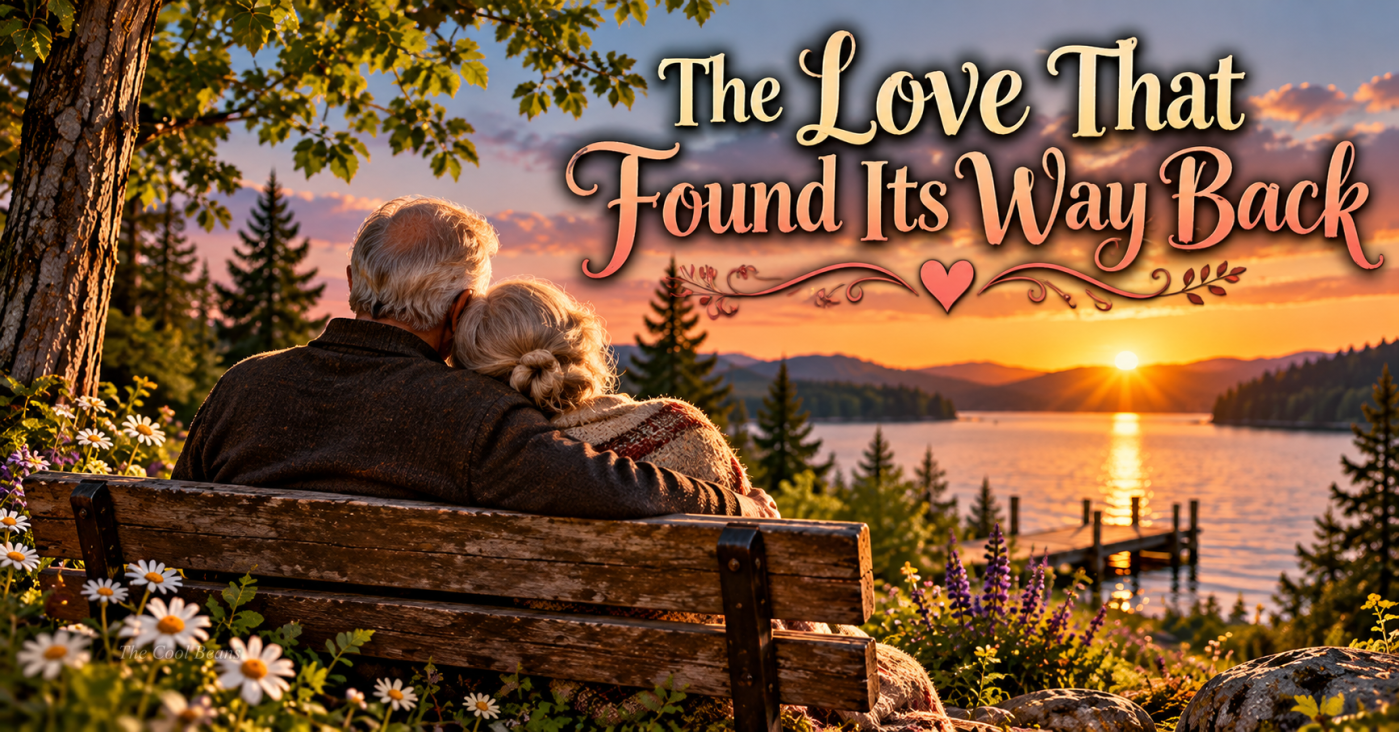
They sat together on a bench nearby.
For a while, they watched the water.
“I’ve had a good life, Margaret,” Thomas said eventually. “A very good one.”
“So have I.”
“I loved Eleanor more than I could ever explain.”
Margaret nodded.
“And I loved David.”
Thomas looked out across the lake.
“Funny thing, isn’t it? When we’re young, we think there’s only one great love waiting for us.”
Margaret smiled.
“Perhaps life is kinder than that.”
He turned toward her.
“Would you think it terribly foolish if I asked to see you again?”
She pretended to consider the question.
“That depends. Are you still a dreadful dancer?”
“Worse, I’m afraid.”
“Then I suppose someone ought to supervise you.”
Their second date was at a botanical garden. Their third was at a little Italian restaurant where Thomas accidentally ordered a dish so spicy that Margaret had to rescue him with half her dessert and two glasses of water.
By their fourth date, they had stopped pretending these outings were merely friendly visits.
They were falling in love.
Not in the breathless, uncertain way they had at nineteen and twenty-one, but in a quieter, steadier way.
They knew what it meant to love someone through illness, disagreements, ordinary Tuesdays, and the inevitable changes that come with age.
They understood that real love wasn’t made entirely of grand gestures. Sometimes it was remembering how someone liked their tea, carrying an extra sweater because they always got cold, or sitting together without needing to fill the silence.
Their children were delighted.
Margaret’s daughter, Susan, was especially amused.
“Mom, you’re blushing.”
“I am not.”
“You’re seventy-six years old and blushing over a boy.”
“He’s seventy-eight, Susan. I hardly think ‘boy’ is appropriate.”
“Fine. You’re blushing over a senior citizen.”
Margaret threw a cushion at her.
Thomas’s daughters were equally merciless.
When he bought a new shirt for a dinner date, Claire announced that he was officially experiencing his second adolescence.
Thomas informed her that if she continued making such observations, he would leave his collection of antique fishing equipment to her sister.
Eventually, Thomas moved back to Ontario.
They decided against marrying immediately, not because they doubted their feelings, but because they had learned that happiness didn’t need to be rushed.
They spent their days visiting family, exploring small towns, attending concerts, and making each other laugh.
On Sundays, they sometimes visited the cemeteries where David and Eleanor were buried.
Margaret would bring flowers for David. Thomas would bring flowers for Eleanor.
There was no jealousy, no discomfort, and no feeling that their new relationship somehow diminished the love that had come before.
One afternoon, as they walked back to the car, Margaret slipped her hand into Thomas’s.
“Do you ever feel strange about being happy again?” she asked.
Thomas considered the question carefully.
“Sometimes. But then I think about Eleanor. She spent forty-three years trying to make me happy. I don’t believe she’d want me to stop now.”
Margaret squeezed his hand.
“David used to say that love was the one thing you could give away without having less of it.”
“Smart man.”
“He really was.”
Thomas smiled.
“Then I suppose we ought to honour them by making the most of the time we’ve been given.”
And they did.
Two summers after their reunion, Thomas surprised Margaret with tickets to a community dance.
It was being held in the same old hall where they had first met, though the decorations were considerably nicer and the refreshments were no longer free.
Margaret wore a blue dress.
Thomas wore his best suit and a tie that Claire had described as “aggressively cheerful.”
When the band began playing a slow song, he stood and offered his hand.
“Margaret Sullivan, may I have this dance?”
She looked at him, remembering a young man who had once knocked over a chair while trying to impress her.
“Are my feet safe?”
“Absolutely not.”
She took his hand anyway.
They moved slowly across the dance floor, laughing whenever Thomas lost the rhythm. His knees weren’t what they used to be, and Margaret’s back occasionally reminded her that she was no longer nineteen.
But none of that mattered.
Halfway through the song, Thomas leaned close.
“You know,” he said, “I used to wonder what might have happened if we’d stayed together.”
Margaret rested her head against his shoulder.
“I used to wonder too.”
“Do you regret it?”
She thought about David, their children, the bookshop, the family holidays, and all the beautiful ordinary years she’d been given.
Then she thought about Eleanor, the family Thomas had raised, and the happiness he had known.
“No,” she said softly. “Not one bit.”
Thomas smiled.
“Neither do I.”
They continued dancing.
“Besides,” Margaret added, “if we’d married at twenty, I might have murdered you over that toaster incident.”
Thomas laughed.
“It was a perfectly good repair.”
“The toaster exploded.”
“A minor technical setback.”
She shook her head, still smiling.
And as the music carried them gently across the floor, Margaret realized something wonderful.
Their story had never been about two people who had spent a lifetime waiting for each other.
It was about two people who had been fortunate enough to experience love twice, in different seasons of their lives, without either love diminishing the other.
They had not wasted the years apart.
They had lived them.
They had loved deeply, raised families, made memories, endured loss, and discovered that a heart could hold gratitude for yesterday while still welcoming tomorrow.
When the song ended, Thomas kissed Margaret’s forehead.
“Would you like another dance?”
She glanced down at her feet.
“Perhaps after I’ve checked for injuries.”
He grinned.
And she laughed that same wonderful laugh he’d fallen in love with nearly sixty years earlier.
Outside, the evening sky glowed pink and gold, and the world carried on as it always had.
But inside that little dance hall, two people who had once said goodbye were discovering the unexpected joy of saying hello again.
Not because their first love had been unfinished.
Not because their marriages had been anything less than beautiful.
But because sometimes, after a lifetime of wonderful chapters, life leaves room for one more.
And perhaps the loveliest part of growing older is discovering that the heart doesn’t have to choose between cherishing the love it has known and embracing the love it can still find.
Sometimes, love doesn’t come back to correct the past.
Sometimes, it simply arrives to make the future a little brighter.
Enjoying what you find here? 💜 Consider subscribing and becoming part of our little community. It’s a simple way to stay connected, support what we do, and make sure you don’t miss what’s coming next. We’d truly love to have you here. 🌿✨


Leave a Reply