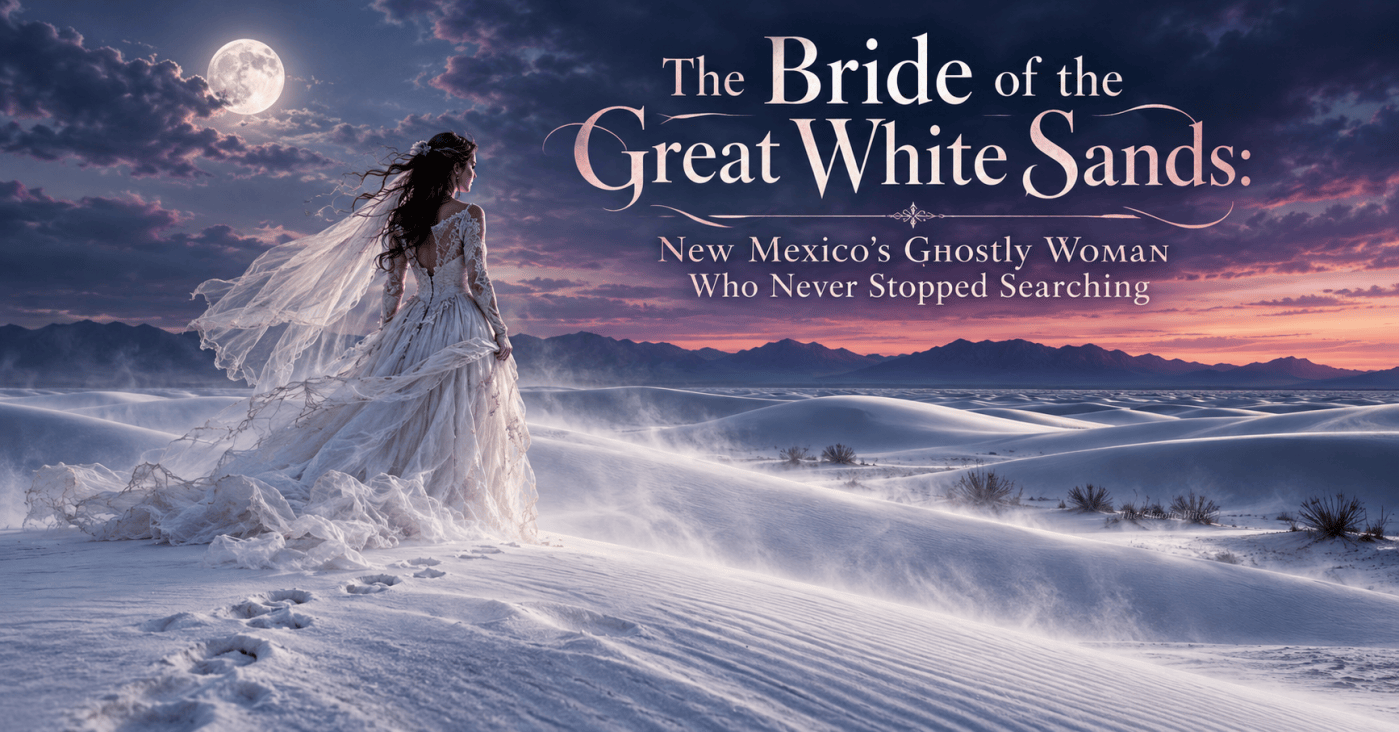
Deep in the desert of southern New Mexico lies a landscape unlike almost anywhere else in North America. Thousands of acres of brilliant white gypsum sand stretch across the Tularosa Basin, creating an extraordinary wilderness of rolling dunes, shifting shadows, and seemingly endless horizons. During the day, the sand glitters beneath the desert sun, but when evening approaches, the landscape transforms into something altogether more mysterious.
As the sun disappears behind the distant mountains, the dunes turn shades of silver, violet, and pale blue. The desert winds sweep across the sand, reshaping the hills and creating strange formations that can vanish as quickly as they appear. In the moonlight, the dunes sometimes seem to move, their pale surfaces giving the illusion that something is wandering through the darkness.
And according to a haunting New Mexican legend, something is.
For generations, stories have circulated about a mysterious woman dressed in white who wanders among the dunes, forever searching for someone she lost centuries ago. Some describe her as a beautiful young bride whose flowing gown seems to merge with the surrounding sand. Others claim she appears only as a faint, ghostly silhouette moving across a distant ridge before dissolving into the evening mist.
She is known as Pavla Blanca, sometimes called the White Wraith of the Great White Sands, and her story is one of love, heartbreak, and a promise that even death could not break.
The legend begins in 1540, when Spanish explorer Francisco Vázquez de Coronado set out on an ambitious expedition northward from Mexico. Coronado and his men were searching for the fabled Seven Cities of Gold, legendary settlements believed to contain extraordinary wealth. Their journey would take them through unfamiliar territory, across deserts, mountains, and vast stretches of land that would later become part of the American Southwest.
Among the men said to have accompanied the expedition was a young Spanish conquistador named Hernando de Luna. According to the legend, Hernando was handsome, courageous, and deeply devoted to a young woman named Manuela de Godoy. The couple had fallen passionately in love and were engaged to be married, dreaming of the life they would build together once Hernando returned from his travels.
But when Hernando learned that he would be joining Coronado’s expedition, their happiness was overshadowed by uncertainty. The journey promised adventure and the possibility of great fortune, but it also meant months or even years of separation. The route was dangerous, supplies were limited, and there was no guarantee that every man who departed would return.
Manuela was devastated by the thought of losing him. She pleaded with Hernando to let her accompany him, insisting that she would rather face the hardships of the wilderness than remain behind wondering whether he was alive. But according to the story, she was forbidden from joining the expedition and had no choice but to watch him leave.
Before their separation, Hernando promised that he would return to marry her. Manuela, holding tightly to the man she loved, made a promise of her own. No matter how far he travelled or what dangers awaited him, she vowed that she would follow him to the ends of the Earth if necessary.
Neither could have known how tragically those words would shape their future.
As Coronado’s expedition travelled northward, the men encountered vast stretches of unfamiliar terrain. According to the legend, their route eventually brought them near the extraordinary white dunes of what is now southern New Mexico. The landscape was unlike anything many of them had seen before. Brilliant white hills rose from the desert floor, resembling enormous drifts of snow despite the region’s dry climate.
But the strange beauty of the Great White Sands concealed dangers. Travelling through the desert meant enduring intense sunlight, limited water, unfamiliar terrain, and the constant possibility of becoming separated from the expedition.
According to the traditional story, disaster struck when Coronado’s men encountered a group of Apache warriors. A violent confrontation followed, and during the fighting, Hernando de Luna was mortally wounded. Some versions claim that he died during the attack, while others suggest that he became separated from his companions and disappeared somewhere among the shifting dunes.
Whatever the circumstances, Hernando never returned to Manuela.
When the surviving members of the expedition eventually brought news of his disappearance, Manuela’s world collapsed. She had spent countless days imagining their reunion, picturing the moment when Hernando would come home and they could finally begin their married life together.
Instead, she received only uncertainty.
No one could tell her precisely where he had died. No one could show her his grave or provide the comfort of a final farewell. Without proof of his death, Manuela refused to accept that the man she loved was gone forever.
Perhaps Hernando had survived the battle. Perhaps he had been injured and was waiting somewhere for help. Perhaps he was wandering through the wilderness, trying desperately to find his way home.
As long as there was even the smallest possibility that he remained alive, Manuela believed she had to find him.
Ignoring warnings about the dangers of the journey, she gathered what supplies she could carry, mounted a horse, and set off toward the lands where Hernando had last been seen. She travelled through unfamiliar country, following whatever information she could obtain about Coronado’s expedition and the place where her beloved had disappeared.
The journey was long and exhausting, but Manuela refused to turn back. Every mile brought her closer to the possibility of finding Hernando, and every night she imagined that the following day might finally reunite them.
Eventually, she reached the Great White Sands.
Before her lay an immense landscape of pale dunes stretching toward the horizon. The sand shimmered beneath the sunlight, its brilliant whiteness making it difficult to judge distances. Hills that appeared close were often much farther away, and the constantly shifting terrain made navigation treacherous.
Still, Manuela continued.
She rode between the dunes, searching for tracks, abandoned belongings, or any sign that Hernando had passed through the area. She called his name into the wind, listening desperately for an answer.
But the desert remained silent.
As the hours passed, her search became increasingly desperate. She climbed one dune after another, scanning the horizon and refusing to believe that her journey had been in vain. Whenever she spotted a distant shadow or movement, she hurried toward it, hoping that it might be the man she had travelled so far to find.
Then, according to the legend, something extraordinary happened.
As evening approached and the sun began sinking toward the mountains, Manuela noticed a dark figure standing on a distant dune.
It appeared to be a man.
For a moment, she could scarcely believe what she was seeing. The figure stood motionless against the fading light, its outline strangely familiar.
Manuela’s heart raced.
She was certain it was Hernando.
Calling his name, she hurried toward the distant figure, struggling through the loose sand as the evening wind began to rise. But when she reached the top of the dune, the figure was gone.
Looking farther ahead, she thought she saw him again.
This time he appeared beyond another ridge, standing in the shadows as though waiting for her.
Some versions of the legend claim that Manuela could hear Hernando calling her name, his voice carried faintly across the dunes. Whether it was truly his voice or merely the desert wind, she became convinced that he was somewhere nearby.
She followed.
As daylight disappeared, the desert began to change. The pale dunes that had seemed so beautiful beneath the sun became an endless maze of indistinguishable hills. Shadows deepened between the ridges, and the wind lifted the fine gypsum sand into swirling clouds.
Manuela lost sight of the path she had travelled.
Still, she refused to stop searching.
The figure appeared and vanished, always seeming to remain just beyond her reach. Each time she believed she was close to finding Hernando, another dune stood between them.
The wind grew stronger, sweeping across the landscape with enough force to obscure the horizon. Sand swirled around her, filling the air with pale drifting clouds. The stars were hidden, and the desert became a place of confusion and darkness.
At some point during that terrible night, Manuela disappeared.
She was never seen alive again.
According to the legend, no one discovered her body or learned what had become of her horse and supplies. The vast white dunes seemed to have swallowed her completely, leaving behind no trace of the young woman who had risked everything to find the man she loved.
But the story does not end with her disappearance.
Long after Manuela was believed to have died, unusual sightings reportedly began occurring among the dunes. Travellers described glimpsing a pale figure moving across the white sand, particularly during the hours between sunset and darkness.
At first, the figure appeared to be an ordinary woman walking alone. But as observers watched, they noticed something unsettling. Her white clothing seemed to flow into the surrounding landscape, and her movements were strangely silent.
Some claimed she wore a wedding gown, its long fabric trailing behind her as she wandered through the desert. Others described her as a drifting column of white sand that briefly took on the shape of a woman before dissolving into the wind.
She seemed to be searching for something.
Sometimes she appeared to pause on the crest of a dune, gazing toward the horizon as though expecting someone to emerge from the darkness. At other times, she moved steadily forward, disappearing behind the hills before anyone could approach her.
Those familiar with Manuela’s tragic story believed they knew who the mysterious woman was.
It was the bride who had never reached her wedding day.
The woman who had promised to follow her beloved to the ends of the Earth.
And whose spirit, according to the legend, had never stopped searching.
Over time, the apparition became known as Pavla Blanca, the White Wraith of the Great White Sands. Her story was repeated by travellers, residents, and those fascinated by the strange landscape of the Tularosa Basin.
But as the legend spread, it acquired a darker warning.
In one traditional telling published during the twentieth century, seeing the ghost once was considered an extraordinary experience. Encountering her a second time was said to bring misfortune, while a third sighting supposedly foretold death.
The warning added a frightening dimension to an otherwise sorrowful legend. The ghostly bride was no longer merely a tragic figure searching for her lost lover. She had become an omen, a mysterious presence whose appearances could inspire both wonder and fear.
Some storytellers warned travellers never to follow the woman if they saw her wandering among the dunes. To pursue her might mean becoming hopelessly lost in the desert, just as Manuela herself had supposedly become lost centuries earlier.
Yet not everyone who encountered something strange in the Great White Sands believed they had witnessed a spirit.
One particularly fascinating account involves Tom Charles, an early advocate for preserving the region that would eventually become White Sands National Park, and his wife, Bula.
According to Bula’s later recollections, the couple visited the dunes around 1909 when Tom pointed out an unusual formation created by the desert wind. A column of white sand had risen along the side of a dune, swirling and shifting in a way that gave it an almost human appearance.
To Tom, the shape resembled Pavla Blanca.
Bula was skeptical of the supernatural explanation, but the strange sight left a lasting impression. The moving sand seemed capable of briefly assuming recognizable shapes before collapsing back into the landscape.
The experience offered a possible explanation for at least some of the mysterious sightings.
The dunes of White Sands are composed primarily of gypsum, a pale mineral that reflects light in unusual ways. Strong winds can lift the fine particles into the air, creating swirling columns, drifting curtains, and fleeting shapes that appear to move independently across the desert.
Under the right conditions, particularly at twilight or beneath a bright moon, a formation of blowing sand might resemble the outline of a person moving across the dunes.
Distance and shifting shadows could add to the illusion, making a naturally occurring phenomenon seem almost supernatural.
But for those familiar with the legend of Manuela de Godoy, the resemblance carried a far more emotional meaning.
They were not simply seeing the wind.
They were seeing the bride.
As the years passed, Pavla Blanca became deeply associated with the Great White Sands. Her story appeared in publications, regional folklore collections, and later retellings devoted to the mysteries of New Mexico.
Tom Charles published an account of the White Wraith in 1940, and the legend attracted wider attention through newspaper coverage the following year. Later generations continued to preserve the tale through storytelling, historical discussions, artistic interpretations, and performances.
The legend eventually became part of the cultural identity surrounding White Sands, with the National Park Service also acknowledging the story as an example of regional folklore.
Despite its enduring popularity, there is no reliable historical evidence confirming that Manuela de Godoy and Hernando de Luna existed as described in the legend. Nor has the supposed battle, disappearance, or supernatural activity been independently established.
The story’s connection to Coronado’s expedition provides a historical setting, but the tragic romance and ghostly encounters belong to folklore rather than documented fact.
Even the precise origins of the legend remain uncertain. Although the tale is set in the sixteenth century, its surviving published versions are much more recent, and researchers have not established how far back the story was told orally.
Yet perhaps the uncertainty is part of what makes Pavla Blanca so compelling.
The legend is not simply about a ghost wandering through a lonely desert. At its heart, it is about the devastating uncertainty of losing someone without knowing what happened to them.
Manuela was never given the opportunity to say goodbye. She had no grave to visit, no final words to remember, and no certainty that the person she loved was truly gone.
Instead, she was left with a promise.
A promise that she would follow Hernando wherever he went.
And according to the story, it was a promise she could not abandon, even after death.
Unlike many ghost legends involving revenge, punishment, or violence, the Bride of the Great White Sands is driven by grief and devotion. In its most sympathetic interpretations, Manuela does not seek to harm the living. She simply continues the search that consumed her final days.
Her wedding gown, an enduring symbol of the marriage she never experienced, becomes part of the desert itself. Its pale fabric blends with the white dunes, making her appear almost inseparable from the landscape that claimed her life.
The desert, meanwhile, remains an extraordinary setting for such a haunting.
White Sands National Park preserves the world’s largest gypsum dunefield, a place where the landscape changes continually beneath the influence of the wind. Visitors can walk across brilliant white hills that seem to stretch endlessly toward distant mountains, creating an experience that feels almost removed from ordinary time.
During the day, the dunes are dazzling.
But at twilight, when the sun slips below the mountains and the sand begins reflecting the cool colours of the evening sky, the landscape takes on an entirely different character.
The white hills glow faintly beneath the moon. The wind whispers across the ridges, lifting small streams of sand into the air. Familiar landmarks become difficult to distinguish, and the quiet can feel almost overwhelming.
Imagine standing alone on the crest of a dune as the last trace of daylight disappears.
Far in the distance, something begins to move.
At first, it seems like an ordinary swirl of sand caught by the evening breeze. But as the pale shape rises, it begins to resemble a woman dressed in white.
She moves slowly across the ridge, her gown trailing behind her.
For a moment, she seems to turn toward you.
Then she looks away, as though searching the horizon for someone who has not yet arrived.
You blink.
The wind changes direction.
And the figure is gone.
Was it only sand carried by the desert wind? A trick of light and distance? Or something that has inspired generations of people to wonder whether the spirit of a heartbroken young woman still wanders among the dunes?
No scientific evidence supports the existence of Pavla Blanca as a supernatural being, and the reported sightings remain unverified. Nevertheless, the legend continues to be told because of the emotional truth at its centre.
It speaks to love, longing, and the difficulty of accepting a loss that offers no answers.
More than four centuries have passed within the imagined timeline of Manuela’s story. The world around White Sands has changed enormously, and the region that once lay along the routes of Spanish exploration is now home to a protected national park.
But the dunes continue to shift, the winds continue to sweep across the basin, and the mysterious woman in white remains part of the stories told about this remarkable place.
Somewhere in the endless folds of pale gypsum sand, the imagination can still picture Manuela walking beneath the moon, searching for the man she promised to marry.
She climbs one dune after another, listening for his voice.
Each distant shadow offers the possibility that he might finally be waiting for her.
Each empty ridge brings another disappointment.
And still she continues.
For according to the legend, the bride of the Great White Sands has never abandoned her promise.
She followed her beloved into the desert, disappeared among its shifting hills, and became part of a mystery that has survived through generations of storytelling.
Perhaps one evening, when the wind rises and the moon illuminates the dunes, another traveller will glimpse a pale figure moving silently across the horizon.
A woman in a flowing white gown.
A bride still searching for her wedding day.
And a ghost who, according to the haunting legend of Pavla Blanca, has never stopped looking for the man she loved.
Sources: Information about the legend of Pavla Blanca, also known as the White Wraith of the Great White Sands, is documented in historical and folklore material associated with White Sands National Park, including the National Park Service publication A Lingering Love. Additional information appears in Ray John de Aragón’s article Lost Love at White Sands, published by New Mexico Magazine on October 7, 2026. Earlier published versions include Tom Charles’s 1940 account of the White Wraith and reporting published in The New York Times in 1941. Accounts involving Tom and Bula Charles and the unusual windblown sand formations of the Great White Sands are also discussed in regional historical writing, including Tales of the Tularosa and material published by the Las Cruces Sun-News.
A little magic is always waiting. Subscribe and step inside the circle. 🖤🔮✨


Leave a Reply