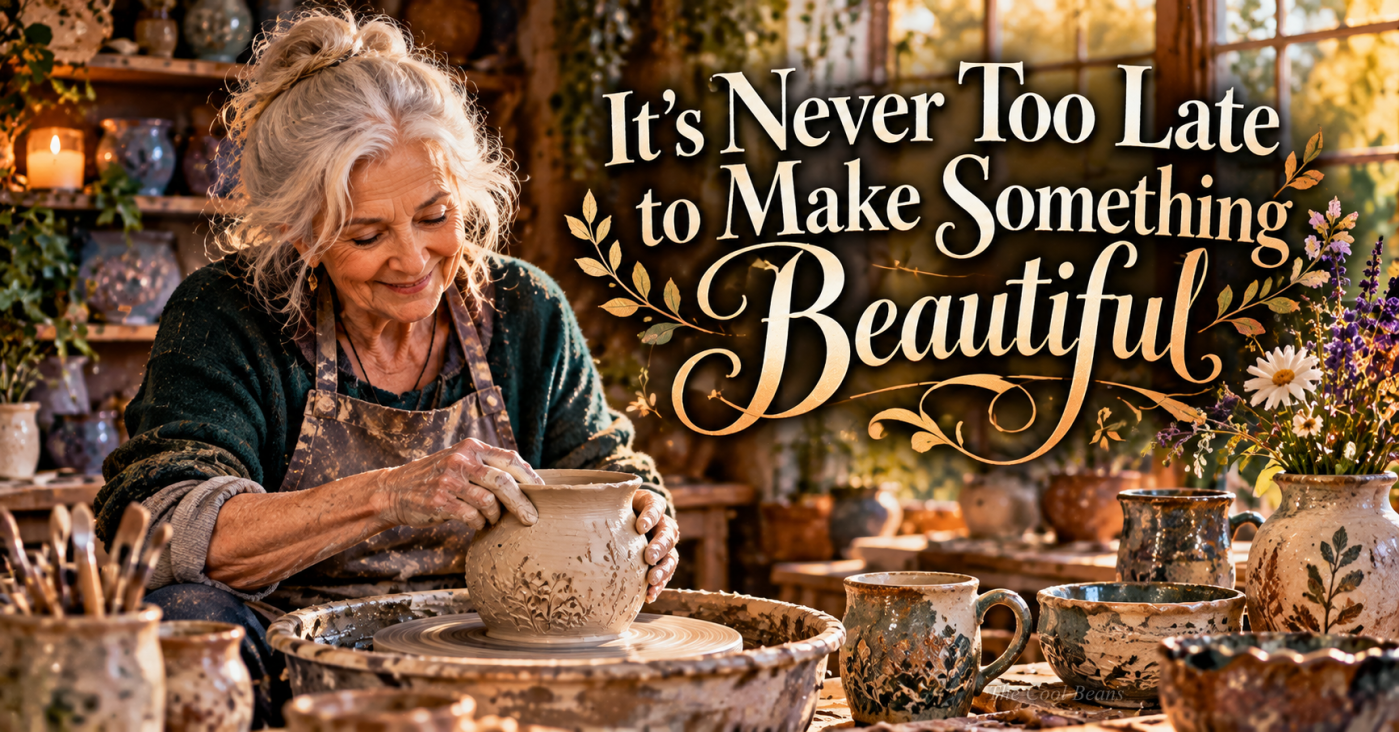
At eighty years old, Evelyn discovers that trembling hands, a lifetime of memories, and the courage to try something new can create something extraordinary.
Evelyn Weston had spent eighty years being good at things she never particularly wanted to be good at. She was good at stretching a dollar until it squeaked, making soup out of almost nothing, remembering birthdays, mending torn sleeves, and finding the right words when someone she loved was hurting. She had raised three children, buried a husband, survived two hip surgeries, and learned to use a smartphone through sheer stubbornness and the occasional assistance of her twelve-year-old granddaughter. But she had never been particularly good at doing something simply because it made her happy. There had always been something more important, someone who needed feeding, somewhere she needed to be, or a responsibility that couldn’t wait.
By the time she turned eighty, Evelyn had begun to believe that the adventurous part of her life was finished. Her world had become comfortably predictable. Coffee at seven, crossword at eight, a little gardening if the weather cooperated, Tuesday grocery shopping, and Thursday afternoon television with her neighbour, Margaret, who insisted she hated the characters on her favourite soap opera but never missed an episode. Every evening, Evelyn sat beside the living room window, watching the sun disappear behind the maple trees and wondering, with a quiet sadness she never mentioned to anyone, whether she had already experienced everything life had left to offer.
Then one Tuesday, something unexpected happened. She noticed a flyer taped crookedly to the bulletin board at the community centre, between an advertisement for chair yoga and a notice about a missing orange cat. It announced beginner pottery classes, promising that no experience was necessary and all ages were welcome. Evelyn stopped walking. She remembered being seventeen and standing outside a little ceramics shop in her hometown. In the window had been a beautiful blue vase, uneven around the rim, with delicate flowers pressed into its surface. She had wanted desperately to learn how to make something like it, but there had been no money for lessons. Then came marriage, children, work, and all the years that seemed to vanish between one responsibility and the next. She hadn’t thought about that vase in decades.
Standing in the community centre hallway, Evelyn found herself reaching for a registration slip. Then she looked down at her hands. They trembled, not terribly, but enough that pouring tea required concentration and fastening small buttons had become an exercise in patience. Some mornings were better than others. On difficult days, her fingers seemed determined to do their own thing. Pottery, she reasoned, probably required steady hands. She put the registration slip back, took two steps toward the door, and stopped. For reasons she couldn’t quite explain, she thought about that blue vase again. Before she could talk herself out of it, she turned around, picked up the slip, and tucked it into her handbag.
Three weeks later, Evelyn walked into the community centre’s pottery studio wearing her nicest cardigan and carrying a handbag full of unnecessary supplies, including tissues, peppermints, and a small packet of biscuits. She was the oldest student by at least thirty years. Around her sat university students, young parents, and people who appeared to know exactly what they were doing despite the class being advertised for beginners. Their hands looked steady, their movements seemed confident, and they laughed easily as they gathered around the pottery wheels. Evelyn chose a seat near the back, hoping nobody would notice how nervous she was.
The instructor, a cheerful woman named Clara, introduced herself and explained that pottery wasn’t about perfection. She told the class that clay had a personality of its own and that sometimes it did what you wanted, while other times it taught you what it wanted. Evelyn wasn’t sure she liked the sound of that. When she placed her first lump of clay on the spinning wheel, it immediately became apparent that the clay had absolutely no interest in cooperating. Her fingers shook, the wheel spun, and the clay wobbled. What was supposed to become a small bowl transformed into something resembling a collapsed mushroom. A young man beside her made a nearly perfect cylinder, while Evelyn’s creation leaned dangerously to the left.
She tried again, but the second attempt was worse. By the end of the lesson, her apron was covered in clay, her shoulders ached, and she had produced a lopsided object that looked as though it had survived a minor earthquake. She stared at it miserably before telling Clara that she thought she might be too old for pottery. Rather than disagreeing immediately, Clara pulled up a chair and picked up the crooked little bowl. She turned it slowly, examining the ripples left by Evelyn’s trembling fingers, and explained that she’d seen people create beautiful pottery with steady hands, but she’d also seen them create beautiful things because their hands weren’t steady. The unusual markings on Evelyn’s bowl were something no other artist could reproduce exactly. They belonged to her.
Evelyn studied the uneven surface and noticed, for the first time, how the little ridges caught the light. She wasn’t entirely convinced, but something about Clara’s words stayed with her. She returned the following Tuesday, and the Tuesday after that. At first, she tried desperately to make her pottery look like everyone else’s. She watched instructional videos, practised holding her hands differently, and became increasingly frustrated when the clay refused to form smooth, symmetrical shapes. Every crooked rim felt like another reminder of something her body could no longer do.
One afternoon, after ruining a bowl she’d spent nearly an hour working on, Evelyn pushed back from the wheel and burst into tears. It wasn’t really about the bowl. She was tired of feeling as though her body was becoming a collection of things she could no longer manage. She missed the confidence of reaching for something without wondering whether her hands would cooperate. Clara sat quietly beside her until the tears passed, then gently asked what would happen if Evelyn stopped trying to make the clay smooth. Evelyn sniffed and replied that it would probably become an even bigger mess. Clara smiled and suggested that perhaps it would become something else entirely.
That evening, Evelyn went home and opened an old wooden box she kept beneath her bed. Inside were photographs, handwritten recipes, faded letters, and small treasures collected over eight decades. There was a photograph of her mother hanging laundry in the backyard, a pressed flower from her wedding bouquet, and a picture of her children sitting beneath the kitchen table with their faces sticky from jam. As she ran her fingers over those memories, she remembered her mother’s hands, rough from washing clothes, the ridges in her father’s garden soil, the bark of the apple tree her children used to climb, and the tiny fingerprints her youngest son had once left in a lump of homemade play dough. Suddenly, she understood something she’d never considered before. Life wasn’t smooth, so why should her pottery be?
The following week, Evelyn arrived at class with a different idea. Instead of trying to control every movement of her hands, she began working with the tremors. She pressed her fingertips into the clay and allowed the small, unpredictable movements to create patterns. She carved uneven lines into bowls, shaped rippling edges on vases, and left delicate impressions that resembled tree bark, flowing water, and wind moving through tall grass. She stopped worrying about whether her creations looked like anyone else’s and began making pieces inspired by her memories.
One bowl had a rough, textured surface that reminded her of the stone steps outside her childhood home. Another was decorated with tiny pressed leaves, like those she had collected with her children during autumn walks. A tall, crooked vase was glazed in soft blues and greys, inspired by the lake where her husband had proposed. She called that one The Day He Asked. It leaned slightly to one side, and Evelyn thought her husband would have found that hilarious. She could almost hear him teasing her about it, just as he’d teased her for forty-six wonderful years.
For the first time in years, Evelyn found herself waking up excited about something. Her kitchen table became crowded with sketches, and she began keeping a notebook beside her bed so she could write down ideas in the middle of the night. She even started wearing old clothes to pottery class because, as she proudly explained to Margaret, art was a filthy business. Margaret thought the whole thing was wonderful. Evelyn’s daughter, Susan, was slightly less enthusiastic when she discovered that her mother had started keeping clay-covered tools in the refrigerator. When Susan pointed out that there was a pottery sponge beside the cheese, Evelyn calmly explained that everything was wrapped and, besides, the cheese hadn’t complained.
By spring, Evelyn had filled two shelves at the community centre with her unusual creations. They were nothing like the smooth, polished pottery displayed in expensive shops. Her bowls were irregular, her vases leaned, and her mugs had little ridges and impressions that made them look as though they had been shaped by wind, rain, and time. Yet there was something undeniably beautiful about them. Each piece seemed to hold a memory, a feeling, or a moment that might otherwise have been forgotten.
One afternoon, Clara asked permission to photograph a few pieces for the community centre’s social media page. Evelyn agreed, although she didn’t entirely understand why anyone would want to look at pictures of bowls on the internet. Clara explained that people looked at photographs of sandwiches all the time, to which Evelyn replied that at least her bowls would last longer. Clara photographed Evelyn holding a pale blue vase, her silver hair tied back with a scarf and her apron dusted with clay. Her hands rested gently against the textured surface, and she wore the slightly embarrassed smile of someone who wasn’t accustomed to being the centre of attention.
Clara posted the photograph with a caption explaining that Evelyn was eighty years old and had taken her first pottery class only six months earlier. She described how Evelyn’s hands trembled and how, rather than hiding the marks they left, she’d made them part of her art. Clara ended by reminding readers that creativity didn’t have an expiration date. She expected a few dozen likes from community centre supporters, but by the following morning, the photograph had been shared more than a thousand times. By the end of the week, Evelyn’s story had reached people across the country.
Comments poured in from strangers who had been moved by her determination. A woman in her sixties wrote that she’d always wanted to learn to paint but had convinced herself she was too old. A twenty-three-year-old student said Evelyn’s story had inspired him to return to music after years of struggling with self-doubt. A retired carpenter shared photographs of the wooden toys he’d started making after losing much of the strength in one hand. Then a young woman living with a movement disorder wrote something that brought tears to Evelyn’s eyes. She explained that she’d spent much of her life trying to hide what her hands did, but Evelyn had made her wonder what they might create if she stopped being ashamed of them.
Evelyn read that comment three times before printing it and taping it to her refrigerator, right beside the cheese. She had never imagined that her little bowls could mean anything to someone she’d never met. Soon, people began asking whether they could buy her pottery, which astonished her. She reminded Susan that some of the bowls weren’t even round, but Susan pointed out that neither were most potatoes, and people seemed quite fond of those. With Clara’s help, Evelyn opened a small online shop called Evelyn’s Beautiful Imperfections. Her first collection sold out in forty-eight hours.
The money was lovely, of course, but what mattered more were the letters that began arriving. People sent photographs of themselves trying new things, sometimes for the first time in decades. There was a seventy-four-year-old man taking his first dance lesson, a grandmother learning to play the violin, a woman in her fifties who had finally enrolled in university, and a teenager who had stopped throwing away drawings because they weren’t perfect. Evelyn kept every letter. Some evenings, she sat at her kitchen table surrounded by them, wondering how something as ordinary as a lump of clay could have travelled so far beyond her little community centre.
Then came an invitation that nearly frightened her into giving up. A local art gallery wanted to exhibit her work. Evelyn imagined walking into a room filled with serious artists and sophisticated collectors, all staring at her crooked bowls and wondering who had let the grandmother into the building. She nearly refused, but Clara reminded her of the first day she’d walked into the pottery studio, convinced she didn’t belong. If she’d listened to that fear, she would never have discovered what her hands could create. After several days of worrying, Evelyn agreed.
The exhibition opened on a rainy Saturday afternoon. Evelyn wore a navy-blue dress, sensible shoes, and the pearl earrings her husband had given her for their thirtieth wedding anniversary. Her children and grandchildren came, and Margaret arrived carrying flowers, announcing to anyone who would listen that she had known Evelyn before she became famous. The gallery was filled with people admiring the textures, asking about the memories behind each piece, and listening as Evelyn explained how her art had developed. She had expected to feel embarrassed, but as the afternoon unfolded, she began to realize that the visitors weren’t looking for perfection. They were looking for the stories.
A little girl, perhaps eight years old, stood in front of the blue vase called The Day He Asked. She studied it carefully before asking why it was crooked. Her mother looked embarrassed, but Evelyn crouched beside the child and explained that her hands shook. The girl wanted to know whether that made pottery harder, and Evelyn admitted that sometimes it did. When the child asked why she kept doing it, Evelyn smiled and said it was because she loved it. The little girl considered the vase for another moment before announcing that she thought it looked like it was dancing.
Evelyn laughed, but the child’s words stayed with her for the rest of the afternoon. Dancing. All those months, she’d believed her trembling hands were something she needed to overcome. Perhaps she’d misunderstood what overcoming the odds really meant. Maybe it didn’t always mean defeating the thing that made life difficult. Sometimes it meant finding a way to create something meaningful alongside it. Her hands hadn’t stopped trembling, and she still had days when working with clay was frustrating or exhausting. Yet those same hands had created something that made people smile, remember, and believe in themselves.
Later that evening, after the gallery emptied and her family went home, Evelyn stood alone in front of her work. There were bowls inspired by childhood summers, mugs that reminded her of her mother’s kitchen, and vases carrying memories of love, loss, laughter, and ordinary afternoons that had somehow become precious with time. Eighty years of living, shaped into clay. She thought of the seventeen-year-old girl who had stood outside a ceramics shop, dreaming of making something beautiful. She wished she could tell that girl what was coming, not the fame or the exhibition, but the simple fact that her dream hadn’t disappeared. It had simply waited.
A few weeks later, Evelyn was invited to speak at a gathering of community art students. She was nervous because public speaking had never been her strength, and she’d written her speech on several index cards that kept slipping from her trembling fingers. When she reached the microphone, she looked out at the audience and admitted that she had been eighty years old when she first touched a pottery wheel and had been absolutely dreadful at it. The audience laughed, and Evelyn relaxed enough to continue.
She explained how she’d spent months trying to make things the way everyone else made them, smooth, even, and perfect, but her hands had other ideas. For a long time, she’d believed those hands were letting her down. They couldn’t do some of the things they used to do, and there had been times when she’d felt embarrassed or angry about that. But those same hands had raised her children, held her husband’s hand when he was frightened, planted gardens, baked birthday cakes, wiped away tears, and carried more grocery bags than any reasonable person should. Now, she told the audience, they were making pottery.
Evelyn held up a small bowl, its surface covered in tiny ripples, and explained that she’d spent most of her life believing dreams belonged to young people. She had thought there was an age when people were supposed to stop beginning things, but she’d been wrong. Sometimes, she said, you couldn’t do something the way you’d imagined. You might need to take longer, ask for help, or discover a different way. But different didn’t always mean worse. Before leaving the stage, she encouraged everyone not to wait until they were eighty to give themselves permission to be beginners.
The applause lasted so long that Evelyn blushed. She went home exhausted, made herself a cup of tea, and fell asleep in her favourite chair before the evening news. The following morning, she woke to find her granddaughter sitting at the kitchen table, grinning at her phone. Apparently, Evelyn was going viral again. Evelyn sighed and asked whether that meant she needed to see a doctor. Her granddaughter burst out laughing and explained that it meant people loved her speech. Evelyn considered this, reached for the kettle, and declared that it was a much better diagnosis than she’d feared.
By her eighty-first birthday, Evelyn had helped establish a small community arts fund for older adults and people who needed adaptive equipment to pursue creative hobbies. She continued attending pottery classes every Tuesday, and despite her growing reputation, she still ruined bowls and occasionally made mugs that looked suspiciously like flowerpots. Her hands still trembled, and some days she needed to rest more often or ask Clara for help. But she no longer apologized for any of it. She had discovered that asking for assistance didn’t diminish her independence and that creating something worthwhile didn’t require everything to come easily.
One afternoon, a new student arrived at the community centre. She was sixty-seven, recently retired, and visibly nervous. She confessed to Evelyn that she’d never done anything artistic and was afraid she’d be terrible at pottery. Evelyn handed her a lump of clay and cheerfully agreed that she probably would be, at least at first. When the woman looked horrified, Evelyn laughed and explained that being terrible at something was one of the wonderful things about starting something new. You got to make mistakes, learn, and discover what you were capable of doing. The woman smiled, and Evelyn helped her settle at the wheel.
Returning to her own workstation, Evelyn began shaping a new vase, larger than anything she’d attempted before. It was ambitious, a little ridiculous perhaps, and the rim was already beginning to wobble. She could have stopped, started over, or tried to force the clay into something more conventional. Instead, she smiled and pressed her trembling fingertips gently against the surface. The clay rippled beneath her hands, creating another pattern, another memory, another beautiful imperfection.
Outside, the afternoon sunlight streamed through the studio windows, warming the tables and illuminating the tiny particles of clay floating through the air. Evelyn looked at the unfinished vase and thought about all the years she’d spent believing that the best parts of life were behind her. How strange that she’d needed eighty years to discover something so simple. She wasn’t finished becoming herself. Not even close.
As the pottery wheel turned beneath her hands, Evelyn began to laugh. For the first time in a very long time, she wasn’t thinking about how much life she had left or what she could no longer do. She was thinking about the places she still wanted to visit, the people she hoped to inspire, and the beautiful things she hadn’t made yet. She had spent so many years measuring her life by the things she’d accomplished for everyone else that she’d almost forgotten she was allowed to have dreams of her own.
And now, at eighty-one years old, with trembling hands covered in clay and a crooked vase taking shape before her, Evelyn Weston finally understood that it was never too late to begin something wonderful. Sometimes the greatest victory wasn’t overcoming every limitation, but discovering that those limitations never had the power to define the beauty you could bring into the world.
The pottery wheel kept spinning, and Evelyn kept creating. There were still mistakes to make, memories to shape, and dreams waiting patiently for their turn.
Her story wasn’t finished.
In fact, she was only just getting started.
Enjoying what you find here? 💜 Consider subscribing and becoming part of our little community. It’s a simple way to stay connected, support what we do, and make sure you don’t miss what’s coming next. We’d truly love to have you here. 🌿✨


Leave a Reply