In witchcraft and many Pagan traditions, the elements are regarded as fundamental forces of nature, each representing a unique aspect of the physical world, human experience, and spiritual existence. Earth, Air, Fire, and Water are often understood as the building blocks of life, while Spirit, sometimes referred to as Aether, is recognized in many modern traditions as the fifth element that connects and unifies them all. Together, these elements symbolize the delicate balance between the natural and spiritual worlds, offering practitioners a deeper understanding of the energies, rhythms, and cycles believed to influence existence.
Each element carries its own distinctive qualities, symbolism, and magickal correspondences, making them important components of spellwork, rituals, meditation, divination, and personal spiritual development. Earth is associated with stability, grounding, protection, fertility, and abundance. Air represents wisdom, communication, inspiration, and intellectual clarity. Fire embodies passion, courage, creativity, transformation, and personal empowerment. Water symbolizes emotion, intuition, healing, purification, and the subconscious mind. Spirit represents unity, consciousness, sacred connection, and the mysteries that extend beyond the physical world.
Throughout many forms of witchcraft, practitioners work symbolically with these elements to strengthen their intentions and create a meaningful connection with the natural forces surrounding them. This may involve incorporating herbs, stones, feathers, candles, water, or other natural objects into rituals, with each item chosen for its traditional elemental associations. The elements may also be honoured through seasonal celebrations, moon rituals, meditation, and the casting of sacred circles, where they are sometimes invoked as guardians or representations of the four cardinal directions.
Beyond their use in magickal practices, the elements also provide a framework for understanding personal growth and emotional well-being. They remind us that life requires a balance of strength and sensitivity, thought and action, stability and change. Just as the natural world depends upon the interaction of different forces, practitioners may view their own lives as a reflection of these elemental relationships. Working with the elements can therefore become an exercise in mindfulness, self-discovery, gratitude, and developing a more intentional relationship with the environment.
Elemental correspondences, including colours, directions, seasons, plants, and symbolic tools, can vary considerably between traditions and individual practitioners. Rather than representing a single universal system, they reflect the rich diversity of beliefs and practices found throughout contemporary witchcraft and Pagan spirituality. What unites many of these approaches is the understanding that nature is worthy of reverence and that its everyday expressions can carry profound spiritual meaning.
Ultimately, elemental magick invites us to look beyond the ordinary appearance of the world and recognize the wonder within it. The strength of ancient mountains, the whisper of wind through the trees, the dancing flame of a candle, the soothing rhythm of flowing water, and the quiet mystery of Spirit all become reminders of our connection to something greater than ourselves. Through this relationship, the elements offer not only inspiration for magickal practice but also an opportunity to cultivate harmony, awareness, and respect for the living world.
Earth – Stability & Abundance
Represents grounding, protection, fertility, prosperity, and growth. Associated with the North, winter, green and brown, crystals, stones, soil, and herbs.
Magickal uses: Protection jars, prosperity spells, grounding rituals, and garden blessings.
Air – Wisdom & Communication
Represents intellect, inspiration, freedom, clarity, and new beginnings. Associated with the East, spring, yellow and white, feathers, incense, and wind.
Magickal uses: Mental clarity, divination, communication spells, and releasing negative thoughts.
Fire – Passion & Transformation
Represents courage, creativity, strength, passion, and change. Associated with the South, summer, red and orange, candles, flames, and sunlight.
Magickal uses: Motivation spells, courage rituals, transformation, and banishing unwanted habits.
Water – Emotion & Intuition
Represents healing, dreams, compassion, emotional balance, and purification. Associated with the West, autumn, blue and silver, seashells, bowls of water, and rain.
Magickal uses: Emotional healing, dreamwork, cleansing, and self-love rituals.
Spirit (Aether) – Connection & Unity
In traditions that recognize a fifth element, Spirit represents the sacred connection between all living things, consciousness, and the unseen world. Often associated with the centre, white, violet, and the pentacle.
Magickal uses: Meditation, spiritual connection, circle casting, and bringing the four elements into harmony.
The Elements and the Pentacle: Understanding the Sacred Balance of Magick
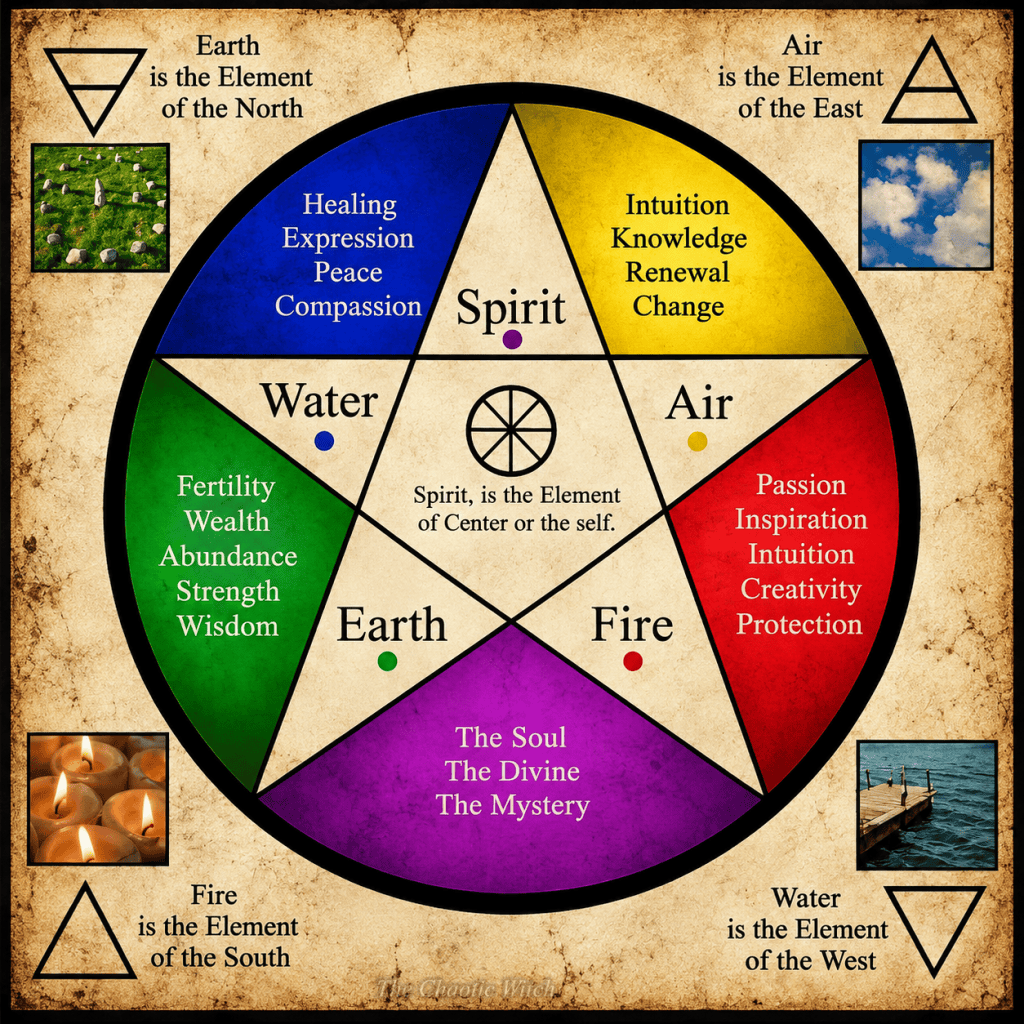
In many modern witchcraft and Pagan traditions, the pentacle is one of the most recognizable and meaningful symbols of spiritual practice. Far more than a five-pointed star enclosed within a circle, it represents the relationship between the natural world, the spiritual realm, and the energies believed to flow through all living things. Each of its five points is commonly associated with one of the elements: Earth, Air, Fire, Water, and Spirit. Together, they symbolize balance, harmony, transformation, and the interconnectedness of existence.
Earth represents the physical world, offering stability, strength, protection, and nourishment. It is the foundation upon which life grows and flourishes. Within elemental magick, Earth is associated with grounding, prosperity, fertility, patience, and the ability to turn intentions into tangible results. Its energy can be found in the soil beneath our feet, the roots of ancient trees, the mountains that endure through centuries, and the stones that hold the memory of the land. Working with Earth encourages us to slow down, remain present, and appreciate the security and abundance already surrounding us.
Air represents the mind, communication, wisdom, and the freedom to explore new possibilities. Invisible yet constantly moving, it symbolizes thought, inspiration, imagination, and the power of words. In magickal practice, Air is often called upon when seeking mental clarity, strengthening intuition, improving communication, or welcoming fresh perspectives. A gentle breeze can symbolize the arrival of new opportunities, while a strong wind may represent the release of stagnant energy. Air reminds us that change often begins with a single thought and that our minds possess the ability to shape how we experience the world.
Fire embodies passion, courage, creativity, willpower, and transformation. It is the spark that inspires action and the force that encourages us to move beyond fear or limitation. Within witchcraft, Fire is frequently associated with motivation, personal empowerment, purification, and the courage to pursue meaningful change. Just as a flame can provide warmth and light, it can also consume and transform. This dual nature reminds practitioners that power must be approached with awareness, responsibility, and respect. Fire teaches us that transformation sometimes requires releasing what no longer serves us so that something new can emerge.
Water represents emotion, intuition, compassion, healing, and the mysterious depths of the subconscious mind. Its constantly changing nature reflects the movement of feelings, dreams, and personal experiences. Water is often incorporated into rituals involving emotional renewal, cleansing, self-love, and spiritual reflection. Rivers symbolize life’s continuing journey, oceans represent the vastness of the unknown, and rain offers an image of renewal and release. Through Water, practitioners are encouraged to honour their emotions without allowing themselves to become overwhelmed by them, recognizing that vulnerability and sensitivity can be sources of strength.
Spirit, sometimes called Aether, is traditionally understood in many contemporary systems as the fifth element that connects and unifies the other four. It represents consciousness, spiritual awareness, the sacred mysteries of existence, and the connection between the physical and unseen worlds. Unlike the other elements, Spirit is not associated with a single physical substance. Instead, it symbolizes the life force or sacred presence believed to exist within and beyond all things. In some traditions, the uppermost point of the pentacle represents Spirit, reflecting the importance of bringing spiritual awareness into harmony with earthly experience.
The circle surrounding the five-pointed star carries its own significance. Without a beginning or an end, it represents eternity, wholeness, unity, and the continuous cycles of nature. The changing seasons, phases of the Moon, rhythms of birth and death, and patterns of growth and renewal are all reflected in its unbroken form. Within certain witchcraft traditions, the circle also symbolizes a sacred boundary, representing the protected space created during ritual or spellwork.
Together, the star and circle illustrate a fundamental principle found in many forms of elemental magick: no element exists entirely independently of the others. Earth requires Water to nourish its growth, Air to sustain living things, and the warmth of Fire to support many natural processes. Spirit, within this symbolic framework, represents the connection that brings these forces into a meaningful whole.
This relationship is also reflected within ourselves. Earth can represent our physical bodies and need for stability, Air our thoughts and communication, Fire our passions and determination, Water our emotions and intuition, and Spirit our deeper sense of purpose and connection. When one aspect of life feels neglected or overwhelming, elemental symbolism can provide a way to reflect on what may need greater attention.
For example, someone experiencing uncertainty may turn toward Earth-inspired grounding practices to encourage a sense of security. A person struggling with creative inspiration might meditate on Fire, while someone seeking emotional peace may find comfort in Water symbolism. Air can encourage clearer thinking and honest communication, while Spirit invites reflection on personal values, spiritual beliefs, and one’s place within the larger world.
In ritual practice, the elements are often honoured through simple objects and natural materials. A stone, bowl of soil, or living plant may represent Earth. Incense, feathers, or the movement of a breeze may symbolize Air. A candle or carefully tended flame can represent Fire, while a bowl of water, seashell, or collected rainwater may honour Water. Spirit may be represented by the pentacle itself, a central candle, meditation, or the practitioner’s intention.
Many modern traditions also associate the elements with particular directions, colours, and seasons. Earth is frequently connected with North, green or brown, and winter; Air with East, yellow or white, and spring; Fire with South, red or orange, and summer; and Water with West, blue or silver, and autumn. Spirit is commonly placed at the centre or above the other elements. However, these correspondences are not universal. Different traditions, cultural influences, geographic locations, and individual practices may arrange them differently.
The pentacle can also serve as a reminder that magick is not solely about performing elaborate rituals or gathering special tools. For many practitioners, its deeper meaning lies in developing awareness of the natural world and recognizing the significance of ordinary experiences. Walking barefoot on the grass, feeling the wind against your skin, watching a candle flicker, listening to rainfall, or sitting quietly beneath the stars can become meaningful moments of connection.
Elemental magick encourages a relationship with nature built upon observation, gratitude, and respect. It invites us to recognize that the world is constantly changing and that we, too, are part of those cycles. There are times to remain grounded, moments to embrace new ideas, opportunities to act with courage, and periods when emotional reflection and renewal are needed.
Ultimately, the pentacle symbolizes more than five separate elements. It represents the possibility of bringing different aspects of existence into balance while acknowledging that each has its own purpose and importance. Its message is not that life must always remain perfectly harmonious, but that balance is something we can continually seek as we grow, change, and learn.
The beauty of elemental magick lies in its simplicity. The sacred does not have to be distant, hidden, or difficult to reach. It can be found in the earth beneath our feet, the air filling our lungs, the warmth of sunlight, the cleansing movement of water, and the quiet sense of connection we experience when surrounded by nature.
For those who follow an elemental path, the pentacle becomes a symbol of that relationship: a reminder that we are not separate from the natural world, but part of its ever-changing, interconnected whole.
Five elements, one sacred circle, and an endless reminder that magick begins with the world around us.
A little magic is always waiting. Subscribe and step inside the circle. 🖤🔮✨


Leave a Reply