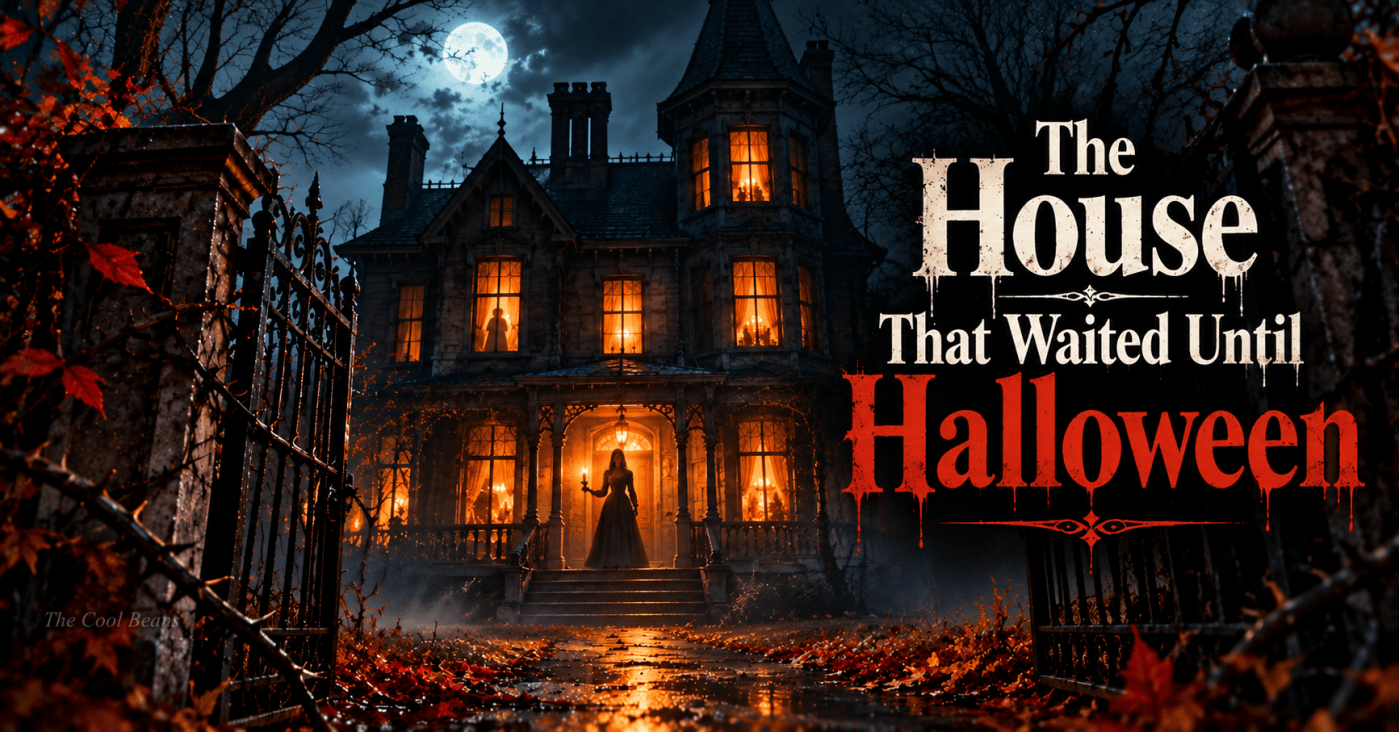
The first thing Eloise noticed was the smell. It drifted through the open window of her car as she turned onto Briar Lane, a warm, delicious mixture of cinnamon, roasted apples, and something buttery baking in an oven. It reminded her of her grandmother’s kitchen, of October afternoons when the windows fogged with steam and the entire house smelled of pumpkin pie. Except there were no occupied houses at this end of Briar Lane. There hadn’t been for decades.
The narrow road wound through a tunnel of ancient maple trees, their branches scraping together overhead. Dead leaves skittered across the pavement, and the occasional gust of wind sent them spinning in little orange whirlwinds. Beyond the trees, the neighbourhood gave way to an abandoned stretch of land where old stone walls disappeared beneath ivy and rusted gates leaned crookedly from their hinges.
Eloise had driven this road hundreds of times. She had grown up in the little town of Ashwick, left at eighteen, and returned twenty years later to settle her mother’s estate. She knew every bend, every pothole, and every local story, including the one about the house at the end of the lane.
People called it Blackthorn House, although the family who had built it had been named Whitmore. It was an enormous Victorian mansion with a steep slate roof, narrow windows, and a wraparound porch that sagged beneath the weight of time. Its gardens had long since surrendered to weeds, and a dead oak tree stood beside the front gate like a skeletal guardian.
According to local legend, the Whitmore family had vanished on Halloween night in 1953. Not died, not moved away – they just vanished. There had been six of them: Arthur and Margaret Whitmore, their three children, and Margaret’s elderly mother. Neighbours reported seeing the family preparing for a Halloween dinner. Candles burned in every window, music drifted from the house, and the dining room glowed with warm golden light.
Then, shortly after midnight, the music stopped. The following morning, the front door stood open. Dinner remained on the table, six chairs had been pulled out, and six plates held food that had gone cold. There were no signs of violence, no blood, and no evidence that anyone had packed a suitcase. The family had simply disappeared.
For years afterward, people claimed the house came alive every Halloween. Lights appeared in its windows. Laughter echoed across the overgrown gardens. Sometimes, motorists reported seeing a woman standing on the porch, wearing a long white dress and holding a candle. Eloise had never believed any of it. At least, not until that evening.
It was October 31, and the sun was sinking behind the trees when she rounded the final bend in Briar Lane. Blackthorn House appeared through the branches, its dark silhouette rising against a bruised purple sky. Every window was glowing. Eloise slammed on the brakes and stared in disbelief. The mansion was supposed to be empty. Its electricity had been disconnected decades earlier, and the property had been condemned after part of the roof collapsed. Yet warm yellow light spilled through the windows, smoke curled from one of the chimneys, and the front porch was decorated with glowing jack-o’-lanterns.
Then she saw the woman. She stood at the front door, dressed in a dark green gown with lace sleeves. Her hair was pinned neatly at the back of her head, and she held a silver candlestick in one hand. The woman lifted her free hand and waved.
Eloise felt a cold prickling sensation travel along her spine. She had no intention of stopping, but as she pressed the accelerator, the engine sputtered and died. The dashboard lights went dark. She tried the ignition again, but nothing happened. Outside, the woman continued waving.
Eloise reached for her phone. No signal. She tried restarting it, but the screen flickered once before going black. A soft tapping came from the passenger-side window, and Eloise turned so quickly that her neck hurt.
A little girl stood beside the car. She couldn’t have been older than eight. She wore a blue velvet dress, white stockings, and polished black shoes. Her dark hair was tied with two ribbons, and she held a battered cloth doll against her chest. The child smiled and asked, “Are you coming to dinner?”
Eloise stared at her. “Where did you come from?”
“From the house, silly,” the girl replied, tilting her head as though the question made no sense.
“Is your mother here?”
The girl nodded enthusiastically. “Everyone’s here. We’re only waiting for one more.”
Eloise glanced toward the mansion. The woman on the porch had disappeared. “Listen, sweetheart,” she said carefully, “I think you should go back inside. I’m going to call someone to help with my car.”
The girl’s smile faded. “But you can’t leave.”
Eloise felt her stomach tighten. “Why not?”
The child looked toward the house, then lowered her voice. “Because it’s almost time.”
Before Eloise could ask what she meant, the girl turned and skipped toward the gate. Her little shoes made no sound on the gravel. Eloise watched her disappear through the overgrown garden, and then the car radio turned on.
A burst of static filled the vehicle, followed by the thin, distant sound of music. It was an old recording, something from the 1940s, with a cheerful female singer accompanied by a crackling orchestra. Eloise reached for the radio controls, but the buttons wouldn’t respond. The music stopped, and a man’s voice whispered through the speakers.
“Six chairs. Six plates. Six souls. One chair has always been empty.”
The radio clicked off. Eloise was out of the car before she could think. Her shoes crunched through the leaves as she hurried toward the road, intending to walk back to town. She made it perhaps twenty paces before realizing something was wrong. The road was gone.
Where the asphalt should have stretched between the trees, there was only a dense wall of blackthorn bushes, their twisted branches tangled together so tightly that not even a rabbit could have squeezed through. Eloise turned around. Her car was still there, parked beside the mansion. Beyond it, the road ended in another wall of thorns. The entire property had been enclosed.
From somewhere inside Blackthorn House came the sound of a dinner bell. Three slow, delicate chimes. Then a woman’s voice called from the porch, “Eloise, darling. You’ll catch your death out there.”
The woman in the green dress had returned. She stood beneath the porch light, smiling with the patient expression of someone waiting for a tardy guest. Eloise’s mouth went dry as she asked how the woman knew her name.
“Oh, sweetheart,” the woman replied with a soft laugh. “We’ve been expecting you for such a long time.”
There were moments in life when fear became so overwhelming that it stopped feeling like fear. Eloise experienced one of those moments as she walked through the gate and up the cracked stone path. She knew she should run, scream, break a window, do anything other than enter the house. But the thorns were growing thicker behind her, and something in the darkness beyond them had begun moving.
It was tall, much taller than a person. She could see its outline shifting between the branches, and whenever it moved, the thorns rustled as though a thousand dry fingers were rubbing together. The woman stepped aside and invited her in, explaining that dinner was nearly ready.
The entrance hall was beautiful, and that was the most unsettling thing about it. The walls were covered in deep burgundy wallpaper, the polished wooden floor reflected the light of an enormous chandelier, and fresh flowers filled a porcelain vase on a little table beside the staircase. A grandfather clock ticked in the corner, and the air smelled of cinnamon and roasted apples. Nothing looked abandoned. Nothing looked seventy-three years old.
Eloise glanced toward the front door as it closed behind her. There was no handle on the inside. The woman followed her gaze and smiled. “Arthur removed it years ago. The children kept trying to sneak out before dessert.”
Eloise swallowed. “Who are you?”
“Margaret Whitmore, of course.”
The name struck Eloise like a physical blow. She remembered the newspaper photographs, the missing family, the Halloween dinner, and the mysterious disappearance in 1953. Margaret Whitmore had been thirty-nine years old when she vanished. The woman standing before her looked exactly thirty-nine.
Margaret took Eloise’s coat, although Eloise couldn’t remember removing it, and hung it on a brass hook. Then she gently touched Eloise’s shoulder and led her toward the dining room, explaining that everyone was waiting.
The dining room was at the end of a long hallway. Eloise could hear voices, silverware clinking against plates, and the occasional burst of laughter. As they approached, she noticed that the wallpaper was decorated with little flowers that seemed to shift whenever she looked away. Some of the flowers were opening. Others were closing. Beneath the wallpaper, something was breathing.
Margaret pushed open the dining room doors. Five people sat around a long mahogany table. An older man with a neatly trimmed moustache occupied the head chair. Beside him sat an elderly woman in a black dress, her hands folded in her lap. Two boys sat opposite each other, one about twelve and the other perhaps fifteen. The little girl from the road sat beside Margaret’s empty place, still holding her cloth doll.
All five turned toward Eloise. Their smiles appeared at exactly the same moment. Margaret announced that their guest had finally arrived, and the older man rose from his chair.
“At last,” he said, crossing the room to take Eloise’s hand. His skin was cold and dry, like paper that had been stored in a cellar. “Arthur Whitmore. It’s a pleasure to finally meet you.”
Eloise tried to pull her hand away, but his grip tightened. She whispered that there must have been a mistake, but Arthur’s smile only widened. He assured her that there had been no mistake at all before releasing her hand and gesturing toward the table.
There were seven chairs. Six were occupied, and the seventh stood at the far end, directly beneath a large oil painting of the Whitmore family. Eloise stared at the painting. Arthur, Margaret, the three children, and the elderly grandmother were all there, but someone else stood among them.
A young woman stood behind the family, one hand resting on Margaret’s shoulder. Her face was turned slightly toward the artist, and her expression was solemn. Eloise recognized her immediately. It was her grandmother, not as she had looked in the years before her death, with silver hair and deep wrinkles around her eyes, but as a young woman of perhaps twenty-five.
Eloise stepped closer. Beneath the painting, a small brass plaque read, The Whitmore Family, October 1953.
She turned toward Margaret. “My grandmother knew you?”
Margaret’s expression softened. “Oh, she knew us very well.”
The elderly woman at the table gave a low, unpleasant chuckle. “She was supposed to stay.”
Eloise felt the blood drain from her face and demanded to know what that meant. Arthur sighed and returned to his chair. He explained that her grandmother had been invited to dinner on Halloween night in 1953. She had been a dear friend of Margaret’s, and they had planned a lovely evening together. But when the hour came, she had become frightened and fled the house before the final bell.
Margaret lowered her eyes. “She left us without our seventh guest.”
Eloise looked from one face to another. “Seventh guest?”
The youngest boy leaned forward. “That’s how many it needs.”
His older brother kicked him beneath the table and warned him not to spoil it. Arthur raised one hand, silencing them both. Eloise took a step backward and asked what needed seven.
The grandfather clock in the hallway began striking. One. Two. Three. The sound was impossibly loud, each chime reverberating through the floorboards. Arthur’s smile disappeared.
“The house,” he said.
The lights flickered. Something moved behind the walls. It began as a faint scratching, like mice running through the plaster. Then came a slow, heavy dragging sound from somewhere beneath the dining room floor. The table trembled, the chandelier swayed, and Eloise backed toward the doors, but they slammed shut before she reached them.
Margaret looked genuinely distressed. “Oh, dear. It’s getting impatient.”
Arthur stood and ordered Eloise to sit down. She shook her head and whispered that she didn’t belong there. The elderly woman laughed again and replied that neither had they. The little girl looked up from her doll and added, “Not at first.”
Eloise stared at them, suddenly understanding that the family wasn’t hosting the dinner. They were serving it. The house had taken them in 1953, and it had kept them ever since.
Something pressed against the wallpaper. A shape appeared beneath the burgundy flowers, enormous and vaguely human, as though a giant face were pushing outward from the other side. The paper stretched. Two deep hollows formed where eyes should have been, followed by a long, crooked indentation that might have been a mouth.
Then the wallpaper whispered, “Hungry.”
Every candle in the room bent toward Eloise. Arthur moved quickly, pulling out the seventh chair and ordering her to sit. Eloise ran instead. She threw herself against the dining room doors, expecting them to resist, but they burst open beneath her weight. She stumbled into the hallway and raced toward the entrance, her footsteps pounding against the polished floor.
Behind her, chairs scraped backward. Margaret screamed for Arthur to stop her, and the grandfather clock continued striking. Four. Five. Six.
Eloise reached the entrance hall and grabbed the front door. There was still no handle, but she slammed her shoulder against it until pain shot down her arm. The door didn’t move. Behind her, the staircase creaked.
She turned and saw someone standing at the top. It was her grandmother. She wore the same pale blue dress she had worn in the painting, and her dark hair fell in soft waves around her shoulders.
Eloise’s knees nearly buckled. “Grandma?”
The woman descended one step and told Eloise to listen. Her voice was exactly as Eloise remembered it, warm and slightly husky, with the faint Scottish accent that had grown stronger whenever she was upset. Eloise began to cry, whispering that her grandmother was dead.
“I know, sweetheart,” the woman replied. She explained that she had been trying to keep Eloise away from the house for years. That was why she had always warned her never to take Briar Lane after sunset.
Eloise remembered. Her grandmother had said it dozens of times when she was a child. She had never explained why, only insisted that Eloise promise. Eloise whispered that she had forgotten, and her grandmother nodded sadly.
“The house never did.”
The clock struck seven. A deep groan rolled through the mansion. Her grandmother looked toward the dining room, where shadows were spilling into the hallway, and explained that there was a way out, but Eloise would have to do exactly as she said.
Eloise nodded desperately as her grandmother explained that the house needed seven people at the table when the clock struck midnight. That was how it fed and how it kept them. When Eloise asked what happened to the seventh person, her grandmother’s expression changed.
“They become part of it.”
Eloise looked toward the dining room and asked about the Whitmores. Her grandmother explained that they had been waiting for someone to take their place. The house had promised that if they brought it another guest, it would let one of them go.
A terrible realization settled over Eloise. They were trying to sacrifice her. Her grandmother nodded, but explained that the family didn’t know what she had learned before escaping.
The shadows were moving closer. Her grandmother leaned forward and whispered that the house could only keep what accepted its invitation. Eloise protested that she hadn’t accepted anything, but her grandmother reminded her that she had entered through the door and allowed Margaret to take her coat. She had not eaten or sat at the table, however, which meant the invitation was not complete.
The clock struck eight. A long, black hand emerged from the dining room doorway. It had too many fingers. The fingers curled around the frame, followed by a second hand, then something that resembled a head made of darkness and tangled roots.
Eloise stumbled backward as her grandmother told her to refuse the house’s hospitality. She had to say the words clearly, three times.
Eloise turned toward the thing in the doorway. Its mouth opened, revealing rows of tiny white objects. At first she thought they were teeth, but then she realized they were human fingernails. The thing began crawling toward her.
“I refuse your hospitality,” Eloise whispered.
The house shuddered, and the creature stopped.
“I refuse your hospitality,” she repeated, louder this time.
Every window shattered. The chandelier crashed to the floor, and the walls began splitting open. Behind the plaster were layers of dark, pulsing material, like the inside of something living. The creature shrieked, and Eloise covered her ears.
“I REFUSE YOUR HOSPITALITY!”
For one terrible second, everything went silent. Then the front door exploded outward. Cold October air rushed into the hallway. Eloise stumbled onto the porch, fell down the steps, and landed hard on the gravel path.
Behind her, the house screamed. It was not the sound of timber breaking or windows shattering. It was the sound of something ancient and furious, something that had waited decades for a meal and been denied at the final moment.
Eloise scrambled to her feet and ran. The blackthorn bushes lining the road twisted and writhed, their branches reaching toward her as she passed. She felt one thorn tear through her sleeve, another scrape across her cheek, but she didn’t stop. She ran until she reached her car, and the engine started on the first turn of the key.
Eloise threw the vehicle into reverse, swung it around, and accelerated toward town. The road had returned, stretching between the trees as though nothing unusual had happened. She didn’t look in the rearview mirror, not even once. By the time she reached the main street, the clock on her dashboard read 12:01am. It was November 1.
Eloise drove directly to the police station. The officer on duty listened patiently as she described the lights, the Whitmore family, the strange creature, and the impossible appearance of her grandmother. He asked whether she had been drinking, whether she had taken any medication, and whether she might have fallen asleep while driving.
Eloise insisted that everything had happened exactly as she described. Eventually, the officer agreed to send a patrol car to Briar Lane. At dawn, two officers returned with photographs.
Blackthorn House was empty. Its roof had collapsed years earlier, the windows were boarded shut, and the front porch had rotted away. There were no decorations, no signs of electricity, and no evidence that anyone had entered the building recently.
But the officers had found something unusual. On the front steps sat a woman’s coat. Eloise’s coat. The same one Margaret Whitmore had taken from her the previous evening. It was perfectly clean, neatly folded, and smelled faintly of cinnamon.
The officer handed it to her in a plastic evidence bag. Eloise stared at it for a long time before noticing something tucked inside one of the pockets. It was a small, cream-coloured envelope, with her name written across the front in elegant handwriting.
With trembling fingers, she opened it. Inside was a folded card, decorated with tiny illustrations of pumpkins and autumn leaves.
Dearest Eloise,
We are terribly sorry that you had to leave before dessert. Arthur was quite disappointed, and the children have been asking when you will return.
Of course, we understand that you were frightened. Your grandmother was frightened too, all those years ago.
But there is one thing you should know. The house does not forget its guests.
We look forward to seeing you next Halloween.
With love, Margaret Whitmore.
Eloise dropped the card. The officer asked if she was all right, but she couldn’t answer. Beneath Margaret’s signature was something else, a tiny handwritten note in a different ink.
P.S. Your grandmother was very clever. She knew the words that would let her escape. Unfortunately, she never told you what happens to the person who teaches them.
Eloise looked down at the card. The final line appeared slowly, as though an invisible pen were writing across the paper.
Tell her we said thank you.
That evening, Eloise returned to her mother’s house and climbed the narrow staircase to the attic. She found the old wooden trunk containing her grandmother’s belongings, the one nobody had opened since the funeral. Inside were photographs, letters, a collection of handkerchiefs, and a small leather-bound diary.
Eloise turned the brittle pages until she found an entry dated October 31, 1953. The handwriting was frantic.
I escaped. God forgive me, I escaped. But I heard it speaking as I ran, and I know what it wants.
The house is not haunted. The house is alive.
It does not merely eat people. It eats the years they would have lived. Every life it takes gives it another season, another Halloween, another chance to open its doors.
I told it I refused its hospitality, and it let me go. But it whispered that a debt had been created.
One day, it said, someone of my blood would come to settle it.
Eloise’s hands began to shake. She turned the page and found another entry, written fifty years later, dated October 31, 2003.
The house has started calling again. I hear the dinner bell in my dreams, and sometimes I wake to find cinnamon on my pillow.
I thought I had escaped it forever. But last night, I saw Margaret standing outside my window. She was holding a little girl’s coat. Eloise’s coat.
Eloise stared at the words. In 2003, she had been twenty years old and away at university. She had lost her favourite winter coat that October. Her grandmother had told her it must have been stolen.
Eloise turned the page and discovered one final entry, written shortly before her grandmother died.
If Eloise ever returns to Ashwick, I pray she never goes near that house. But if she does, she must know one thing.
The house cannot take someone who refuses its invitation, unless someone inside has already invited them by name.
A cold breeze moved through the attic. Eloise looked toward the window, but it was closed. She glanced back at the diary and noticed a final sentence at the bottom of the page, written in handwriting she did not recognize.
Your grandmother invited you years ago.
Eloise felt the blood drain from her face. From downstairs came the soft, familiar sound of a dinner bell. One chime, then another, then a third. She stood slowly, staring at the attic doorway.
Somewhere below, a woman laughed. A child giggled, and a man’s voice called pleasantly from the kitchen, “Eloise, dear. Dinner is ready.”
The smell of cinnamon drifted up the stairs. Then the grandfather clock in the hallway began to strike midnight. But Eloise’s mother’s house had never had a grandfather clock.
She backed toward the attic window, her heart pounding so hard she could barely breathe. Downstairs, the voices grew louder. Chairs scraped across the floor, silverware clinked against porcelain, and beneath it all, something enormous began breathing inside the walls.
Eloise looked at the diary one last time. The final sentence had changed.
You never left the house, Eloise. We simply let you dream that you did.
From somewhere directly behind her, Margaret Whitmore whispered, “Now, darling, don’t be rude.”
A cold hand settled on Eloise’s shoulder. “Everyone is waiting.”
Downstairs, at the end of a hallway that had not existed a moment earlier, seven candles flickered above a beautifully set dining table. Six chairs were occupied, and the seventh had been pulled out.
It was waiting, just as it had been for seventy-three years.
💜 Enjoying the chaos that is my life? Subscribe to The Cool Beans! It’s cheaper than therapy and slightly more organized 🤣


Leave a Reply