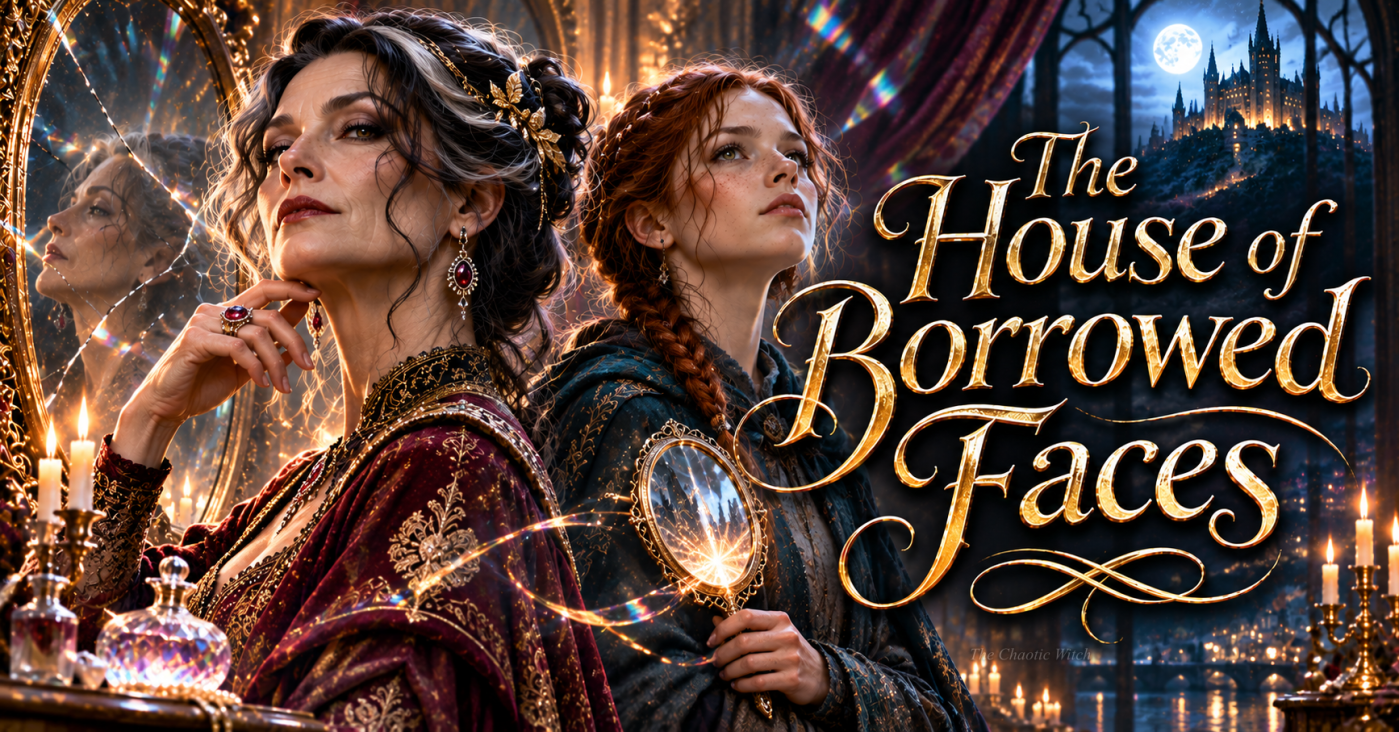
In the kingdom of Avelaine, beauty was power, appearances were everything, and the truth was considered a rather unfortunate inconvenience. Nobody understood this better than Lady Seraphine Vale, the most celebrated illusionist in the royal court. For forty-seven years, she had advised monarchs, influenced elections, ruined reputations, and maintained the appearance of a woman barely thirty. Her skin was flawless, her dark hair shone like polished silk, and her emerald eyes possessed the unsettling ability to make even the most powerful men forget what they had intended to say.
The truth was that Seraphine was seventy-two, her hair had turned silver decades ago, and a long scar crossed the left side of her face. She concealed these details beneath layers of glamour magic, an ancient art that manipulated light, reflection, and perception. In Avelaine, glamour was more valuable than gold. It could turn a crumbling mansion into a palace, disguise a beggar as a nobleman, or make an entire ballroom believe a guest had never arrived. The finest practitioners could even influence how others remembered them, although such magic required considerable skill and came with consequences that few were willing to discuss.
Seraphine had mastered the art so completely that she sometimes forgot which parts of herself were real. She had worn her youthful appearance for so long that her reflection occasionally startled her when she was too exhausted to maintain the illusion. On those rare evenings, she avoided mirrors entirely, preferring the comforting dishonesty of candlelight.
Her carefully constructed existence began to unravel on a rainy Tuesday when a street orphan stole her face.
It happened outside the Royal Conservatory, where Seraphine had just finished persuading three influential council members that an unpopular new tax was, in fact, an extraordinary opportunity for national prosperity. She stepped into her carriage, adjusted her gloves, and caught sight of a thin girl standing beneath the awning of a shuttered bakery. The child could not have been older than thirteen. Her clothes were soaked, her boots were held together with string, and she was staring at Seraphine with an intensity that bordered on impolite.
Seraphine was accustomed to being admired. She was considerably less accustomed to being studied.
She raised one perfectly shaped eyebrow, expecting the child to look away. Instead, the girl lifted her hand toward the carriage window. The glass shimmered, and Seraphine’s reflection changed.
For one terrible instant, she saw herself as she truly was: silver-haired, lined with age, and bearing the scar she had spent forty years concealing. The illusion returned almost immediately, but Seraphine’s heart continued pounding long after the image vanished.
The girl smiled.
Seraphine ordered the carriage to stop.
By the time her driver opened the door, the child was already halfway down the street. Seraphine followed her through the rain, furious at the indignity of running in expensive shoes. She caught up beside a fountain and seized the girl’s wrist, demanding to know what spell she had used.
The child said nothing. She simply looked at Seraphine, then at the fountain’s dark water.
The reflection changed again.
This time, Seraphine saw herself standing in a crowded ballroom twenty years earlier, accepting an award for services to the Crown. The image was not entirely unfamiliar, but something was wrong. In the reflection, her expression was frightened rather than triumphant, and a small boy stood behind her, crying as guards dragged his mother away.
Seraphine released the girl’s wrist.
She remembered that evening. She had simply spent twenty years convincing herself that she didn’t.
The girl reached into her coat and produced a small slate. With a piece of chalk worn almost to nothing, she wrote three words.
You look tired.
Seraphine stared at the message. Of all the things the child might have written, this was perhaps the most offensive.
She straightened her shoulders, summoned her most commanding expression, and informed the girl that she was coming home with her. The child considered this proposition, looked down at Seraphine’s ruined shoes, and wrote another message.
Do you have food?
Seraphine sighed. “Unfortunately, yes.”
That was how Mira entered the House of Vale.
Seraphine told the servants that she had adopted the girl out of charitable concern, a declaration that immediately caused three aristocratic acquaintances to send congratulatory flowers. In truth, she had brought Mira home because the child possessed a form of magic Seraphine had never encountered, and she had no intention of allowing the royal court to discover it first.
Mira could not speak. She communicated through writing, gestures, and a fluid system of signs that Seraphine initially dismissed as unnecessarily elaborate. Within a week, however, the illusionist discovered that learning to understand the girl’s hands was considerably easier than enduring her increasingly sarcastic written observations.
The servants adored Mira. She ate enormous quantities of bread, befriended the elderly gardener, and demonstrated a remarkable ability to appear in rooms where she had been specifically forbidden to go. She also possessed an unfortunate habit of examining Seraphine’s belongings and revealing their true appearance.
A diamond necklace became a string of ordinary glass beads. An expensive painting revealed the unfinished sketch beneath its glamorous surface. A silver vase, supposedly gifted by a foreign prince, turned out to be a cheap ceramic jug that Seraphine had purchased at a market thirty years earlier.
When Mira exposed the true condition of the grand staircase, revealing that its magnificent marble steps were actually cracked limestone, Seraphine finally lost her patience.
“Must you uncover every imperfection in this house?” she demanded.
Mira considered the question, then wrote on her slate.
Must you hide every one?
Seraphine had no answer, which was becoming an increasingly irritating feature of their relationship.
Nevertheless, she began teaching Mira the fundamentals of glamour.
Their lessons took place in a circular room lined with mirrors, each framed in silver and enchanted to reflect a different quality of light. Seraphine explained that ordinary glamour worked by bending the light surrounding an object, persuading the eye to perceive something other than what existed. More advanced practitioners could manipulate the expectations of an observer, allowing an illusion to survive even when someone looked directly at it.
The first lesson involved a simple red apple. Seraphine placed it on a velvet cushion and transformed its appearance into a golden pear. She instructed Mira to reproduce the effect.
Mira studied the fruit, raised her hand, and watched as the illusion dissolved. The apple returned to its original colour, complete with a small bruise near its stem.
Seraphine frowned and tried again. This time, she disguised the apple as a ruby. Mira immediately stripped away the glamour, revealing not only the apple but the tiny worm tunnelling through its centre.
The girl looked delighted.
Seraphine looked personally betrayed.
Over the following weeks, they discovered that Mira’s abilities were unlike any known form of glamour. She could not easily create illusions of her own, but she could absorb those cast by others, drawing the manipulated light into herself and releasing it as an unfiltered reflection. Where ordinary mirrors showed whatever glamour was presented to them, Mira revealed what the magic was hiding.
More astonishingly, she could sometimes uncover images trapped within reflective surfaces. Every mirror, polished blade, and still pool of water retained faint impressions of the things it had witnessed. Most practitioners considered these echoes impossible to retrieve, but Mira could draw them forward, allowing the past to appear briefly in the present.
Seraphine called the ability Reflection Magic.
Mira called it seeing.
Their training became a competition. Seraphine constructed increasingly elaborate illusions, and Mira dismantled them with infuriating ease. One afternoon, the older woman created an entire imaginary garden within the mirror room, complete with flowering trees, singing birds, and a marble fountain. Mira studied the scene for several moments before revealing that every flower was an illusion, the birds were reflections of candle flames, and the fountain was actually Seraphine’s overturned teacup.
Then, with a mischievous smile, Mira made the teacup appear in all twelve mirrors simultaneously.
Seraphine stared at the impossible reflections.
Mira bowed.
For the first time in decades, Seraphine laughed so hard that tears gathered in her eyes.
Their relationship grew into something neither had expected. Seraphine taught Mira how to navigate aristocratic society, how to recognize a threat concealed beneath a compliment, and how to make an entrance without appearing desperate for attention. She taught her which forks to use at formal dinners, which nobles could be trusted, and why one should never reveal an entire plan when a carefully chosen fragment would suffice.
Mira, in return, taught Seraphine that elegance was not the same as goodness, that silence could be more powerful than speech, and that the people who appeared least important were often the ones who noticed everything.
But as Mira’s abilities strengthened, the mirrors throughout the House of Vale began behaving strangely.
At night, Seraphine sometimes glimpsed unfamiliar figures standing behind her reflection. A woman in a torn blue dress appeared in the drawing-room mirror. A little boy pressed his hands against the glass of an upstairs window. Once, Seraphine entered her bedroom and saw a crowded ballroom reflected in her dressing mirror, although the room itself was empty.
She recognized the ballroom immediately.
It was the Hall of Crowns, where twenty years earlier the kingdom had celebrated the signing of the Unity Decree.
The decree had been presented as a measure to protect Avelaine from dangerous magical practitioners. In reality, it had granted the Crown sweeping authority to seize property, imprison suspected dissidents, and remove entire communities from land coveted by wealthy families.
Seraphine had helped make the decree possible.
She had been responsible for the magnificent illusion displayed during the signing ceremony, a spectacle that made the king appear surrounded by radiant symbols of peace and prosperity. The people had cheered, believing they were witnessing the beginning of a golden age.
Behind the glamour, soldiers had been arresting protesters.
Seraphine had known.
She had told herself that refusing the commission would accomplish nothing. She had argued that someone else would simply perform the spell. Most importantly, she had convinced herself that remaining influential within the court would allow her to prevent worse atrocities.
Twenty years had passed, and she had never once used that influence to challenge the decree.
Now the past was appearing in her mirrors, and she could no longer persuade herself that it had been necessary.
One evening, Mira found Seraphine sitting before her dressing table, staring at her reflection. The glamour was failing around the edges, revealing silver strands beneath her dark hair and the faint outline of the scar along her cheek.
Mira approached quietly and placed her hand against the mirror.
The illusion dissolved completely.
Seraphine recoiled, but Mira gently caught her hand before she could turn away. The girl studied her true face, tracing the air near the scar without touching it. Then she took her slate and wrote a question.
Who hurt you?
Seraphine stared at the words for a long time.
“The fire,” she finally whispered. “During the northern uprising. I was trying to rescue a child from a burning building.”
Mira waited.
Seraphine swallowed. “I saved him. But the flames caught my face, and afterward, people stopped looking at me the way they had before. They looked at the scar. They looked at my age. They stopped listening.”
She touched her cheek, remembering the years when beauty had opened doors that talent alone could not.
“So I changed what they saw. At first, only a little. Then more. Eventually, I discovered that people were willing to believe almost anything if it came from someone they found beautiful.”
Mira studied her reflection again. Then she wrote something that made Seraphine’s throat tighten.
You were beautiful when you saved him.
Seraphine turned away before the girl could see her cry.
The following morning, an invitation arrived from the palace.
King Alaric was hosting the Festival of Radiance, the grandest celebration in Avelaine’s social calendar. Every influential family would attend, along with foreign dignitaries, military commanders, and the members of the Royal Council. The festival would conclude with the unveiling of a new decree granting Chancellor Dorian Vex complete authority over the kingdom’s magical institutions.
Seraphine knew what that meant.
The Chancellor had spent years seeking control over every practitioner capable of challenging the Crown. Under the proposed decree, all independent illusionists would be required to register their abilities, submit to royal supervision, and surrender any enchanted objects deemed politically dangerous.
Mira would be among the first people targeted.
Seraphine read the invitation twice, then burned it in the fireplace.
Mira watched the flames consume the royal seal. When she asked what was wrong, Seraphine explained that the Chancellor intended to place every magical practitioner in Avelaine under his authority.
Mira listened, then wrote a simple question.
Will you stop him?
Seraphine looked toward the window, where the palace towers rose above the city.
“I have spent forty-seven years making myself indispensable to those people,” she admitted. “If I oppose them now, they will destroy everything I have built.”
Mira wrote another question.
What have you built?
Seraphine opened her mouth to answer, but the words would not come.
That night, she entered the mirror room and removed every glamour from her body. Her silver hair fell around her shoulders, her scar emerged fully, and the lines of her face settled into their natural places. She studied herself in the glass, searching for the woman she remembered being before ambition had become more important than conscience.
For the first time, she did not look away.
Three days later, Lady Seraphine Vale arrived at the Festival of Radiance wearing a magnificent black gown embroidered with silver thread. Her youthful glamour was flawless, her dark hair gleamed beneath the chandeliers, and every eye in the ballroom turned toward her as she entered.
Beside her walked Mira, dressed in deep blue velvet, her hair braided with tiny silver ribbons. The girl carried no jewellery except a small polished mirror hanging from a chain around her neck.
The aristocrats whispered immediately.
Some admired Seraphine’s generosity in adopting a street orphan. Others questioned the wisdom of bringing a child of uncertain parentage into royal society. One elderly duchess remarked that Mira was fortunate to have found someone willing to overlook her unfortunate inability to speak.
Seraphine smiled sweetly.
“Indeed,” she replied. “I have discovered that listening is a far more valuable skill than speaking. You might consider trying it.”
Mira covered her mouth to hide a grin.
The evening unfolded beneath a thousand enchanted lights. Musicians performed on a floating platform, dancers moved across a floor that appeared to be made of stars, and servants carried trays of delicacies whose colours changed with every movement.
At the centre of the ballroom stood the Great Mirror, an enormous silver-framed creation commissioned by Chancellor Vex. Its surface reflected not only the room but every public square in Avelaine, allowing the royal celebration to be witnessed throughout the kingdom.
Seraphine recognized the enchantment immediately.
The mirror was not merely displaying the festival. It was transmitting a carefully controlled illusion of royal harmony, concealing the soldiers gathering outside the palace and the prisoners already being transported to the new magical detention facilities.
The Chancellor had learned from her.
He had taken the art of glamour and transformed it into an instrument of government.
When the king rose to announce the decree, Seraphine felt Mira’s fingers tighten around her hand.
The girl was staring at the Great Mirror.
Its surface had begun to shimmer.
Seraphine realized, with sudden terror, that Mira was absorbing the illusion surrounding the entire ballroom. Golden light gathered beneath the girl’s skin, spreading from her fingertips toward her shoulders.
It was too much power.
The Great Mirror was connected to hundreds of enchanted surfaces throughout the kingdom. If Mira attempted to strip away every illusion at once, the accumulated magic could overwhelm her, destroying her ability to control what she absorbed.
Seraphine knelt beside her and signed a warning, using the language she had spent months learning.
Stop. It will hurt you.
Mira shook her head.
The Chancellor noticed them. His expression hardened, and he signalled to the guards.
Seraphine rose slowly, placing herself between Mira and the approaching soldiers. The Chancellor demanded to know what she was doing, and she responded with the elegant smile that had deceived generations of politicians.
“Why, Chancellor, I am preparing a performance.”
Before he could object, she lifted both hands.
Every chandelier in the ballroom blazed with silver light.
The walls appeared to dissolve, revealing an endless chamber of mirrors. Hundreds of reflections surrounded the guests, multiplying their faces until the entire court seemed to be standing inside a glittering maze.
The nobles gasped in delight, believing themselves to be witnessing another of Seraphine’s legendary illusions.
The Chancellor was less impressed.
He recognized the spell as a diversion and ordered his guards to seize Mira.
Seraphine moved first.
With a flick of her wrist, she disguised the soldiers as identical copies of the Chancellor. Confused, they stumbled into one another, unable to distinguish their commander from their companions. The ballroom erupted in laughter, but Seraphine’s expression remained grim.
She knew she could not hold the illusion indefinitely.
Mira stepped toward the Great Mirror.
The girl placed both palms against its surface, and the golden light within her body surged. Seraphine felt the magical current shift, pulling against her own enchantments.
The younger illusionist was not merely absorbing the glamour.
She was searching beneath it.
Images began appearing in the mirror: prisoners being marched through city streets, families forced from their homes, royal officials accepting bribes, and soldiers burning records that contradicted the Crown’s official accounts.
The ballroom fell silent.
The images continued, revealing the truth behind the Unity Decree and the years of suffering that had followed. Faces appeared in the glass, hundreds of them, belonging to people who had been erased from the kingdom’s official history.
Among them was the woman in the blue dress.
Seraphine recognized her at last.
She had been the mother of the little boy arrested during the signing ceremony, the woman whose desperate pleas Seraphine had concealed beneath her magnificent illusion of peace.
The realization struck like a physical blow.
She had not merely witnessed the woman’s suffering. She had helped make it invisible.
The Chancellor lunged toward Mira, but Seraphine intercepted him. Their magic collided in a violent burst of silver and crimson light, sending a shockwave through the ballroom.
Vex was powerful, but Seraphine had spent nearly half a century mastering deception. She surrounded him with a dozen identical copies of herself, each moving independently, each speaking in her voice.
The Chancellor attacked one illusion after another, growing increasingly furious.
Then he smiled.
“You think you can expose me without exposing yourself?” he demanded. “You were there, Seraphine. You helped us. Your magic concealed every arrest, every disappearance, every inconvenient truth.”
Seraphine stopped moving.
The ballroom was silent enough to hear the crackling of the enchanted chandeliers.
The Chancellor stepped closer. “Tell them, Lady Vale. Tell them what you did.”
For one terrible moment, Seraphine considered creating another illusion. She could erase the conversation, disguise the Chancellor’s words, or persuade the court that everything they had witnessed was part of an elaborate performance.
She had done such things before.
Then she looked at Mira.
The girl stood beside the Great Mirror, trembling beneath the weight of the magic she had absorbed. Her eyes were fixed on Seraphine, not with accusation, but with expectation.
Mira was waiting to see which woman would emerge from beneath the glamour.
Seraphine lowered her hands.
The illusions vanished.
Her youthful face dissolved, revealing the silver-haired woman beneath. The scar appeared along her cheek, and the years she had concealed settled naturally across her features.
A murmur swept through the ballroom.
Seraphine did not flinch.
“The Chancellor is telling the truth,” she announced. “I helped conceal the suffering caused by the Unity Decree. I convinced myself that remaining close to power would allow me to change it, but I used my influence to protect my position instead.”
She turned toward the Great Mirror, where the faces of the forgotten still shimmered.
“I cannot undo what I helped make possible. But I can refuse to hide it any longer.”
Then she reached for Mira’s hand.
Together, they redirected the magical current flowing through the Great Mirror.
Instead of allowing the girl’s body to absorb the entire enchantment, Seraphine opened her own aura, drawing part of the burden into herself. The power was immense, tearing through the glamour she had maintained for decades and shattering the carefully constructed illusions that protected her reputation.
For a moment, she thought the magic would destroy them both.
But Mira understood what her mentor was attempting.
Rather than holding the stolen light, she reflected it outward.
The Great Mirror blazed.
Across Avelaine, every enchanted surface connected to the royal network began displaying the truth. In marketplaces, taverns, homes, and public squares, people watched the images of the Crown’s hidden crimes. The carefully manufactured illusion of a peaceful kingdom collapsed before their eyes.
Inside the ballroom, the Chancellor screamed for the guards to stop the transmission.
Nobody moved.
Even the king remained frozen, staring at the evidence unfolding across the glass.
When the last image faded, the Great Mirror cracked from top to bottom. The golden light vanished from Mira’s hands, and she collapsed.
Seraphine caught her before she struck the floor.
For one horrifying instant, the girl lay motionless. Seraphine pressed her fingers against Mira’s wrist, searching desperately for a pulse.
Then Mira opened one eye.
She raised a trembling hand and signed a single word.
Dramatic.
Seraphine laughed through her tears.
“Unbearable child,” she whispered, gathering Mira into her arms.
The weeks that followed were anything but peaceful.
The revelations triggered investigations, protests, and demands for reform throughout Avelaine. Chancellor Vex was arrested after several members of the Royal Council testified against him. The king was forced to suspend the new magical decree, and an independent tribunal began examining the abuses committed under the Unity Decree.
Seraphine was summoned to testify.
She did not attempt to conceal her involvement.
For the first time in her life, she entered a public chamber without glamour, wearing her silver hair uncovered and her scar visible. Some people condemned her. Others praised her courage. She accepted neither response as an excuse to forget what she had done.
She surrendered her political appointments and much of her fortune to support the families harmed by the policies she had helped conceal. The House of Vale remained hers, but it was no longer the glittering monument to status it had once been.
The false marble staircase was repaired. The expensive paintings were returned to their original appearances, and the enchanted chandeliers were replaced with ordinary candles.
Seraphine discovered that she preferred the softer light.
Mira recovered slowly. Her ability to absorb glamour had been strained by the events at the palace, and for several weeks she could barely perceive the magic surrounding her. Seraphine remained beside her, teaching her to rebuild her strength through gentle exercises and reminding her, sometimes rather sternly, that extraordinary power did not make reckless behaviour sensible.
Mira responded by writing increasingly elaborate arguments on her slate.
Their disagreements became legendary among the servants.
One morning, nearly a year after the Festival of Radiance, Seraphine found Mira standing in the mirror room. The girl had grown taller, and her dark hair now fell well past her shoulders. She was practising a complicated reflection spell, carefully separating the glamour surrounding a silver bracelet from the truth beneath it.
Seraphine watched quietly.
Mira noticed her reflection in the glass and smiled.
With a graceful movement of her hands, she transformed the bracelet’s appearance into a delicate golden crown.
Seraphine raised an eyebrow. “Very impressive. But you’ve overlooked something.”
She stepped forward and added a second illusion, making the crown appear to float above the table.
Mira narrowed her eyes.
A moment later, the crown vanished, revealing the ordinary bracelet once more.
Then Mira made the bracelet disappear entirely.
Seraphine looked around the room, genuinely puzzled.
The girl grinned and pointed toward the older woman’s head.
Seraphine reached up and discovered the bracelet resting in her silver hair.
She laughed.
“You cheated.”
Mira signed her reply with enormous satisfaction.
You taught me.
Seraphine shook her head, smiling as she removed the bracelet. There had been a time when she would have considered such a display of independence disrespectful. Now she found herself almost unbearably proud.
Later that evening, as the sun set beyond the gardens, Seraphine stood before her dressing mirror. Her reflection showed an elderly woman with silver hair, thoughtful green eyes, and a scar that had long ago ceased to frighten her.
She studied the face for a moment, remembering how desperately she had once tried to escape it.
Mira entered quietly and stood beside her.
The girl looked at their reflections, then reached for her slate.
Do you miss being beautiful?
Seraphine considered the question carefully.
“I miss being young sometimes,” she admitted. “I miss believing there would always be another opportunity to make things right. But I don’t miss being afraid of what people might see when they looked at me.”
Mira smiled and wrote another message.
I think you’re more beautiful now.
Seraphine felt her eyes sting.
“Flattery,” she said, attempting to sound stern. “A terribly dangerous habit. I thought I had taught you better.”
Mira shook her head and held up the slate once more.
Not flattery. Truth.
Seraphine looked back at the mirror.
For decades, she had believed that the purpose of magic was to make the world see what she wanted it to see. She had used beauty as armour, deception as a weapon, and influence as proof that she mattered.
But a silent child from the streets had taught her something that no royal tutor, ancient manuscript, or powerful monarch had ever managed to explain.
The greatest magic was not the ability to create a perfect illusion.
It was the courage to stand before the world without one.
And in the House of Vale, where mirrors had once existed to conceal imperfections and preserve beautiful lies, two extraordinary women began teaching a new generation of illusionists how to recognize the difference between what was beautiful and what was true.
Seraphine taught them how to bend light, disguise their movements, and survive in a world where appearances could still be dangerous. Mira taught them how to look beneath the surface, how to recognize the stories hidden inside reflections, and how to uncover the truths that powerful people preferred to keep buried.
Their lessons were often competitive, occasionally disastrous, and rarely conducted without an argument.
But the students loved them.
And sometimes, when the evening light caught the mirrors at just the right angle, Seraphine would glimpse the younger version of herself standing beside her reflection. The beautiful woman with dark hair and flawless skin would smile, as though inviting her to return to the life she had once known.
Seraphine would smile back.
Then she would turn away, take Mira’s hand, and walk into the garden without changing a single thing about herself.
For she had finally learned that a reflection could reveal the truth, but it could never decide who she would become.
That choice had always belonged to her and at last, she was ready to make it.
A little magic is always waiting. Subscribe and step inside the circle. 🖤🔮✨


Leave a Reply