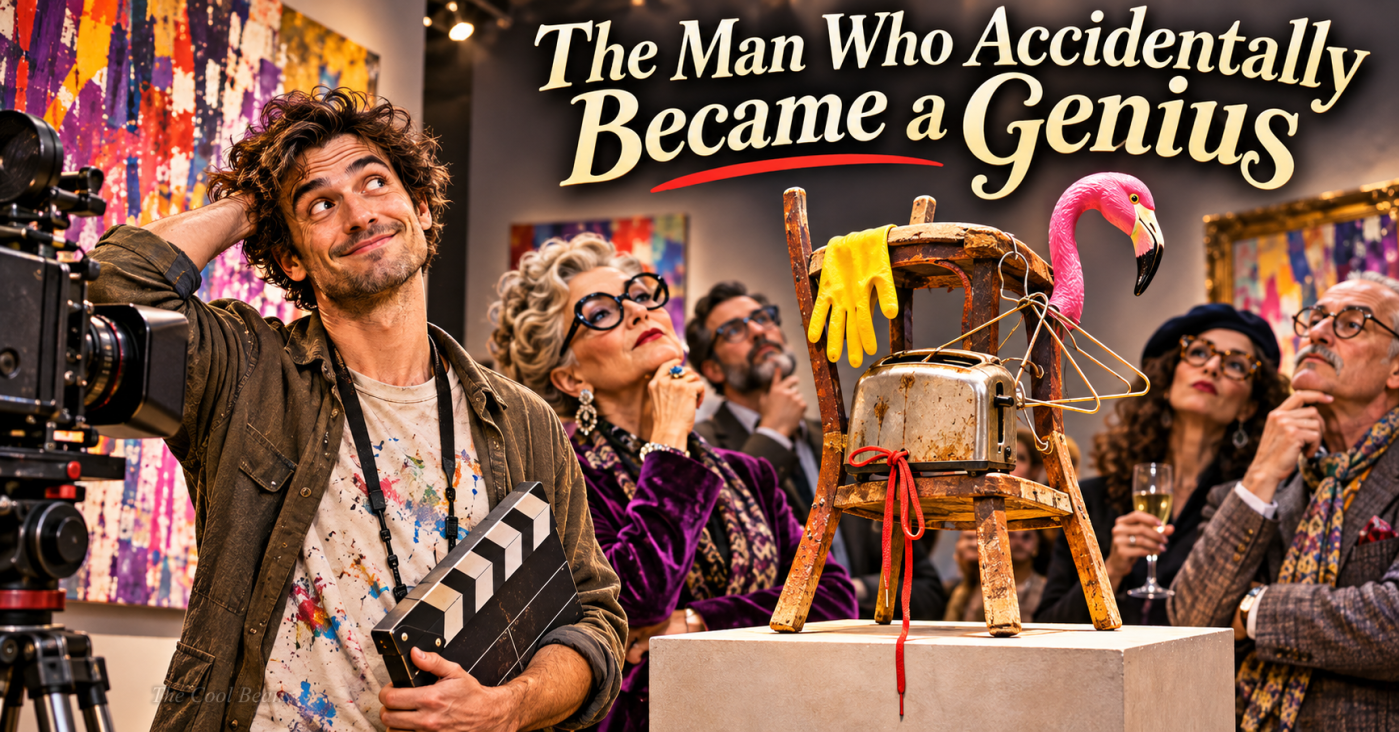
Oliver Finch had three talents: making terrible films, spending money he didn’t have, and convincing himself that everything would work out if he simply avoided thinking about it long enough.
At thirty-two, he had directed seven independent films, none of which had made a profit, received a favourable review, or been watched voluntarily by anyone outside his immediate family. His most recent production, The Last Sandwich, was a psychological thriller about a man who believed his refrigerator was trying to kill him. The film had been described by one critic as “ninety minutes of footage that appears to have been taken accidentally.”
Oliver considered this an unfair assessment. The film was only eighty-seven minutes long.
Nevertheless, he remained determined to make his masterpiece. His latest project, The Silence Between Potatoes, was an experimental drama about a lonely farmer who communicated exclusively through interpretive dance. To achieve the cinematic quality he believed the film deserved, Oliver had rented a professional camera lens worth twenty-eight thousand dollars.
The rental agreement was very clear about the consequences of losing it. Unfortunately, Oliver had not read the rental agreement. He had been too busy admiring the lens and telling the rental clerk that he was “on the verge of changing cinema forever.”
Three days later, he lost it.
The disappearance occurred during an outdoor filming session in a public park. Oliver had been attempting to capture a dramatic shot of his lead actor throwing a potato into a pond while whispering, “You were never really mine.”
A goose attacked the actor. The actor attacked the goose. Oliver dropped his equipment bag, shouted something about artistic integrity, and fled when the goose turned its attention toward him.
By the time the situation was resolved, the lens was gone.
Oliver searched the park for six hours. He questioned joggers, interrogated a gardener, and attempted to bribe the goose with a packet of crackers. Nothing worked. The lens had vanished, the rental company expected it back on Monday, and it was already Friday afternoon.
Oliver had seventy-two hours to find twenty-eight thousand dollars. He had seventeen dollars and forty-three cents in his bank account. His emergency savings consisted of a jar containing foreign coins and a button.
Things were not looking promising.
That evening, Oliver sat in his apartment contemplating the possibility of changing his name and moving to a country without extradition treaties for camera equipment.
His best friend, William, arrived carrying takeaway noodles and the expression of a man who had already endured too many of Oliver’s emergencies.
“You could tell the rental company what happened,” William suggested.
Oliver stared at him. “William, these are professionals. They expect professionalism.”
“You lost their lens because you were chased by a goose.”
“Exactly. They wouldn’t understand.”
William glanced around the apartment and suggested selling something. Oliver looked at his possessions. He owned a broken treadmill, fourteen novelty mugs, an inflatable dinosaur costume, and a collection of obscure foreign films he insisted were investments.
Then his eyes fell upon a peculiar object standing beside the kitchen window.
It was a hideous sculpture he had constructed the previous winter during what he described as “a period of emotional and financial experimentation.”
The sculpture consisted of an upside-down wooden chair, a dented toaster, a yellow rubber glove, three coat hangers, and a plastic flamingo head. Everything had been painted a particularly unpleasant shade of brown. A single red shoelace dangled from the toaster.
William followed his gaze and immediately shook his head. “No. Absolutely not.”
“Why not?” Oliver asked.
“Because that’s not art. That’s what happens when a garage explodes.”
Oliver approached the sculpture thoughtfully. “Modern art is subjective.”
“So is food poisoning. That doesn’t make it desirable.”
Oliver ignored him. He photographed the sculpture, opened an online marketplace, and created a listing advertising an original contemporary artwork for twenty-eight thousand dollars. He added that the price was firm and that only serious collectors should inquire.
William watched over his shoulder. “You’re asking twenty-eight thousand dollars for something you made out of rubbish?”
“Twenty-eight thousand, five hundred,” Oliver corrected. “I need money for gas.”
Then he pressed Post.
Neither man expected anything to happen.
By Saturday morning, Oliver had received three messages. The first asked whether the toaster still worked. The second offered him twelve dollars. The third was from Dr. Beatrice Wexley, an internationally respected art historian, consultant to several major auction houses, and one of the most influential contemporary art appraisers in Europe.
Her message contained six words.
Where did you obtain this piece?
Oliver stared at the screen before typing back, My kitchen.
A reply appeared almost immediately.
Extraordinary. May I inspect it personally?
Oliver looked at William. “Someone wants to see it.”
“Someone from a psychiatric hospital?”
“An art appraiser.”
William took the phone, read the message, and slowly lowered himself into a chair.
“Oh, this is going to be terrible.”
Dr. Wexley arrived at eleven that morning wearing an enormous silk scarf, expensive sunglasses, and the expression of a woman who had never paid full price for anything.
She entered Oliver’s apartment, ignored the furniture, and walked directly toward the sculpture. For several minutes, she said nothing. She circled it, crouched beside it, tilted her head, and eventually produced a magnifying glass.
Oliver watched anxiously as she examined every detail of his creation. Finally, she stepped backward and whispered, “My God.”
Oliver swallowed. “Is something wrong?”
She turned toward him, visibly trembling. “Do you understand what you have here?”
“A chair?”
She closed her eyes. “Precisely.”
Oliver blinked. “Precisely what?”
“The rejection of identity. The denial of function. The chair that refuses to be a chair.”
Oliver looked at the upside-down chair. “Well, yes. You can’t sit on it.”
Dr. Wexley inhaled sharply. “Brilliant.”
William, standing in the kitchen doorway, made a strangled noise.
Dr. Wexley examined the toaster next, describing it as a domestic appliance rendered impotent by its own existence and an indictment of consumer culture.
“It doesn’t work,” Oliver explained. “I dropped it.”
“Of course you did,” she replied knowingly.
She leaned closer to the rubber glove, declaring that the yellow hand represented humanity reaching toward an indifferent universe.
Oliver scratched his head. “I was going to use a blue one, but it had a hole.”
Dr. Wexley stepped backward. “A hole,” she repeated softly. “A void. An absence.”
“Well, there was a hole.”
She clasped her hands together. “This is magnificent.”
Oliver began to feel that perhaps he had misunderstood modern art his entire life.
Then came the question that changed everything.
“Tell me,” Dr. Wexley said, “is this the work of A. V. Nott?”
Oliver frowned. “Who?”
“A. V. Nott. The elusive conceptual artist. The recluse. The genius who abandoned the art world thirty years ago.”
Oliver had never heard of him. “I don’t know Nott,” he replied.
Dr. Wexley froze. “You don’t know Nott?”
“No. Not at all.”
Her eyes widened. “Not at all,” she whispered. “Of course.”
She reached for her phone, her hands trembling with excitement.
“It’s the title!”
Oliver stared at her. “What?”
“Not at All. The legendary missing piece. Mentioned in Nott’s correspondence but never publicly exhibited. Scholars have searched for it for decades.”
Oliver opened his mouth to explain that he had absolutely no idea what she was talking about. From the kitchen, William shook his head violently.
Oliver closed his mouth.
Dr. Wexley pointed at the red shoelace dangling from the toaster. “And this confirms it. Nott frequently incorporated red thread to symbolize humanity’s fragile attachment to meaning.”
Oliver looked at the shoelace. He had used it because he couldn’t find any string.
“Where did you acquire it?” she demanded.
Oliver hesitated before explaining that it had been sitting in his apartment for a while. When she pressed him for a more precise answer, he shrugged and said it felt like forever.
Dr. Wexley pressed a hand to her chest. “Hidden in plain sight. All these years.”
Oliver realized he was standing at a crossroads. One direction led toward honesty, financial ruin, and an extremely unpleasant conversation with a camera rental company. The other direction led toward twenty-eight thousand dollars.
He chose the second direction.
“It’s a complicated story,” he said.
Dr. Wexley nodded solemnly. “The best ones always are.”
By Sunday morning, Oliver Finch was famous.
Or rather, his sculpture was famous.
Dr. Wexley had posted a photograph online with the caption:
After decades of speculation, I believe the lost A. V. Nott masterpiece Not at All has finally resurfaced. An extraordinary moment in contemporary art history.
The photograph spread across social media. Art critics began arguing about the symbolism of the rubber glove. A university professor published a lengthy essay explaining that the toaster represented “the collapse of Western domestic certainty.”
An influential art magazine called the sculpture “a brutal, uncompromising confrontation with the absurdity of existence.”
William read the article aloud while Oliver sat on the sofa eating cereal.
“That’s impressive,” William said. “Your toaster has apparently destroyed capitalism.”
Oliver nodded thoughtfully. “It always was temperamental.”
By Sunday afternoon, Dr. Wexley had arranged a private sale to a wealthy collector for eighty-five thousand dollars.
Oliver nearly swallowed his spoon.
“Eighty-five thousand?”
“An absolute bargain,” she assured him. “If authenticated, its cultural significance is incalculable.”
“But I only wanted twenty-eight thousand.”
She smiled. “How refreshingly uninterested in money.”
Oliver tried to explain that he was extremely interested in money, but she interrupted to ask whether he was Nott’s representative, a relative, or perhaps a disciple.
Oliver denied all three possibilities.
Dr. Wexley studied him carefully. “Then what is your relationship to the artist?”
Oliver panicked. “I’m just the person who made the thing.”
Silence filled the room.
Dr. Wexley slowly removed her glasses.
“You?”
Oliver realized what he had said. “Yes, but—”
“You are A. V. Nott?”
“No, I’m—”
She seized his hands.
“All these years. Living anonymously. Refusing recognition. Rejecting the machinery of fame.”
“Actually, I make films.”
“Moving images,” she murmured. “Of course. Your art has evolved.”
“Bad films.”
“Deliberately bad?”
“Apparently.”
Her face lit up. “Anti-cinema!”
Oliver closed his eyes. Somewhere behind him, William began laughing so hard he had to leave the room.
Within forty-eight hours, Oliver’s life had become unrecognizable.
Dr. Wexley announced that the mysterious A. V. Nott had been living under the assumed name Oliver Finch, secretly creating experimental films as part of a decades-long artistic performance.
Nobody questioned how a thirty-two-year-old man could have begun his artistic career thirty years earlier. One critic called it “a radical rejection of chronological certainty.” Another suggested Oliver had deliberately falsified his age to challenge society’s obsession with time.
A third wrote an entire article arguing that Oliver might not exist at all.
Oliver attempted to correct this during a television interview.
“I’m definitely real,” he said.
The interviewer nodded knowingly. “And yet, what is reality?”
Oliver looked directly into the camera. “I have a dentist.”
The clip went viral.
Art students began wearing T-shirts reading I HAVE A DENTIST.
Within a week, Oliver had sold the sculpture, paid the rental company for the missing lens, and deposited enough money into his account to avoid financial catastrophe.
He should have stopped there.
Unfortunately, Dr. Wexley had other plans.
She wanted an exhibition.
A major London gallery had offered Oliver a solo show titled The Silence of Objects: Thirty Years of Nott.
There was one small problem.
Oliver had no other art.
Dr. Wexley considered this a minor inconvenience. She insisted that he must have something hidden away, perhaps sketches, sculptures, or unfinished experiments.
Oliver looked around his apartment. There was a cracked mirror in the hallway, a lamp without a shade, a broken vacuum cleaner, and a cardboard box containing old takeaway menus.
He cleared his throat. “I’ve got a few things.”
Three weeks later, the exhibition opened.
The cracked mirror was displayed beneath the title The Fractured Self. The lamp without a shade became Illumination Denied. The broken vacuum cleaner was renamed The Consumption of Emptiness.
The takeaway menus were arranged in a glass case and labelled The Last Supper, Reconsidered.
A gallery visitor stood in front of the vacuum cleaner for twenty minutes before declaring that it had made her reconsider her relationship with her mother.
Oliver, who had been hiding behind a pillar, was deeply concerned.
Meanwhile, his artistic persona was becoming increasingly difficult to maintain.
Dr. Wexley advised him to speak less during interviews, explaining that his silence was his greatest strength.
Oliver considered this excellent advice.
Unfortunately, silence only made him more fascinating.
At an exhibition dinner, a collector asked what inspired his work. Oliver, exhausted, replied that he didn’t know and simply made things up.
The collector gasped. “Art as pure invention. How liberating.”
Another guest asked why he had chosen to use discarded objects.
“Because I couldn’t afford anything else,” Oliver explained.
A critic immediately wrote down the sentence and whispered something about poverty as an aesthetic resistance to consumerism.
Someone else asked why Oliver rarely smiled in public.
“Because I’m terrified.”
“Ah,” said the woman. “The burden of genius.”
Oliver began to suspect that he could announce he was a potato and someone would call it revolutionary.
He tested the theory.
During a radio interview, he declared, “I am a potato.”
The next morning, a newspaper published the headline:
NOTT REJECTS HUMAN IDENTITY IN STUNNING EXISTENTIAL STATEMENT.
The phrase appeared on tote bags by lunchtime.
William found the whole situation delightful.
“You’ve done it,” he said one evening. “You’ve finally become successful by being completely incompetent.”
Oliver stared at him. “I’ve been successful at being incompetent for years.”
“Yes, but now people are paying you.”
The trouble began when a documentary filmmaker named Harriet Cross announced that she was producing a film about the mysterious A. V. Nott.
Harriet was intelligent, persistent, and entirely unimpressed by expensive scarves.
She began researching the artist’s supposed history. Within two days, she discovered that there were no reliable photographs of Nott before Oliver’s sudden appearance. Within three days, she found that the original sculpture contained a toaster manufactured only four years earlier.
Within four days, she learned that Oliver had purchased the plastic flamingo head from a discount shop the previous Christmas.
And on the fifth day, she arrived at his apartment carrying a folder.
“Mr. Finch,” she said pleasantly, “I believe you’re a fraud.”
Oliver looked at the folder, then at Harriet, and finally at William, who was sitting on the sofa eating crisps.
“Can you be more specific?” Oliver asked.
Harriet laid the evidence on the table. She explained the dates, the materials, the impossible chronology, and the inconsistencies in Dr. Wexley’s claims.
Oliver listened in silence.
When she finished, he sighed. “You’re right.”
Harriet blinked. “I am?”
“Yes.”
She had expected denials, legal threats, perhaps a dramatic confrontation. Instead, Oliver offered her tea.
“I made the sculpture because I needed money,” he admitted. “I lost a camera lens. A very expensive camera lens. I thought if I sold something, I could replace it.”
Harriet stared at him. “You’re telling me this entire international art sensation began because you lost a lens?”
“Yes.”
“And you made the sculpture yourself? Out of rubbish?”
“Mostly.”
“And you allowed everyone to believe you were a legendary reclusive artist?”
Oliver considered this. “I tried to tell them I wasn’t.”
“Did you?”
“I told one interviewer I was a potato.”
Harriet slowly lowered her pen.
William began laughing again.
Harriet spent the next hour listening to the entire ridiculous story. By the time Oliver finished, she was laughing too.
Then she asked a question that changed everything.
“Have you recorded any of this?”
Oliver looked puzzled. “Recorded what?”
“The exhibitions. The interviews. The critics. The people explaining the meaning of your toaster.”
Oliver nodded. “Of course. I’m a filmmaker. I film everything.”
Harriet leaned forward. “Oliver, do you realize what you’ve got?”
“A criminal record waiting to happen?”
“No. You’ve got the greatest documentary about the modern art world that anyone has ever accidentally made.”
Oliver stared at her.
For the first time in his career, someone had called his footage valuable without being related to him.
Together, they made a plan. At the closing night of his exhibition, Oliver would reveal the truth. Harriet would film everything, Dr. Wexley would be furious, the collectors would be furious, and the art critics would probably require medical attention.
Oliver would finally be free.
The night arrived.
The gallery was packed with wealthy collectors, journalists, critics, celebrities, and several people who appeared to have dressed themselves during a power cut.
Oliver stood before the crowd wearing a black turtleneck that Dr. Wexley had insisted made him look “artistically unavailable.”
Behind him stood his latest work.
It was an empty pedestal.
The gallery had titled it The Weight of Absence.
In reality, Oliver had forgotten to bring the sculpture.
He stepped toward the microphone.
“Ladies and gentlemen, I have something to confess.”
The room fell silent.
“I am not A. V. Nott.”
A murmur passed through the audience.
“I have never studied art. I have no artistic philosophy. I made the original sculpture out of rubbish because I needed twenty-eight thousand dollars to replace a camera lens I lost while being attacked by a goose.”
Nobody moved.
Oliver continued, explaining that the toaster was broken, the glove was yellow because the blue one had a hole, and the red shoelace was simply a shoelace. He informed the audience that the vacuum cleaner in the next room did not represent consumerism. It had stopped working in March.
“I’ve been pretending to be a genius because every time I told the truth, someone decided it was a metaphor.”
There was a long, terrible silence.
Then an elderly critic in the front row began to clap.
Slowly.
Deliberately.
“Oh, magnificent,” he whispered.
Oliver froze.
Another critic stood. “An artist exposing the artificiality of artistic identity!”
A woman gasped. “He’s dismantling the very institution that celebrates him!”
Someone shouted, “The goose represents capitalism!”
Oliver gripped the microphone.
“No! The goose was an actual goose!”
The audience erupted into applause.
Dr. Wexley, standing near the front, pressed a hand to her heart.
“His greatest performance yet,” she murmured.
Oliver stared helplessly at the cheering crowd. He had confessed everything, and somehow, it had made him even more famous.
Harriet captured the entire disaster on film.
Six months later, their documentary, I Am Not a Potato, premiered at an international film festival.
It was funny, uncomfortable, ridiculous, and unexpectedly moving. It explored how easily people could mistake confidence for expertise, how money shaped cultural value, and how desperately human beings wanted ordinary things to possess extraordinary meaning.
For once, Oliver had made something genuinely good.
The documentary won three awards. Critics praised its humour, honesty, and remarkable insight. Oliver received offers to direct major productions and an invitation to lecture at an art university.
He declined the lecture.
“I think I’ve done enough damage to education,” he told William.
The original sculpture eventually sold again at auction.
This time, the buyer paid four hundred and sixty thousand dollars.
Oliver watched the sale on television from his apartment while William sat beside him, staring at the screen in disbelief.
“Four hundred and sixty thousand,” William repeated. “For a broken toaster.”
Oliver nodded. “Apparently.”
“Does that bother you?”
“A little.”
William considered this before asking whether Oliver had ever thought about making another sculpture.
Oliver shook his head. “Absolutely not. I’m concentrating on filmmaking.”
“Good. What’s your next project?”
Oliver smiled. “A psychological thriller about a man who becomes convinced that his microwave is communicating with the dead.”
William closed his eyes. “Oh, for God’s sake.”
Oliver leaned forward enthusiastically. “There’s a twist. The microwave is actually his father.”
William stood up. “I’m going home.”
But just as he reached the door, Oliver’s phone rang.
It was the rental company.
The manager sounded confused.
“Mr. Finch? You rented a twenty-eight-thousand-dollar camera lens from us several months ago?”
Oliver stiffened. “Yes?”
“Well, we’ve been doing some inventory. It appears you returned a camera bag containing a rubber chicken, two potatoes, and a handwritten note saying, ‘Sorry about the goose.’”
Oliver closed his eyes. “Right.”
“We were going to call you earlier, but something rather strange happened.”
Oliver felt a familiar sense of dread. “What happened?”
“The original lens turned up.”
Oliver sat bolt upright.
“WHAT?”
“It was in a box of equipment recovered from the park. Apparently, a groundskeeper found it the day after your shoot and sent it to our storage department. Nobody checked the box until yesterday.”
Oliver was silent.
The manager continued, explaining that the lens was in perfect condition and that the company would be refunding his replacement payment, less the late fees.
Oliver stared at the wall.
He had spent months lying to the international art world, impersonating a legendary genius, and destroying his reputation as a filmmaker only to discover that the lens had been sitting safely in a storage room the entire time.
William noticed his expression.
“What?”
Oliver lowered the phone.
“They found the lens.”
William stared at him.
Then he sat down.
Then he began laughing.
He laughed so hard that tears rolled down his face. Oliver watched him for a moment before joining in, and soon both men were laughing until neither could breathe.
Finally, William wiped his eyes.
“Well,” he said, “at least it all worked out.”
Oliver nodded. “Yes. I suppose it did.”
Then his phone buzzed with a new email.
It was from Dr. Beatrice Wexley.
Darling Oliver, wonderful news! The Museum of Modern Art wishes to acquire your latest piece, The Weight of Absence. Their opening offer is six hundred thousand dollars.
Oliver stared at the message.
William leaned over his shoulder.
“Isn’t that the empty pedestal?”
“Yes.”
“The one you forgot to put anything on?”
“Yes.”
William slowly stood up, walked to the kitchen, opened a cupboard, and removed an empty cereal box.
He placed it on the table and looked Oliver directly in the eyes.
“How much,” he asked, “do you think we could get for this?”
Oliver studied the box.
Then he smiled.
“William,” he said solemnly, “it’s not about the money.”
William nodded. “Of course not.”
“It’s about challenging society’s relationship with breakfast.”
And somewhere in London, without knowing why, Dr. Beatrice Wexley felt a sudden, overwhelming urge to applaud.
💜 Enjoying the chaos that is my life? Subscribe to The Cool Beans! It’s cheaper than therapy and slightly more organized 🤣


Leave a Reply