The first star Dr. Elena Ramos ever loved was not the brightest in the sky, nor the most beautiful. It was a tiny point of light she discovered through her grandfather’s battered telescope when she was seven years old, standing barefoot in the grass behind his farmhouse. She had spent nearly an hour trying to find it, squinting through the eyepiece while her grandfather patiently adjusted the telescope. When the little star finally appeared, she gasped so loudly that a nearby owl took flight from the barn roof. “There it is!” she cried excitedly. Her grandfather chuckled and placed a gentle hand on her shoulder. “Funny thing about stars, Ellie. They’ve been there all along. Sometimes we just need a different way to find them.” Sixty years later, Elena would remember those words with a clarity that her eyesight could no longer provide.
At sixty-seven, Elena had spent most of her adult life studying the heavens. She had worked at observatories, published papers about distant galaxies, and taught thousands of university students how to recognize the constellations. She could identify nearly every major star in the northern sky, and she had once navigated her way through a power outage simply by looking upward. The universe had always been her greatest love, a source of endless fascination that had carried her through heartbreak, loneliness, and the ordinary disappointments of life. No matter what happened on Earth, she had always found comfort in the stars. And now, slowly and relentlessly, they were disappearing from her view.
The diagnosis had come three years earlier. A progressive retinal condition was stealing her vision, leaving patches of darkness where details had once been sharp. At first, she struggled to read the small numbers on telescope instruments. Then the stars began to blur together, their once-distinct points of light becoming faint, indistinguishable smudges. Eventually, even the familiar outline of Orion became difficult to recognize. Her doctors could not tell her precisely how much useful vision she would retain, only that she would need to prepare for significant changes. Elena accepted the news with the same determination she had brought to every difficult problem in her career, but accepting something intellectually and making peace with it emotionally were two very different things. Some evenings, she sat alone in her garden, staring upward at a sky she could remember better than she could see. She was not afraid of darkness itself. She was afraid of losing something that had helped her understand who she was.
Then, one rainy Thursday afternoon, a little girl named Cecilly changed everything. Cecilly was nine years old and had been blind since birth. She arrived at the university observatory with a group of children from a local school that specialized in accessible education. Elena had agreed to give them a tour, although she privately wondered how much of the observatory’s usual presentation would be meaningful to children who could not see its enormous photographs and projected star charts. The other children explored the equipment with the help of their teachers, asking questions about telescopes, planets, and astronauts. Cecilly, however, remained beside a large framed photograph of the Andromeda Galaxy, listening carefully as Elena described the swirling collection of stars.
“Dr. Ramos?” Cecilly asked, raising her hand slightly. Elena turned toward her and smiled. “Yes, sweetheart?” The little girl tilted her head thoughtfully. “What does a galaxy feel like?” Elena hesitated. She had answered thousands of questions about galaxies and could explain their formation, gravitational interactions, composition, and astonishing distances from Earth. She could describe the Andromeda Galaxy as a vast collection of stars more than two million light-years away, but nobody had ever asked her what one felt like. “Well,” Elena began carefully, “a galaxy doesn’t really have a texture the way a stone or a leaf does.” Cecilly nodded patiently. “I know. But if you could make one that I could touch, what would it feel like?” Elena looked at the photograph and then back at the little girl standing beside her. For the first time in months, she stopped thinking about the stars she was losing and began imagining the stars she might help someone else discover.
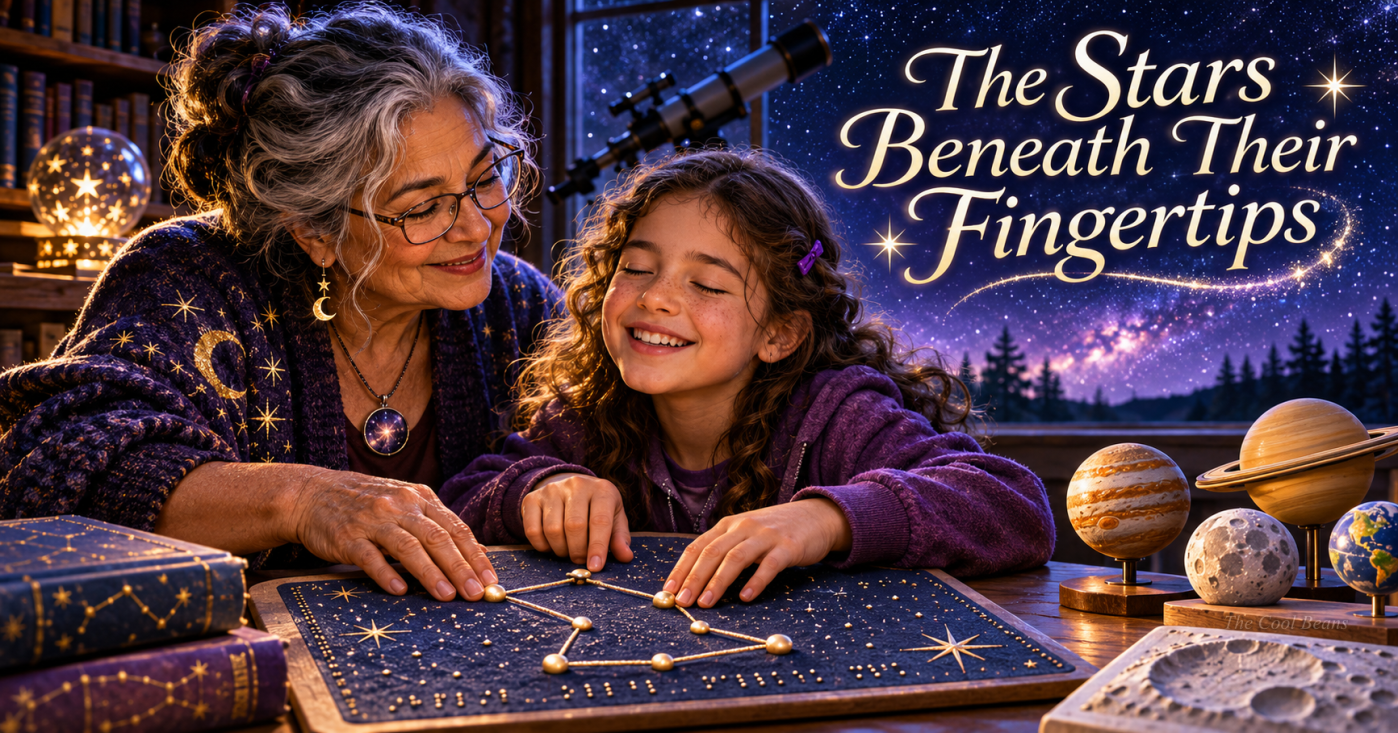
That evening, Elena went home and emptied her kitchen table. Out came cardboard, string, glue, wooden beads, modeling clay, and a collection of buttons she had saved for reasons she could no longer remember. She found a thick piece of foam board and carefully arranged seven wooden beads into the familiar pattern of the Big Dipper. She used larger beads for brighter stars and smaller ones for fainter stars, connecting the points with thin lengths of cord that could be followed with fingertips. It was crude, the spacing was imperfect, and the glue dried in ugly little lumps, but when Elena closed her eyes and ran her fingers across the board, she felt the shape of the constellation emerge beneath her hands. She smiled, then laughed, and for the first time since her diagnosis, she stayed awake all night because she was excited rather than frightened. By morning, she had made Orion, Cassiopeia, and the Northern Cross. By the end of the week, her dining room looked as though a craft store had exploded inside an astronomy department.
Her neighbour, Thomas, discovered the project when he stopped by with a loaf of banana bread. He surveyed the beads, wires, sheets of plastic, and scraps of textured paper scattered across every available surface before asking cautiously whether she had taken up jewelry making. Elena barely glanced up from her work. “I’m building the universe,” she replied. Thomas considered this for a moment, then placed the banana bread on the only clear corner of the table. “Right. Well, in that case, I’ve brought carbohydrates. You’ll need them.” Elena laughed so hard that she nearly knocked over a container of wooden stars. It felt wonderful to laugh about something that had begun with such a frightening diagnosis.
A few days later, Elena invited Cecilly and several other students to test her first collection of tactile star maps. She expected polite interest and perhaps a few encouraging comments, but instead, she received an education. One boy complained that the connecting lines were too thick, while another pointed out that some of the beads felt too similar. Cecilly immediately asked why the maps had no Braille labels, and a girl named Maya wondered whether she could learn how far away the stars were rather than simply where they appeared in the sky. Elena listened to every suggestion, taking careful notes and asking the children to explain what worked and what did not. She had spent decades teaching astronomy, but now she was learning how to teach it differently, and she found herself enjoying the challenge more than anything she had done in years.
Working with blind educators, accessibility specialists, and the children themselves, Elena began designing a collection of tactile astronomy materials. Raised dots represented stars, with different sizes indicating their apparent brightness, while thin ridges traced the traditional constellation patterns. Braille labels identified important stars, and textured backgrounds distinguished different regions of the sky. She developed separate models exploring the enormous distances between stars, explaining that the familiar constellations were patterns seen from Earth rather than groups of stars necessarily close together in space. The children helped her discover which designs were easiest to understand, and their feedback became just as important as her astronomical knowledge. Elena called the project The Sky Beneath Your Fingers, a name Cecilly had suggested during one of their afternoon testing sessions.
At first, the project occupied only Elena’s dining room, but it soon spread into the spare bedroom, the hallway, and eventually the kitchen. Thomas finally suggested that perhaps the universe required a larger address after opening a cupboard and discovering three models of Saturn where the drinking glasses should have been. Elena reluctantly admitted he had a point. She approached the public library with a proposal to create a permanent collection of accessible star maps, tactile planetary models, Braille astronomy guides, and audio descriptions that children could borrow just like ordinary books. The library director, Mrs. Bennett, listened carefully before explaining that their budget was already stretched. Elena had expected that response and immediately offered to raise the money herself. Mrs. Bennett smiled, glanced at the detailed plans spread across her desk, and replied that in that case, they had better find some shelves.
Elena had never been particularly comfortable asking people for donations. She could lecture confidently about black holes to an auditorium of five hundred people, but asking a local business for twenty dollars made her feel like a schoolgirl selling chocolate bars. Fortunately, she had spent forty years making friends in the scientific community. Former students contributed money and expertise, astronomers donated equipment, and a local engineering company offered access to its 3D printers. Volunteers helped produce Braille labels and assemble the models, while the university supplied unused display cases. Thomas organized a fundraising bake sale, although his first attempt at star-shaped cookies produced something resembling potatoes. When Elena pointed this out, he proudly announced that they were celestial potatoes, an extremely rare phenomenon visible only during a total eclipse of common sense. The cookies sold out before lunchtime.
Within six months, the project had grown into something Elena had barely dared to imagine. There were tactile maps of the northern and southern skies, models of the Moon’s craters, raised diagrams of Saturn’s rings, and three-dimensional representations of the solar system. Each model was accompanied by accessible explanations, and the collection was designed for children with different combinations of vision, hearing, and learning needs. Elena wanted the library to be a place where no child felt excluded from the wonders of astronomy, regardless of how they experienced the world. She insisted that every design be tested by the people who would actually use it, believing that accessibility should never be an afterthought.
Her favourite creation was a large circular star map that could be rotated to represent the changing night sky throughout the year. She spent weeks developing it with a young engineer named Derek, who had once been her student. When he brought the finished model to her house, Elena carefully ran her fingers around its edge, following the raised patterns and recognizing the familiar constellations. “You’ve made it beautiful,” she whispered. Derek smiled and told her she had not even experienced the best part yet. He guided her hand toward a small switch, and when Elena pressed it, a gentle voice began describing the position of the stars for that evening. She laughed in astonishment, delighted by the unexpected addition. “Oh, Derek. You’ve given the sky a voice.” He shook his head and smiled. “No, Professor. You just helped us find another way to listen.”
As the library’s opening approached, Elena’s eyesight continued to deteriorate. Reading became increasingly difficult, and she began using screen-reading software for most of her correspondence. She learned new techniques for navigating her home, organizing her work, and carrying out the daily tasks that had once required little thought. Some days were frustrating, while others left her completely exhausted. There were moments when she grieved the ease with which she had once moved through the visual world, and she allowed herself to acknowledge that grief rather than pretending it did not exist. But she was no longer facing those changes alone. The project had brought new friendships into her life, and the children she had originally hoped to teach had become some of her greatest teachers.
Cecilly visited regularly, sometimes to test new models and sometimes simply to share a biscuit and discuss the universe. One afternoon, Elena admitted that she could no longer clearly see the stars outside her bedroom window. Cecilly grew quiet before asking whether that made her sad. Elena considered the question carefully and answered that sometimes it did. Cecilly sat beside her for a moment, thinking. “I’ve never seen them,” she said softly, “but I still love them.” Elena reached for her hand and told her that she knew. Cecilly squeezed her fingers before adding, “Then maybe you can love them without seeing them too.” Elena felt tears gathering in her eyes. She had spent three years believing that her relationship with the universe was coming to an end, and a nine-year-old girl had just reminded her that love did not depend on sight.
The library opened on a bright Saturday morning in early October. Elena had expected a modest gathering of students, teachers, and a few local families, but instead, the building was overflowing. Children arrived with parents, grandparents, siblings, and friends. Some used white canes, others had low vision or additional disabilities, and many were fully sighted children who simply wanted to explore the stars in a new way. The collection had been designed to welcome all of them. At the centre of the room stood the rotating star map, surrounded by shelves of tactile books and models. Above the entrance hung a large sign bearing the words, “The Sky Beneath Your Fingers — The Universe Belongs to Everyone.”
Elena stood beside the display, gripping the edge of a table as Mrs. Bennett introduced her. She had delivered speeches at international conferences and addressed audiences of distinguished scientists, but never had she felt so nervous. When the applause faded, she stepped forward and began to speak. “Most of my life, I’ve believed that the greatest gift astronomy could offer was the opportunity to see something extraordinary. But I was wrong. The greatest gift astronomy offers is wonder, and wonder doesn’t belong to any one sense. It belongs to anyone who has ever asked what lies beyond the world they know.” She paused, gathering her emotions before continuing. “When I began losing my sight, I thought I was losing the stars. But these children taught me something I should have understood long ago. The universe is not something we own because we can see it. It is something we explore because we are curious.”
Elena turned toward the children gathered around the displays and smiled. She told them that the library belonged to them, encouraging them to ask questions, make discoveries, and point out anything that needed improvement. Most importantly, she asked them never to let anyone convince them that the stars were beyond their reach. The applause was louder than she expected, but it was what happened afterward that she would remember most. A little boy named Oliver approached the model of Orion. He was six years old and had very limited vision. His mother helped him find the first raised star, and Elena gently guided his hand toward the next. Oliver followed the line of the constellation with his fingertips, moving from one star to another until he reached the three stars representing Orion’s Belt.
“Wait,” Oliver exclaimed. “I know this one!” His mother smiled and asked if he was certain. “Yes! It’s the hunter!” he announced proudly. He continued exploring the pattern, tracing the raised lines until he reached the final star, then turned toward Elena and asked whether he could show his father. Elena swallowed the lump forming in her throat and told him that of course he could. Oliver hurried away, calling excitedly for his dad, and Elena realized that this was the moment she had been working toward. Not the opening ceremony, the speeches, the newspaper photographs, or the donations. A little boy had discovered a constellation and wanted to share it with someone he loved. That was everything.
Over the following years, The Sky Beneath Your Fingers expanded beyond the original library. Schools requested copies of the models, museums incorporated tactile astronomy into their exhibits, and volunteers translated the accompanying materials into additional languages. Libraries in other communities began developing their own collections, often working with local children and accessibility advocates to ensure the materials met their needs. Elena continued contributing as her vision changed, using accessible technology and collaborating with the growing team of people who had joined the project. She was no longer its only designer, and she preferred it that way. The library had become something far greater than one woman’s idea. It had become a shared effort to make the universe more accessible.
Cecilly grew up alongside the project, becoming one of its most enthusiastic young advisers. By thirteen, she was helping younger children learn the constellations, and by sixteen, she was giving presentations about accessible science education. When she announced that she wanted to study astrophysics, Elena nearly dropped her teacup. She asked whether Cecilly was absolutely certain, and the teenager laughed before explaining that someone would have to take over when Elena retired. “Retire?” Elena repeated indignantly. “I’m only seventy-four!” Cecilly grinned and replied that this was exactly her point, because Elena was practically ancient. Thomas, listening from the kitchen, nearly choked on one of his infamous celestial-potato biscuits.
One winter evening, several years after the library opened, Elena sat in her garden beneath a clear, cold sky. Her vision had diminished considerably, and she could no longer make out the familiar patterns of the constellations overhead. But she knew they were there. On the table beside her lay a small tactile map of the winter sky, one of the earliest models she had made. Its edges were worn smooth from years of handling, and one of the stars had been repaired with a slightly mismatched bead. Elena ran her fingertips across Orion, tracing Betelgeuse, Bellatrix, the three stars of the Belt, and finally Rigel. She remembered seeing them through her grandfather’s telescope, remembered the cold grass beneath her feet, and remembered the excitement of discovering something impossibly distant.
The garden gate clicked open, and Cecilly called out a greeting. She was now a university student and had arrived carrying a thermos of hot chocolate and a small package wrapped in blue paper. Elena welcomed her warmly, delighted by the unexpected visit. Cecilly handed her the package and explained that she had brought something special. Inside was a new tactile star map. Elena traced the raised dots, recognizing the familiar pattern of Cassiopeia, but beneath the constellation was a small Braille inscription. She read it slowly with her fingertips, following each word until the message became clear. “For the woman who taught me that the sky has no limits.” Elena was silent for a long moment before reaching for Cecilly and pulling her into a tight embrace.
Above them, the winter stars shone in their familiar places, indifferent to the passing of years and the small dramas unfolding on a planet unimaginably far below. But in one little garden, two women sat together beneath that enormous sky, sharing hot chocolate and talking about galaxies. One had spent a lifetime studying the universe through telescopes, while the other had first discovered its patterns beneath her fingertips. Neither needed to see the stars to know how beautiful they were. Their shared love of astronomy had created a friendship that stretched across generations, reminding Elena that even when life changed in ways she had never expected, there were still extraordinary things waiting to be discovered.
Across the country, children were opening books, exploring raised constellations, and discovering that the heavens were not distant, untouchable mysteries reserved for those who could look upward. They were places of wonder that belonged to everyone. Some children were learning the shapes of the constellations for the first time, while others were discovering the craters of the Moon, the rings of Saturn, or the enormous distances separating the stars. Each new discovery carried a little piece of Elena’s original dream, but it also belonged to the countless people who had helped bring the library to life.
As the evening grew colder, Elena tilted her face toward the sky and smiled. She thought of her grandfather, of the little farmhouse, and of the night she had first discovered a tiny star through his battered telescope. She remembered his gentle voice telling her that the stars had been there all along and that sometimes people simply needed a different way to find them. For so many years, she had believed those words referred only to patience, curiosity, and the determination to keep searching. Now she understood that they meant something much greater.
Elena had once feared that losing her eyesight would mean losing the universe she loved. Instead, she had discovered that her passion for the stars could grow beyond the boundaries of her own experience. What began as a desperate attempt to hold on to something precious had become a gift that would continue reaching children long after her own hands could no longer build the models. Through the gentle movement of curious fingers across thousands of little points of light, she had helped create a world in which more children could experience the wonder of the heavens.
And as Cecilly sat beside her, describing the brilliant winter sky above their heads, Elena realized that she had never truly lost the stars. They were still there in her memories, in the stories she told, in the models she helped create, and in the excitement of every child who discovered a constellation for the first time. They lived in the laughter of a little boy showing his father Orion, in the questions of young scientists, and in the dreams of a girl who had once asked what a galaxy might feel like.
The stars had been there all along. Sometimes, people simply needed a different way to find them.
And Elena Ramos had spent the most meaningful years of her life making sure that everyone had the chance.
Enjoying what you find here? 💜 Consider subscribing and becoming part of our little community. It’s a simple way to stay connected, support what we do, and make sure you don’t miss what’s coming next. We’d truly love to have you here. 🌿✨


Leave a Reply