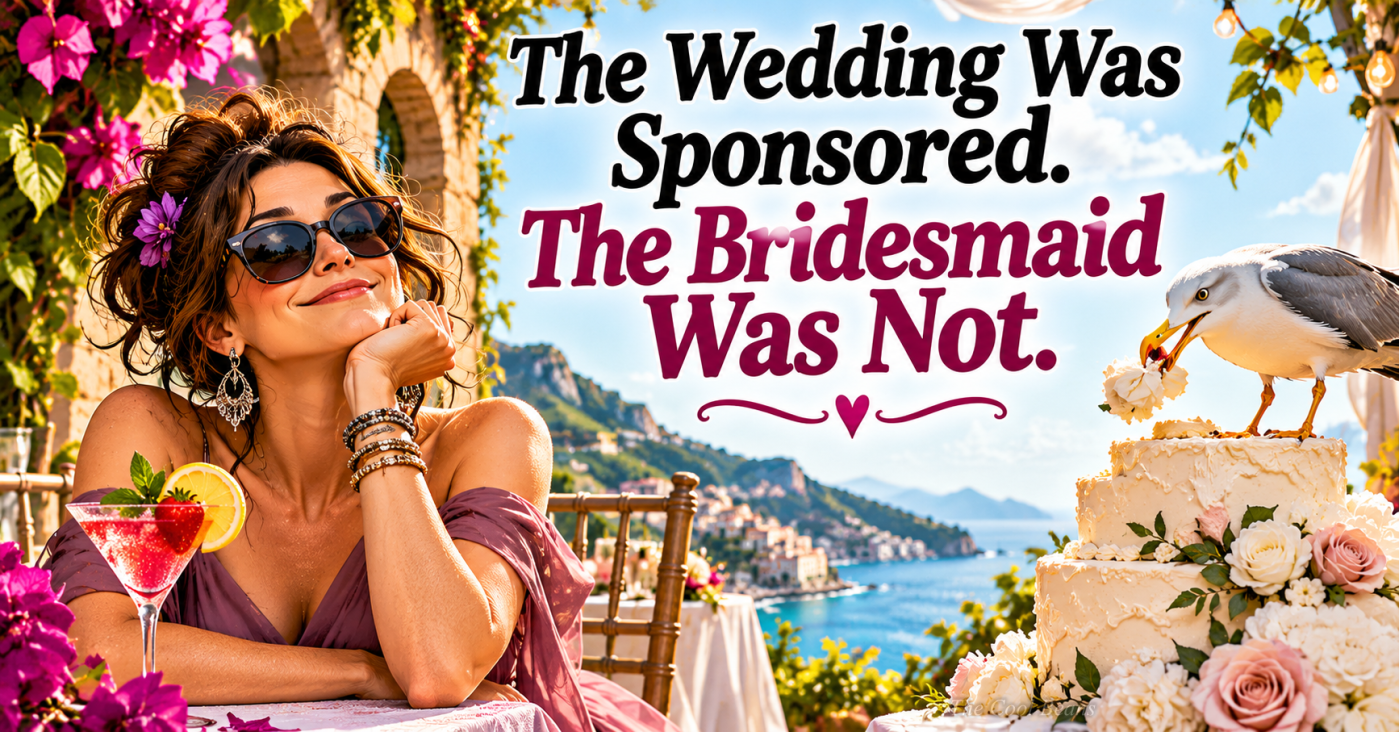
By the time Nina Caldwell arrived at the airport, she had already spent $2,400 on a wedding she wasn’t particularly excited about attending, purchased a bridesmaid dress in a colour best described as “depressed oatmeal,” and received seventeen emails explaining how to behave naturally in photographs. The bride, Marlowe Kensington, had been Nina’s best friend since university, back when Marlowe ate instant noodles, wore mismatched socks, and considered a night out successful if nobody lost their shoes. Somewhere between her twenty-eighth birthday and her engagement to a man named Preston, however, Marlowe had transformed into a lifestyle influencer whose entire personality appeared to have been assembled from Pinterest boards and sponsored skincare products.
Her wedding was taking place at an exclusive villa on the Amalfi Coast in Italy. According to the official wedding website, the four-day celebration would be “an immersive journey through intentional romance, curated connection, and elevated Mediterranean authenticity.” According to Nina, it was going to be four days of expensive bullshit with a sea view. The first warning sign came when Nina received the wedding itinerary, a thirty-seven-page PDF titled The Kensington Love Experience: A Celebration of Timeless Togetherness. It included approved colour palettes, mandatory outfit changes, designated photo opportunities, and an entire page explaining why guests should avoid wearing bright colours. “Vibrant clothing can disrupt the visual harmony of our shared memories,” the document explained. Nina stared at the sentence for several seconds before texting her sister that apparently, her personality clashed with the centrepieces. Her sister replied immediately, advising her to try not to get arrested. Nina considered that an unreasonable restriction.
Upon arriving at the villa, she discovered that Marlowe had hired a wedding content director named Aspen, a woman whose eyebrows appeared permanently raised in judgment. Aspen wore a headset, carried three phones, and referred to ordinary human activities as “moments.” Eating breakfast was a “nourishment moment,” walking through a doorway was a “transition moment,” and hugging another person was a “connection opportunity.” Nina asked whether using the bathroom qualified as a “private release moment.” Aspen did not laugh, which immediately placed her at the top of Nina’s list of people she hoped would accidentally fall into a decorative fountain.
The villa itself was breathtaking, with terracotta rooftops, lemon groves, flowering balconies, and a panoramic view of the Mediterranean Sea. Unfortunately, Marlowe had decided that nature’s existing colour scheme was insufficiently sophisticated. Every available surface had been decorated in shades of cream, ivory, sand, champagne, taupe, and something called “whispering almond.” There were beige flowers, beige candles, beige tablecloths, beige cushions, and beige decorative lemons. Nina picked up one of the artificial lemons and examined it with genuine concern. “Did someone drain the happiness out of this fruit?” she asked. A passing florist gave her a sympathetic look and explained that the bride had requested neutral citrus. Nina nodded solemnly. “Of course she did. Wouldn’t want the lemons showing off.”
The welcome dinner began at six, although guests were instructed to arrive at five-fifteen for “organic pre-dinner mingling.” Nina discovered that organic mingling involved standing in predetermined groups while a photographer instructed everyone to laugh at absolutely nothing. When Aspen called out for some genuine joy, Nina turned to the man beside her and whispered, “Quick. Tell me something funny before she has us euthanized for poor engagement.” The man snorted into his champagne, earning them both a disapproving glare from Aspen. Nina considered it her first successful social interaction of the evening.
Marlowe made her grand entrance wearing a white silk dress that cost more than Nina’s first car. Preston followed three steps behind, carrying her phone, a portable charger, and the exhausted expression of a man who had recently learned that marriage involved lighting equipment. Marlowe embraced Nina carefully, making sure not to disturb her hair, and squealed about how magical everything was. Nina glanced at the beige lemons and replied that it was like a luxury hotel had married a bowl of porridge. Marlowe laughed, apparently assuming it was a compliment. That was when Nina decided she needed a hobby. Since the villa had no bowling alley, she chose sabotage.
Nothing destructive, of course. Nina wasn’t interested in ruining the marriage, damaging property, or getting deported. She simply wanted to introduce a little unscheduled humanity into a wedding that appeared to have been designed by an algorithm suffering from emotional constipation. Her first opportunity arrived the following morning, when Day Two was officially introduced as The Awakening of Love, which sounded suspiciously like a low-budget vampire movie. Guests were required to attend a sunrise yoga session overlooking the ocean, dressed in matching ivory activewear provided by one of Marlowe’s sponsors.
Nina had been awake since five because Aspen had knocked on every bridesmaid’s door to announce that the lighting was “emotionally optimal.” Nina opened her door wearing a sleep mask, one slipper, and the facial expression of a woman who had just been informed that coffee was illegal. Aspen cheerfully asked whether she was ready to align her energy, to which Nina replied that her energy had filed a formal complaint. During yoga, Marlowe instructed everyone to close their eyes and visualize their highest selves. Nina visualized herself at home, wearing sweatpants, eating nachos, and ignoring everyone involved in this wedding. When the instructor asked participants to repeat affirmations about being grounded, present, and open to abundance, Nina quietly added, “I am being held hostage by a woman with a ring light.” Three guests lost their balance laughing, and Aspen made another note on her clipboard.
After yoga came the sponsored wellness breakfast. Each place setting featured a small cream-coloured affirmation card containing inspirational messages such as I radiate intentional gratitude and My soul blooms in curated harmony. Nina found the extra cards in a basket near the buffet, along with a pen that seemed to be practically begging for mischief. By the time breakfast began, several cards had acquired slightly different messages. One encouraged guests to recognize that they were worthy of a second croissant, while another declared that personal boundaries were stronger than mandatory group activities. A third advised releasing negativity, especially before nine in the morning, and a fourth proclaimed trust in the universe but not in people who scheduled sunrise yoga on vacation.
The guests loved them. An elderly aunt laughed so hard she had to remove her reading glasses, Preston’s cousin photographed his card and sent it to the family group chat, and even the yoga instructor quietly pocketed the one about croissants. Marlowe noticed the laughter and beamed, delighted that everyone was connecting so beautifully. Nina smiled into her coffee, feeling the first satisfying flicker of rebellion. The revolution had begun, and apparently, it was being fuelled by baked goods.
By lunchtime, Nina had recruited an unlikely accomplice. His name was Oliver, and he was the wedding photographer’s assistant. He was twenty-six, British, and possessed the weary eyes of someone who had spent the previous forty-eight hours photographing decorative napkins. While hiding behind a lemon tree, he confessed that he had taken three hundred pictures of a single candle. Nina asked whether it was a particularly talented candle, and Oliver explained that apparently, it represented eternal love. Nina wanted to know whether the candle had a union. Oliver laughed so hard he nearly dropped his camera, which immediately earned him a place among her favourite people at the wedding.
Oliver explained that Marlowe had requested two separate wedding albums, one containing actual photographs and another consisting entirely of carefully staged images for social media. The previous afternoon, they had spent forty minutes photographing her hand resting on a balcony. Nina asked whether Preston had been attached to it, and Oliver informed her that he had not. She called it a bold artistic choice. Oliver then revealed that Marlowe had prohibited candid photographs because they might contain “uncontrolled expressions.” Nina stared at him in disbelief. Apparently, her best friend had banned faces from behaving naturally. She shook her head and announced that they were overthrowing a dictatorship.
Their next target was the welcome cocktail party. Marlowe had arranged a signature drinks station featuring three beverages called The Eternal Promise, The Golden Hour, and The Soft Beginning. Each cocktail had been designed to complement the wedding’s neutral colour palette, which meant they all looked vaguely like someone had rinsed a paintbrush in expensive water. Nina discovered that the bartender, a cheerful Italian man named Luca, was privately offended by the concept of beige cocktails. He whispered that he had fresh strawberries, beautiful lemons, blood oranges, and mint, yet the bride wanted everything to resemble dirty water. Nina regarded him solemnly and assured him that his suffering had not gone unnoticed.
Together, they devised a plan. They didn’t alter the official menu, but simply added a small handwritten sign beside the nonalcoholic drinks station inviting guests experiencing emotional damage from excessive beige to ask Luca for the Emergency Personality. The Emergency Personality was a magnificent, bright pink strawberry-and-lemon mocktail decorated with fresh mint and an outrageously colourful fruit skewer. Within twenty minutes, half the guests were drinking them. By the time Marlowe arrived, the terrace resembled a flamingo convention. She demanded to know what everyone was drinking, and Nina took a leisurely sip before explaining that it was joy, apparently, and that it came in colours.
Aspen immediately began photographing the drinks, declaring that the contrast was incredible and could become a really strong engagement moment. Marlowe hesitated, asking whether she truly thought so. Aspen enthusiastically described the drinks as unexpected, playful, and authentic, three qualities Nina was fairly certain had previously been banned from the premises. Marlowe promptly ordered a pink drink for herself. Nina briefly considered throwing herself into the sea. Apparently, rebellion was trending, and she was beginning to suspect that her acts of defiance were accidentally improving the wedding’s social media performance.
Day Three brought the rehearsal dinner, which Marlowe had named An Evening of Intimate Elegance. The dress code was “coastal ethereal,” a phrase Nina interpreted as “dress like a ghost who owns a yacht.” At three in the afternoon, the bridesmaids were summoned for a mandatory content session. Aspen explained that they would be filming a spontaneous video of the bridal party surprising Marlowe with heartfelt compliments. Nina raised her hand and asked whether they were actually scheduling a spontaneous surprise that Marlowe already knew about. Aspen confirmed that they were and added that the bride had approved all the compliments in advance. Nina nodded thoughtfully, relieved that they wouldn’t accidentally experience an emotion.
The approved compliments had been printed on individual cards. Nina’s assigned statement was, “Marlowe, your radiant spirit illuminates every space you enter.” She read it twice before looking at Marlowe, who was currently arguing with a florist because a flower was “too enthusiastic.” When the camera began rolling, Nina smiled sweetly and announced that Marlowe had taught her so much about friendship, patience, and the importance of never letting a flower develop an independent personality. Oliver, operating the second camera, made a strangled noise. Marlowe laughed nervously, and Aspen immediately called for another take.
On the second attempt, Nina declared that Marlowe’s love story reminded everyone that romance was possible, even when it required seventeen vendors and a dedicated lighting technician. Aspen lowered her phone and asked whether Nina could perhaps stick to the approved wording. Nina apologized for bringing original thoughts to a scripted emotional event. By the fourth take, three bridesmaids were crying with laughter, Preston was hiding behind a curtain, and Marlowe had begun to suspect that something was wrong.
Marlowe pulled Nina aside and asked whether she could please take the weekend seriously, explaining that it was the most important celebration of her life. For a moment, Nina’s sarcasm disappeared. She told Marlowe that she was taking it seriously, which was precisely why she was worried that her friend hadn’t actually enjoyed any of it. Marlowe insisted that she was having a wonderful time, but Nina reminded her that she had spent breakfast crying because a napkin looked slightly yellow. Marlowe immediately corrected her, explaining that it was supposed to be warm ivory. Nina then pointed out that Marlowe had made her grandmother change seats because her cardigan didn’t match the tablescape. Although Marlowe insisted her grandmother understood, Nina informed her that the poor woman had described herself as a rejected throw pillow.
Marlowe folded her arms and complained that Nina didn’t understand how important the wedding was for her brand. Nina stared at her friend, feeling something more disappointing than irritation. She reminded Marlowe that she was supposed to be her friend, not an unpaid extension of her marketing department. For a moment, neither spoke. Then Aspen appeared around the corner, announcing that Marlowe was needed for pre-sunset anticipation content. Marlowe immediately straightened her shoulders and hurried away. Nina watched her go before quietly wishing that the algorithm would bless the union. She was beginning to wonder whether the girl she had known at university was still somewhere underneath all that carefully curated nonsense.
By the morning of the wedding, Nina had developed a headache, a blister, and a deep philosophical objection to eucalyptus. The ceremony was scheduled for four o’clock, although the bridesmaids were required to begin hair and makeup at seven. Marlowe had arranged for everyone to wear matching silk robes embroidered with their names. Unfortunately, Nina’s robe had arrived with a spelling error. Instead of NINA, it read NANA. She examined it for several seconds before deciding to put it on anyway. At breakfast, she announced that she was now the bridal grandmother and would be taking no further questions. The other bridesmaids immediately began calling her Nana, and by ten, the nickname had spread throughout the villa. Even Preston greeted her with a cheerful “Morning, Nana,” which Nina decided was the most affection she’d received all weekend.
The wedding preparations continued with military precision. Flowers were adjusted by fractions of an inch, chairs were rearranged for symmetry, and a decorative arch was rebuilt because one side looked “emotionally heavier.” At noon, Aspen announced a crisis involving the wedding’s custom-made seating chart. Apparently, it had arrived with the wrong shade of lettering. Marlowe nearly fainted because the chart was supposed to feature champagne-gold calligraphy on an ivory background, but the lettering was allegedly too aggressively metallic. Nina examined the chart and concluded that it looked gold, like every other gold thing in the history of gold. When Marlowe declared that everything was ruined, Nina glanced around at the magnificent villa, sparkling sea, beautiful flowers, and dozens of people who had travelled thousands of miles to celebrate her marriage. Then she looked at the seating chart and suggested that perhaps they could tell the guests where to sit using their mouths. Aspen gasped, Marlowe glared, and Nina decided to stop talking for approximately seven minutes.
Her final act of rebellion began entirely by accident. While searching for safety pins in the bridal suite, Nina discovered a box containing the wedding’s official reception signs. Each was printed on expensive cream cardstock and featured an inspirational phrase such as Love Is the Ultimate Luxury, Forever Begins Here, and Our Story, Beautifully Curated. Nina stared at the last one for an uncomfortably long time before noticing a stack of blank cards nearby. She didn’t remove or damage any of the official signs. Instead, she wrote several additional messages and placed them discreetly around the reception area. One encouraged guests to enjoy themselves without waiting for permission, another announced that unplanned laughter was now permitted, and a third reminded everyone that their presence was more important than their outfit. She also suggested that people were allowed to eat cake before someone photographed it. Her personal favourite declared that the wedding was not responsible for any spontaneous human emotions.
Nina expected the cards to go unnoticed, but instead, they caused a minor uprising. Guests began laughing, talking, and taking their own photographs. Someone moved a chair to sit beside a relative they hadn’t seen in years, while a group of cousins abandoned their carefully assigned cocktail poses and started dancing. Marlowe’s grandmother, still wearing her apparently offensive cardigan, picked up the sign about unplanned laughter and announced that it was the best thing she’d seen all weekend. She placed it in her handbag and informed Nina that she was keeping it. Nina assured her that she was welcome to do so, explaining that it was her personal contribution to civilization.
The ceremony itself, to Nina’s surprise, was beautiful. Marlowe walked down the aisle looking genuinely happy, and Preston began crying before she had even reached him. For once, nobody appeared to care about camera angles or lighting conditions. Marlowe’s voice trembled during her vows, and Preston forgot half of his carefully prepared speech before simply telling her that he loved her. It was awkward, imperfect, and absolutely wonderful. Nina found herself crying too, although she later insisted it was an allergic reaction to excessive floral arrangements. Watching her friend smile at Preston, she caught a glimpse of the Marlowe she remembered, the girl who had once laughed so hard at a university party that she’d fallen off a chair and taken an entire bowl of popcorn with her.
At the reception, however, the universe finally delivered the justice Nina had been waiting for. The wedding cake was a towering, six-tier masterpiece decorated entirely in ivory sugar flowers. It had cost an obscene amount of money and required two people to transport. Marlowe had insisted that the cake-cutting ceremony be filmed from six different angles, so Aspen carefully positioned the photographers while the guests gathered around. Marlowe and Preston lifted the knife, smiling for the cameras, and at that exact moment, a small, determined seagull flew through the open terrace doors.
Nobody knew where it came from, and nobody knew what it wanted, but it had clearly identified the most expensive object in the room. The bird landed directly on the top tier of the cake, causing a collective gasp from the guests. Marlowe screamed, while Aspen shrieked for the photographers not to stop recording. The seagull examined the cake with the professional confidence of a restaurant critic, selected a particularly attractive sugar flower, and flew away with it. For three full seconds, the room was completely silent. Nina stared at the cake before whispering that finally, a guest had arrived with standards.
Preston began laughing. Not a polite chuckle or a carefully staged smile, but a full-bodied, helpless laugh that made him bend forward and clutch his stomach. Marlowe looked at him in disbelief before she started laughing too. Within seconds, the entire reception was howling. Oliver caught the whole thing on camera, the seagull became the unofficial guest of honour, and someone named it Giuseppe. Nina suggested that Giuseppe be promoted to wedding planner, preferably with full creative control over all future events. Even Aspen was laughing, although Nina suspected she was mostly calculating how many views the footage might receive.
For the first time all weekend, Marlowe stopped worrying about how everything looked. She danced barefoot, ate cake with her hands, hugged her grandmother without checking the cardigan, and kissed Preston while her hair was falling out of its carefully constructed arrangement. Nina watched from a corner table, eating her third slice of cake and feeling suspiciously emotional. Oliver joined her and remarked that it was the first time he’d seen everyone actually having fun. Nina nodded thoughtfully and observed that nature had sent a seagull to accomplish what she couldn’t. Oliver wondered whether the bird was sponsored, and Nina suggested that it probably had an endorsement deal with a local seafood restaurant. They clinked champagne glasses in honour of Giuseppe, the only wedding guest who had successfully disrupted the aesthetic without spending a single euro.
The following morning, Nina woke up to thirty-seven missed notifications. Marlowe’s wedding had gone viral, but not because of the elaborate floral installations, luxury villa, designer dresses, or professionally staged photographs. It was because of Giuseppe. Oliver had posted a short video of the seagull stealing the sugar flower, followed by Preston’s laughter and Marlowe’s delighted reaction. The video had already accumulated millions of views, and the comments were overwhelmingly positive. People loved seeing a wedding where everyone appeared to be genuinely enjoying themselves. Others praised the seagull for understanding the assignment, while one commenter suggested that the bird had seen the wedding budget and decided it deserved a cut. Nina laughed so hard at a comment about spending eighty thousand dollars on decorations only to be upstaged by a flying trash can that she nearly dropped her phone.
Marlowe burst into her room shortly afterward, waving her phone and shouting Nina’s name. Nina sat upright and immediately announced that she hadn’t hired the seagull. Marlowe looked confused for a moment before excitedly explaining that the wedding video had gone viral and that people were absolutely obsessed. Apparently, Aspen believed they should lean into the whole authentic wedding concept. Nina blinked and asked her to clarify. Marlowe enthusiastically explained that authenticity, real moments, and unfiltered joy were becoming incredibly popular online. Nina stared at her friend, trying to process the fact that after four days of meticulously choreographing every breath, Marlowe had finally discovered that people enjoyed watching other people behave like actual human beings. Marlowe nodded enthusiastically, apparently delighted by this revolutionary discovery. Nina looked toward the ceiling and silently requested strength from whatever higher power happened to be available.
Marlowe sat beside her on the bed, and for a moment, she looked less like an influencer and more like the girl Nina had known at university. She admitted that she’d been thinking about what Nina had said the previous afternoon, particularly the accusation that she hadn’t been enjoying her own wedding. After a moment, she quietly acknowledged that Nina had been right. Nina raised an eyebrow and asked whether Marlowe could repeat that, preferably while she recorded it for future legal purposes. Marlowe laughed before admitting that she’d been so worried about making everything perfect that she’d forgotten why everyone was there. She also confessed that she had probably been awful to Nina.
Nina considered the understatement impressive. She reminded Marlowe that she’d made her wake up at five in the morning to photograph a croissant, rejected her shoes because they were too shiny, and referred to her laugh as a visual disruption. Marlowe winced and tried to blame the last comment on Aspen, but Nina pointed out that she’d agreed with her. Marlowe apologized again, and Nina sighed dramatically before announcing that she was glad they’d finally established the full extent of her crimes. Then Marlowe leaned against her shoulder and thanked her for being there anyway. Nina softened, reminding her that they were friends, even if Marlowe had temporarily transformed into a scented candle with Wi-Fi.
They sat together for a while, talking about the wedding, the ridiculous things that had happened, and the years they’d known each other before everything became a performance. Nina told her that she genuinely loved seeing her happy with Preston and that the ceremony had been beautiful. Marlowe admitted that the moments she remembered most clearly were the ones that hadn’t been planned, especially Preston forgetting his vows and the entire reception laughing about Giuseppe. For a little while, the expensive wedding disappeared from their conversation, replaced by the easy friendship they’d once shared over cheap wine and questionable university cafeteria food.
Eventually, Marlowe stood and announced that Aspen wanted them to film a spontaneous post-wedding friendship moment. Nina slowly turned her head. Marlowe quickly assured her that it would only take twenty minutes and that Aspen wanted them to wear matching robes. Nina stared at her for several seconds before pointing toward the door and telling her to get out. Marlowe burst out laughing and hurried away, leaving Nina to collapse backward onto the pillows. Some people, she realized, were simply beyond rehabilitation, and she was beginning to suspect that her friend might need professional help separating her personality from her ring light.
Three days later, Nina finally arrived home, exhausted, sunburned, and financially devastated. She unpacked her suitcase, removed the hideous oatmeal-coloured bridesmaid dress, and threw it into the deepest corner of her closet, where she hoped it would remain until the eventual collapse of civilization. Then she made herself an enormous cup of coffee, put on her oldest sweatpants, and settled onto the couch. There were no photographers, no content schedules, no mandatory emotional authenticity, and absolutely nobody demanding that she align her energy with the sunrise. It was magnificent. She stretched out beneath a blanket and began enjoying the kind of peace that could only be achieved by being thousands of miles away from Aspen.
Her phone buzzed just as she was beginning to relax. It was a message from Marlowe, asking whether Nina would be interested in helping plan her upcoming birthday weekend. Apparently, she was considering a luxury wellness retreat with an authentic, rustic, bohemian vibe. Nina stared at the screen, took a long sip of coffee, and wondered whether it was possible to legally change her identity before the invitations arrived. Then she typed a response explaining that she’d absolutely love to help, but only on one condition. Marlowe replied immediately, promising to agree to anything.
Nina smiled as she typed her final message, informing Marlowe that Giuseppe would have to plan the entire event. Then she turned off her phone, pulled the blanket over herself, and closed her eyes. Somewhere in Italy, a seagull was probably eating another expensive floral arrangement, completely unaware that it had become an international symbol of wedding rebellion.
And Nina Caldwell, former bridesmaid, reluctant influencer accessory, and undefeated champion of passive-aggressive wedding sabotage, had finally discovered the greatest luxury of all. It wasn’t a Mediterranean villa, a designer dress, an elaborate tablescape, or an exclusive wellness retreat with complimentary cucumber water.
It was being completely, gloriously, unapologetically unavailable.
💜 Enjoying the chaos that is my life? Subscribe to The Cool Beans! It’s cheaper than therapy and slightly more organized 🤣


Leave a Reply