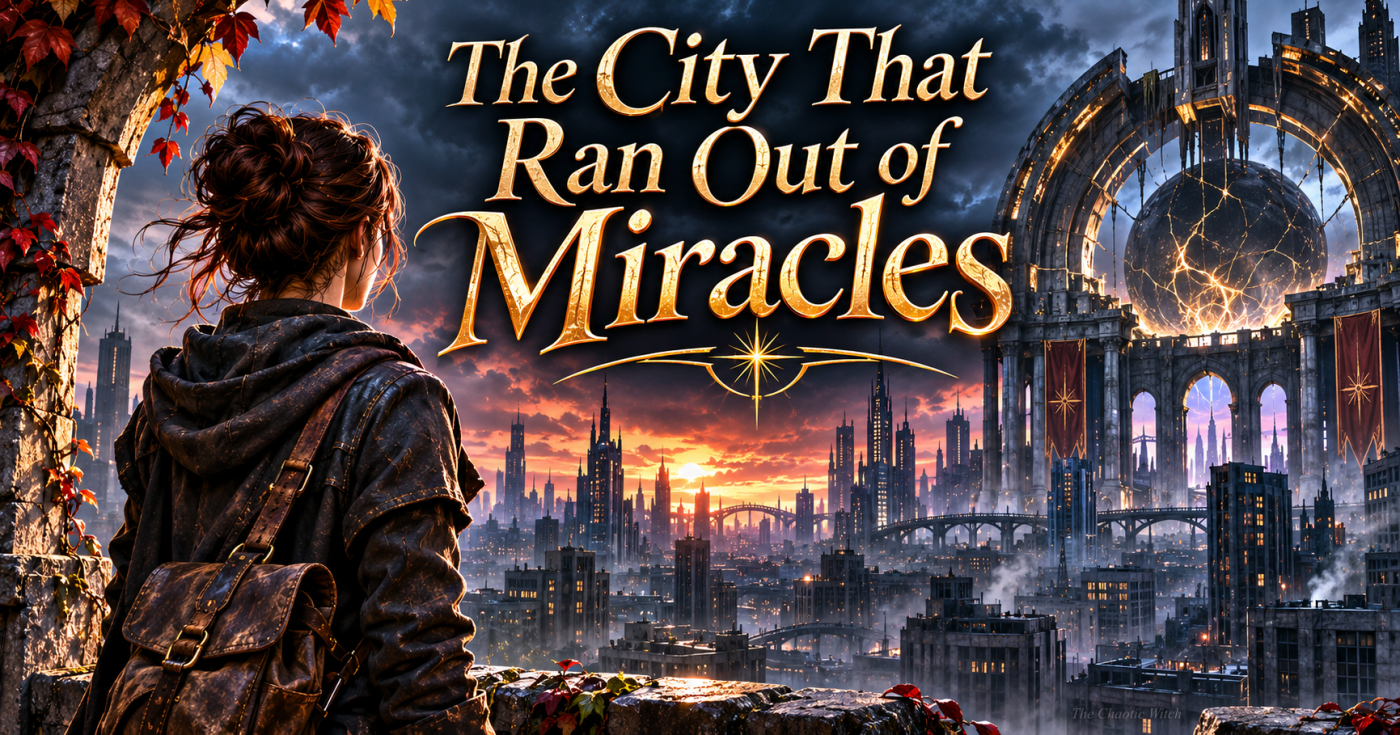
A dystopian thriller about a city built on unlimited magic, the terrifying price of dependence, and the forty-eight hours that revealed how quickly civilization could become a privilege reserved for the powerful.
At 6:17 on a Tuesday morning, the city of Calder lost its heartbeat. There was no explosion, no earthquake, no warning siren, and no spectacular burst of supernatural light. Deep beneath the oldest district of the metropolis, inside a chamber that had been sealed for nearly two centuries, a shimmering sphere of impossible energy simply went dark. For 187 years, the phenomenon known as the Wellspring had provided Calder with an uninterrupted supply of clean, limitless power. It had illuminated every street, heated every home, operated every hospital, powered every vehicle, and transformed a once-modest settlement into a glittering metropolis of eleven million people.
Nobody knew where the Wellspring had come from. Nobody knew how it worked. Scientists had spent generations studying its properties, while theologians argued over whether it was a gift from the gods or evidence that the universe had made an extraordinary mistake. Politicians had long since stopped caring about its origins. As far as they were concerned, it was an inexhaustible resource that required no fuel, produced no pollution, and made Calder the wealthiest city on the continent. Children learned about the Wellspring before they learned multiplication. Its image appeared on currency, government buildings, and the city flag, while the official municipal slogan proudly declared, Tomorrow, Without Limits. Nobody had ever considered what would happen if tomorrow arrived without the Wellspring.
At 6:18, every light in Calder went out. One minute later, the trains stopped, and by 6:20, twenty-three thousand elevators had become stationary metal boxes suspended between floors. Traffic signals died, automated delivery systems froze, and the enormous climate-control towers that kept the city’s densely packed residential districts habitable fell silent. Millions of people stood in kitchens, offices, and train stations, staring at dark screens and waiting for the power to return. At 6:21, the first emergency calls began. By 6:30, there were more calls than the emergency network could process, and by 6:47, a woman named Rhea Sorn understood that Calder was already dying.
Rhea was the deputy director of the Municipal Energy Distribution Authority, a title that sounded impressive until someone discovered that her primary responsibility was ensuring that an unlimited supply of energy continued being unlimited. For seventeen years, her department had operated a system so reliable that most employees considered actual emergencies a theoretical inconvenience. Their emergency procedures were outdated, their contingency equipment was largely ceremonial, and the last citywide disaster simulation had been cancelled because the mayor considered it unnecessarily pessimistic. Rhea had spent years warning that unlimited energy did not eliminate the need for backup infrastructure. She had submitted proposals for independent power generation, decentralized water systems, and emergency mechanical transport. Each had been rejected on the grounds that the Wellspring had never failed.
Now she stood in the central control room, surrounded by dark monitors and engineers trying to revive equipment that had no power source. She demanded to know whether they were dealing with a distribution failure, but her senior technician, Tomas Vale, shook his head. The problem wasn’t the grid. There was simply nothing coming out of the chamber. Zero output, no magical field, no residual energy, and no fluctuation. The Wellspring wasn’t malfunctioning. It was gone. For several seconds, neither spoke. Then Rhea turned toward the emergency storage records and demanded an inventory of every reserve cell in the city.
Calder’s reserve cells were crystalline batteries capable of storing small quantities of Wellspring energy. They had originally been designed to maintain critical systems during maintenance interruptions, although nobody could remember the last time maintenance had required shutting anything down. Hospitals, government buildings, private security companies, and wealthy residential towers possessed their own reserves. The municipality maintained several enormous underground storage facilities, supposedly sufficient to keep essential services operating during a catastrophe. The word essential, Rhea would soon discover, was dangerously flexible.
Tomas finished calculating the available municipal reserves and informed her that, at normal consumption, they had approximately six hours. Rhea felt her stomach tighten and asked how long the energy would last under emergency restrictions. If they shut down everything except hospitals, water distribution, emergency communications, and limited transport, Tomas estimated they might manage forty-eight hours. Even that was uncertain because some of the cells hadn’t been tested in decades. Rhea looked at the clock. It was 6:52 a.m. Forty-eight hours. That was all the time Calder had left before its last stored miracle was exhausted.
At 7:15, Mayor Adrian Kells appeared on the city’s remaining emergency broadcast channels. He stood behind a polished podium, flanked by two senior officials and a large municipal emblem. His suit was immaculate, his voice reassuring, and his speech had clearly been written by someone who had never experienced a genuine emergency. He informed the citizens of Calder that they were experiencing a temporary interruption in the city’s energy distribution network, that technical specialists were working tirelessly to restore service, and that there was no cause for alarm. Everyone was encouraged to remain calm and continue their normal activities wherever possible.
Rhea watched the broadcast on a battery-powered terminal and nearly threw it across the room. There were already more than forty thousand people trapped underground, and the mayor was telling them to continue their normal activities. Tomas quietly corrected the figure to forty-three thousand after receiving an updated estimate from transit authorities. Rhea grabbed the emergency telephone and called the mayor’s office, demanding an immediate conservation order, the evacuation of underground stations, and emergency water distribution. She was transferred four times before reaching his chief of staff, who explained that the mayor believed a measured response would prevent unnecessary panic. Rhea accused him of lying to the public, but he insisted that the administration was maintaining confidence. When she pointed out that public confidence wouldn’t pump drinking water to the seventieth floor, he reminded her that emergency energy allocation was a political decision.
Rhea hung up without another word. By 9:00 a.m., the first neighborhoods began receiving emergency power. Hospitals flickered back to life, several water pumping stations restarted, and limited communications returned to government facilities. Residents cheered as lights appeared in selected buildings, assuming the crisis was ending. What they didn’t understand was that the power wasn’t being restored evenly, and the difference between those who received it and those who didn’t had very little to do with need.
In the wealthy northern district of Crown Heights, luxury apartment towers glowed against the dark skyline. Their private reserve systems continued operating elevators, air conditioning, entertainment systems, and heated swimming pools. Security drones patrolled landscaped courtyards, while automated gates prevented unauthorized visitors from entering. Six kilometers away, in the densely populated South Ward, residents climbed dark stairwells carrying buckets of water. Elderly people were trapped in upper-floor apartments, refrigerated medications began warming, and parents waited outside shuttered childcare centers, unable to contact family members because their devices had no charge.
At South Mercy Hospital, emergency nurse Nadia Sorn watched the backup lighting flicker as another ambulance arrived. Nadia was Rhea’s younger sister, although their schedules and stubborn personalities meant they rarely saw each other outside family gatherings. She had worked at South Mercy for twelve years and believed she had witnessed every possible form of human desperation. By midmorning, she knew she had been wrong. Patients arrived suffering from injuries sustained in stalled trains, falls down dark stairwells, and collisions at intersections where traffic systems had failed. People dependent on electrically powered medical equipment were carried through the hospital doors by terrified relatives. The emergency department filled until patients were lying on blankets in corridors.
The hospital’s reserve cells were supposed to provide seventy-two hours of power, but at 10:34, Nadia learned that the government had requisitioned half of them. The hospital administrator delivered the news with trembling hands, explaining that Emergency Order Seven authorized the government to consolidate reserves for strategic distribution. Nadia stared at him in disbelief. They had patients on ventilators, operating rooms full of people, and hundreds of others waiting for treatment. When she demanded that he refuse the order, the administrator looked away and quietly admitted that the government had sent armed officers.
At 11:10, six security personnel entered South Mercy’s storage wing and began removing reserve cells. Nurses protested, doctors demanded written authorization, and one elderly surgeon physically blocked the loading doors until an officer threatened to arrest him. Nadia stood in front of the final storage cabinet and warned a young officer that taking those cells would kill people. He looked barely twenty-three, his uniform soaked with sweat and his face marked by exhaustion. He told her that he had orders, and she replied that he needed better ones. For a moment, his expression wavered. Then he stepped aside and allowed the transport crew to continue. Nadia watched the cells disappear into an armored vehicle and wondered whether the officer would remember her face when the hospital began deciding which patients could survive without electricity.
At 12:43, Calder’s stock exchange reopened on its emergency reserves. Eight minutes later, it closed again after the value of private energy storage companies increased by more than eight hundred percent. By 2:00 p.m., the city had developed a new currency, and it wasn’t money. It was power. People who possessed reserve cells could purchase almost anything: food, medicine, transportation, protection, access to private shelters, and even passage through security checkpoints. A small household cell that had once cost the equivalent of a week’s groceries was suddenly worth several months’ wages.
Within hours, unofficial markets appeared in abandoned parking structures and darkened shopping centers. People traded jewelry for a few minutes of charging time. Parents surrendered valuables to keep medical equipment operating, while entire apartment buildings pooled their remaining reserves to maintain one functioning elevator for residents who could not use the stairs. The wealthy called it emergency commerce. Everyone else called it extortion. Calder had always celebrated its prosperity, but it had never been particularly interested in examining who possessed that prosperity and who merely lived beneath its illuminated towers.
At 4:20 p.m., Rhea received the first classified allocation report. She read it twice before calling Tomas over and asking him to confirm that it wasn’t a mistake. The document listed the municipal facilities receiving priority access to emergency energy. Hospitals occupied the top category, followed by water distribution, communications, and public safety. Attached to the report, however, was a separate list marked Continuity Assets. It included the mayor’s residence, the executive council complex, three private financial institutions, the headquarters of Meridian Energy Holdings, and a luxury residential enclave containing the homes of Calder’s most influential political donors.
Together, those facilities were consuming more emergency power than the city’s four largest public hospitals. Rhea felt cold as she examined the authorization at the bottom of the page. Mayor Adrian Kells had personally approved the transfers. When she called his office, he answered and calmly explained that his residence was functioning as a secure government facility. Rhea pointed out that his swimming pool was heated while people were dying in hospitals. The mayor dismissed the observation as irrelevant, insisting that far more people would die if the government collapsed. Rhea suggested that he begin preserving civilization by shutting down his swimming pool.
The mayor’s voice hardened. He reminded Rhea that she was an engineer whose responsibility was keeping the system functioning, while his responsibility was preserving order. When she asked whom that order was intended to protect, he refused to answer. Instead, he informed her that all future energy allocation decisions would require approval from the Emergency Executive Council. At 5:07, Rhea received official notification that her access privileges had been restricted. Five minutes later, Tomas quietly handed her a duplicate access key. He had copied it before the government locked them out. When Rhea warned that he could be imprisoned, Tomas shrugged and explained that his mother was trapped on the sixty-third floor of a building with no working elevator. He was beginning to suspect that prison might have better accommodations.
By sunset, Calder no longer resembled the city its residents remembered. The great illuminated towers stood dark against a blood-red sky. Streets once filled with silent electric vehicles were crowded with people walking, carrying bags, pushing carts, and searching for relatives. Shops had closed, but crowds gathered outside supermarkets whose automated doors could no longer open. Police struggled to manage intersections, fires, medical emergencies, and increasingly desperate arguments over access to charging stations. The first major riot began at 7:38 p.m. outside a private energy depot, where hundreds of residents had gathered after hearing that the facility contained enough reserve cells to power the surrounding district for several days.
When guards refused to distribute the cells, the crowd surged toward the gates. Someone threw a bottle, a guard fired a warning shot, and within minutes, the depot’s outer fence had collapsed. People fought over crates of crystalline batteries, desperate to secure enough power for their homes and families. Three people were killed, dozens were injured, and by midnight, the depot was empty. The government called it an act of organized terrorism. Residents of the South Ward called it the first time anyone had shared.
At 1:16 a.m., seventeen hours after the Wellspring failed, the mayor declared martial law. Armed security units established checkpoints around government buildings, energy storage facilities, hospitals, and major intersections. A citywide curfew was announced, unauthorized possession of industrial reserve cells became a criminal offense, and citizens were ordered to surrender surplus energy to designated collection points. The announcement did not mention that private corporations retained legal exemptions. It did not mention the Executive Council’s protected reserves, and it certainly did not mention that the mayor’s swimming pool was still warm.
At 3:40 a.m., Nadia called Rhea from South Mercy. Her voice sounded different, almost frighteningly flat. She explained that the hospital had begun prioritizing patients because there wasn’t enough power to keep everything running. Doctors were moving people out of intensive care if they believed they could survive without equipment, and two patients had already died. Rhea sat alone in the darkened control room, holding the telephone tightly as her sister described a seven-year-old boy named Eli who needed continuous respiratory support. His mother had been sitting beside him for fourteen hours, holding his hand and repeatedly asking when the lights were coming back.
Rhea looked at the emergency reserve display. Thirty-one hours remained at the reduced allocation rate. Nadia admitted that she didn’t know what to tell the boy’s mother, and Rhea realized that for the first time since the blackout began, she had no answer. She had spent seventeen years working with numbers, projections, and carefully structured contingency plans. Now those numbers represented people, and every decision meant someone else might not survive.
At 6:17 the following morning, exactly twenty-four hours after the Wellspring went dark, Calder’s government announced that the emergency was under control. At that precise moment, the South Ward’s largest water pumping station stopped operating. The shutdown was not accidental. The Executive Council had ordered the station’s remaining reserve cells transferred to the central government district, arguing that preserving command infrastructure was essential to public safety. The decision left nearly two million residents dependent on rooftop tanks, emergency distribution points, and whatever water they had managed to store.
By 8:00 a.m., people were lining up outside municipal fountains that no longer worked. By 9:30, fights had broken out at water distribution centers, and by 11:00, the city’s sanitation systems were beginning to fail. At noon, Calder’s emergency medical services reported that dehydration, heat exhaustion, and contaminated water were becoming as dangerous as the blackout itself. Rhea watched the reports accumulate while the government continued broadcasting reassurances. Then she made a decision that would transform the energy crisis into something the mayor feared even more: a crisis of political legitimacy.
She called Tomas into her office and asked him to retrieve the complete municipal energy allocation records, including every private exemption, executive transfer, and reserve movement authorized since the Wellspring’s failure. Tomas hesitated, warning that releasing the records could lead to their arrest and possibly charges of treason. Rhea thought about Nadia, about the patients at South Mercy, and about the millions of people carrying buckets through darkened stairwells while politicians preserved the comforts of their own homes. She admitted that she wasn’t entirely sure it was the right decision, but she was more certain than she’d been the previous day.
At 1:42 p.m., the records appeared on every emergency communications network that still functioned. They showed that the government had diverted nearly a quarter of the city’s available emergency energy into protected facilities, many of which had no direct role in maintaining public safety. They revealed that Meridian Energy Holdings had received preferential distribution rights in exchange for providing security services to the Executive Council. They also showed that hospitals in poorer districts had lost reserves while private medical centers continued operating at near-normal capacity.
Most devastatingly, the records demonstrated that Calder had enough stored energy to maintain basic water distribution for several more days, but only if the government abandoned its current allocation priorities. Within minutes, the information was copied, printed, and passed from person to person. Crowds gathered outside government buildings, security officers began receiving angry calls from their own families, and for the first time since the crisis began, Calder’s collapse became something more dangerous than a technical disaster. It became political.
At 3:00 p.m., Mayor Kells appeared on the emergency broadcast network and accused unnamed extremists of spreading manipulated information designed to undermine public confidence. Seventeen minutes later, three members of his Executive Council resigned. By 3:40, the Municipal Water Workers Union had announced that it would no longer comply with energy transfer orders threatening essential services. At 4:05, several police units refused instructions to seize community-owned reserve cells. Twenty-one minutes later, the mayor ordered Rhea Sorn’s arrest.
She was already gone. Tomas had led her through a maintenance tunnel beneath the distribution center and into the old freight corridors that had existed before Calder became entirely dependent on the Wellspring. The tunnels were dusty, poorly maintained, and largely forgotten, but they had one extraordinary advantage: their doors could be opened by hand. Rhea emerged near the South Ward just after sunset and barely recognized the neighborhood she’d visited countless times during municipal inspections.
People had dragged furniture into the streets to create barricades. Makeshift kitchens burned in open courtyards, while neighbors organized water collection, carried elderly residents down stairwells, and used handwritten notices to communicate when electronic networks failed. Some groups worked together with remarkable generosity. Others guarded their supplies with weapons. A man stood outside a pharmacy charging desperate customers for access to a reserve-powered refrigerator, while two blocks away, volunteers distributed bottled water without asking for payment. On one street, residents had organized a rotating watch to prevent theft. On another, armed men had declared themselves the new neighborhood authority and demanded payment from anyone wishing to pass.
Calder was not becoming one thing. It was becoming a thousand different things at once. In some places, desperation was turning ordinary people into predators. In others, it was revealing a capacity for kindness that the city’s prosperity had never required anyone to demonstrate. Rhea understood that neither response could be dismissed as unusual. The same city that had produced extraordinary wealth and technological achievement had also created millions of people who possessed no meaningful protection against catastrophe.
Rhea found Nadia outside South Mercy, sitting on the hospital steps with blood on her uniform and exhaustion in her eyes. For several seconds, the sisters simply looked at each other before Nadia stood and embraced her. When Nadia mentioned that the government was searching for Rhea, her sister admitted that she knew. Nadia said she was glad, explaining that someone should be looking for the people responsible for what had happened. Inside the hospital, the emergency wards were lit by dim amber lamps. Staff moved quietly between patients, conserving every possible unit of power. Several operating rooms had been closed, and doctors were performing procedures under portable lighting. The corridors smelled of antiseptic, sweat, and fear.
Rhea asked about Eli, the little boy Nadia had mentioned during their telephone call. Nadia hesitated before explaining that he was still alive, although she couldn’t promise how much longer his medical equipment would continue operating. They stood together in silence until Nadia asked how much time remained. Rhea checked the latest reserve estimates and told her that they had less than eighteen hours. Nadia looked toward the hospital doors, then quietly said that they needed to decide what those hours were worth.
At 10:13 p.m., the second night of the blackout, Mayor Kells made his final political mistake. He ordered the deployment of the Civic Guard against a coalition of municipal workers, hospital staff, and neighborhood volunteers who had seized control of the South Ward’s water pumping station. The workers had refused to surrender the facility’s remaining reserves, arguing that doing so would condemn hundreds of thousands of residents to dehydration. The mayor called their actions insurrection. The workers called them survival.
When the Civic Guard arrived, hundreds of people stood between the soldiers and the pumping station. Nurses in bloodstained uniforms stood beside sanitation workers, electricians, parents, and elderly residents. Some carried signs demanding water, while others carried nothing at all. The commanding officer, Captain Jalen Mercer, received orders to clear the entrance by force. He looked at the crowd, then at the soldiers standing behind him. Many had families living in the South Ward, several had spent the previous night helping relatives climb darkened stairwells, and one had a daughter receiving treatment at South Mercy.
Mercer raised his communications device and requested authorization to negotiate, explaining that civilians and medical personnel were occupying the facility. Command refused and ordered him to clear the entrance. Mercer repeated that medical personnel were present, but the response remained unchanged. He lowered the device and looked toward the crowd. For several seconds, the entire street seemed to hold its breath. Then he turned to his soldiers and ordered them to secure the perimeter, making it clear that nobody was to leave with the reserve cells. When one of his lieutenants questioned the order, Mercer explained that they were protecting the water supply.
The lieutenant understood. The soldiers lowered their weapons, and within an hour, three additional Civic Guard units had refused similar orders. By midnight, the mayor no longer controlled his own security forces. The government had spent nearly two days insisting that preserving authority was essential to protecting civilization, but it had failed to recognize that authority depended upon the willingness of ordinary people to obey. Now those people were choosing water, medicine, and their neighbors over the instructions of politicians who had abandoned them.
At 1:30 a.m., the Executive Council evacuated the government district. The official announcement described the departure as a strategic relocation to ensure continuity of leadership. In reality, the mayor and several senior officials had boarded armored transport vehicles carrying enough reserve energy to operate a small hospital for weeks. They intended to reach a fortified estate beyond the city limits, where private security forces and independent supplies would allow them to wait out the collapse they had helped accelerate.
The convoy never made it. At the western checkpoint, a group of exhausted Civic Guard officers refused to open the gates until the vehicles surrendered their reserve cells for public distribution. The mayor threatened arrests, dismissal, and prosecution, but the officers listened politely before informing him that the city no longer had enough functioning prisons, administrative offices, or courts to make his threats particularly convincing. At 2:14 a.m., Adrian Kells surrendered his emergency energy reserves. Six minutes later, he was placed under protective custody.
By morning, photographs of the mayor sitting on a folding chair beside a darkened checkpoint had circulated throughout the city. Someone had written a caption beneath the image that mocked the very promise Calder had spent generations celebrating: Tomorrow, Without Limits. Terms and Conditions Apply. For a few moments, the joke gave people something to laugh about. Then they returned to the more immediate problems of finding water, feeding their families, and keeping the sick alive.
At 4:00 a.m., forty-six hours after the Wellspring failed, Rhea returned to the central distribution facility under the protection of Captain Mercer and a group of municipal workers. The building was nearly deserted. Most of the technicians had fled, the emergency lighting was failing, and the great control screens displayed nothing but declining reserve levels. Tomas was waiting beside the main console, looking as though he’d aged ten years. He informed Rhea that they had approximately two hours before the remaining municipal reserves were exhausted.
Rhea studied the energy map. Calder was fractured into isolated pockets of light, with hospitals, water stations, emergency shelters, and a handful of communications facilities still operating. Everywhere else was dark. The available reserves were too depleted to restore normal services, and even the newly recovered government cells would only delay the inevitable. There was no hidden stockpile large enough to save Calder, no miracle waiting in a forgotten vault, and no ancient prophecy promising that the Wellspring would return. The power was gone, and the reserves were running out.
Rhea sat at the console and began making the final allocations. She directed the remaining municipal reserves toward emergency medical equipment, essential water distribution, and the transport of vulnerable patients. She ordered the release of the city’s complete infrastructure maps, including the locations of gravity-fed water systems, manual access routes, and facilities that could be operated without magical power. She authorized municipal workers to dismantle nonessential energy systems for reusable materials and directed emergency communications to distribute practical instructions rather than political reassurances.
The decisions were imperfect. Some neighborhoods would receive more assistance than others. Some patients would be saved while others would not, and some emergency shelters would remain open while others would close. There was not enough time, equipment, or power to protect everyone. Rhea knew that every decision she made would be questioned by people who had lost someone, and she also knew that refusing to decide would not save them. The responsibility was almost unbearable, but for the first time since the blackout began, those decisions were being made according to need rather than influence.
At 5:30 a.m., Nadia called from South Mercy and informed Rhea that Eli was being transferred to North General Hospital. One of the recovered government reserve cells was keeping the transport equipment running, and the receiving hospital had agreed to take him. Rhea felt a brief rush of relief and asked whether the little boy would survive. Nadia was quiet for a moment before admitting that she didn’t know. It wasn’t the answer Rhea wanted, but it was the only honest one. After two days of government reassurances, empty promises, and carefully managed announcements, honesty had become a rare and precious thing.
At 6:00 a.m., the first sunlight appeared above Calder’s eastern towers. For nearly two centuries, the city had greeted each morning with millions of artificial lights that never needed to be extinguished. Now its vast skyline stood dark and silent. Glass towers reflected the rising sun, while streets below filled with people carrying water, searching for relatives, and gathering around improvised community kitchens. In Crown Heights, residents who had spent two days protected by private reserves emerged from their buildings to discover that money could no longer guarantee comfort. In the South Ward, exhausted volunteers prepared another day of distributing water and carrying supplies.
Across the city, people were beginning to understand that the government they had trusted, the technology they had depended upon, and the prosperity they had taken for granted had all rested on a single impossible phenomenon. Some responded with generosity, others with cruelty, and most were simply frightened. The disappearance of the Wellspring had not transformed Calder’s residents into entirely different people. It had stripped away the systems that once concealed the consequences of their choices.
At 6:17 a.m., exactly forty-eight hours after the Wellspring stopped, the final municipal emergency reserve entered its last discharge cycle. Rhea stood in the distribution center as the remaining control lights dimmed. Tomas watched the numbers fall and quietly announced that thirty seconds remained. Rhea nodded without speaking. When he told her that twenty seconds were left, she looked toward the enormous city beyond the windows. Somewhere outside, a church bell began ringing. Its mechanism was mechanical, operated by a rope pulled by volunteers who had decided that people still needed to know when morning arrived.
As Tomas counted down the final ten seconds, Rhea thought about the people who had died, the hospitals still struggling to function, the families trapped in towers, the neighborhoods organizing their own survival, and the politicians who had tried to purchase safety with everyone else’s remaining time. She had spent seventeen years believing her job was to keep Calder running. Now she understood that keeping a city alive and keeping its machinery operating were not necessarily the same thing. When Tomas reached the final second, the last reserve emptied, and the remaining lights in the control room went dark.
For several seconds, neither Rhea nor Tomas moved. Then, from somewhere outside, they heard voices. Not screaming, at least not yet. People were calling instructions to one another. Someone was organizing a line for water, while someone else was asking for volunteers to help carry an elderly neighbor downstairs. A child was crying, and a woman was singing softly, trying to comfort him. The sounds drifted upward through the open windows, ordinary human noises filling a city that had once measured its greatness by the extraordinary power beneath its streets.
Rhea walked to the window and looked down. Hundreds of people were gathering in the street. Some carried tools, while others carried food, water containers, blankets, or medical supplies. A group of municipal workers had dragged an old handcart from a storage shed and were loading it with emergency equipment. Across the intersection, several volunteers were removing a barricade so that people could reach a community shelter. None of it was enough to solve the catastrophe unfolding around them, but it was something. For the moment, something was all they had.
The city was not saved. Its government had fractured, its economy had collapsed, its hospitals were overwhelmed, and its water supply was dangerously unstable. Millions of residents faced an uncertain future, with hunger, disease, violence, and displacement no longer distant possibilities but approaching realities. There would be no triumphant announcement that afternoon, no restored skyline, no grand celebration, and no miraculous return of the energy that had made Calder extraordinary. The next forty-eight hours might be worse than the first, and the forty-eight after that might be worse still.
Tomas joined Rhea at the window and asked what would happen now. She watched a young man lift an elderly stranger onto his back and begin carrying him toward the hospital. Nearby, two women were arguing fiercely over how to distribute a crate of bottled water, while a third was writing names on a piece of cardboard to make sure nobody was overlooked. Rhea admitted that she didn’t know. Tomas looked at her with an expression of weary disbelief and reminded her that she was supposed to have a plan. Rhea almost laughed before telling him that pretending someone always had a plan was precisely what had gotten them into this mess.
They stood together as the sun climbed higher, illuminating a city that had forgotten how to live without artificial light. Then Rhea picked up a paper map, a flashlight with a nearly exhausted battery, and a bag containing the last of her personal supplies. She told Tomas that they were going to South Mercy because the hospital needed people who understood the infrastructure. When he asked what they would do afterward, she looked toward the street and explained that they would find out what still worked.
They descended the stairs and stepped outside. For the first time in 187 years, Calder had no magic to sustain it. There was no limitless energy, no effortless abundance, and no invisible force quietly holding its magnificent civilization together. It had only its people, and during the first forty-eight hours, those people had revealed something deeply unsettling. The city’s greatest vulnerability had never been the Wellspring itself. It had been the belief that an unlimited resource made fairness, preparation, and responsibility unnecessary.
When the magic disappeared, the powerful had not immediately tried to save civilization. They had tried to decide who deserved to survive it. Now the contracts were meaningless, the reserve vaults were empty, and the glittering towers had become monuments to a vanished age. The people of Calder would have to build something different from the ruins, but before they could begin rebuilding, they would have to survive. And survival, unlike the magic they had once taken for granted, was never going to be distributed equally.
For generations, Calder had believed that miracles were the foundation of civilization. Its people had built their towers, their governments, their fortunes, and their futures upon a source of power they assumed would never disappear. They had mistaken abundance for security, convenience for progress, and prosperity for justice. Only when the Wellspring vanished did they discover how little of their magnificent city had been designed to endure without it.
Yet as Rhea and Tomas walked toward South Mercy, passing volunteers who were distributing water and strangers helping one another through the darkened streets, something else became painfully clear. The Wellspring had powered Calder, but it had never made Calder a community. That responsibility had always belonged to the people living within it, and for too long, they had allowed their extraordinary abundance to disguise the inequalities beneath it.
The miracles were gone. The consequences were only beginning.
And somewhere among the darkened towers, exhausted hospitals, abandoned government buildings, and crowded streets, eleven million people were about to discover whether a civilization that had forgotten how to survive could remember how to care for one another.
A little magic is always waiting. Subscribe and step inside the circle. 🖤🔮✨


Leave a Reply