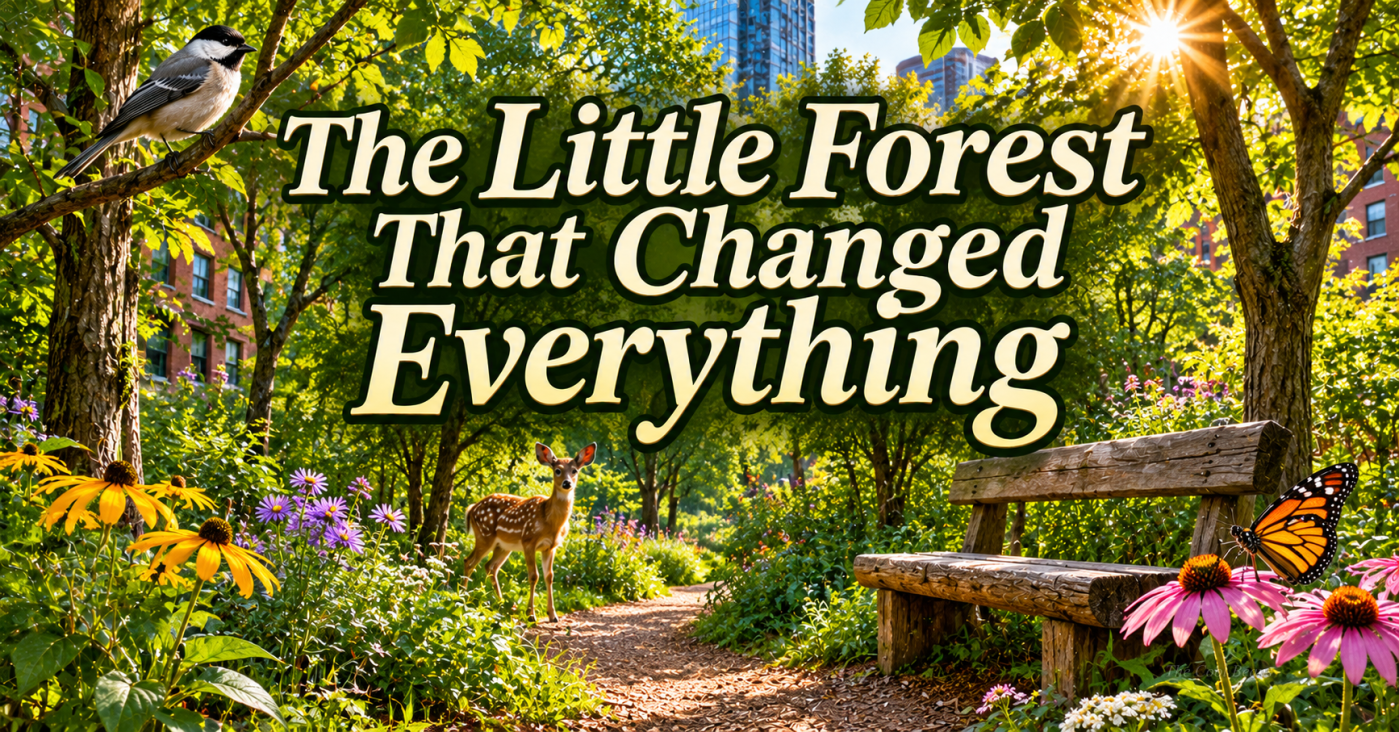
For as long as anyone could remember, the corner of Willow Street and Ninth Avenue had been nothing more than an ugly rectangle of cracked concrete. Weeds pushed through the pavement, rusty shopping carts collected behind a broken fence, and faded yellow parking lines marked spaces that nobody had used in nearly twenty years. During the summer, the concrete became so hot that the air above it seemed to shimmer. In winter, dirty snow piled against the chain-link fence, and by spring, the entire place smelled of wet asphalt and forgotten things.
The people of Greybridge had grown accustomed to ignoring it. They walked past without looking, complained occasionally about the litter, and shook their heads whenever someone mentioned the abandoned property. The lot had once served a department store that closed before most of the neighbourhood’s children were born. Since then, various plans had been proposed for the land, including a parking garage, a convenience store, and a small office building. None had materialized, and eventually, the city simply stopped discussing it.
But ten-year-old Amelia Brooks noticed everything about that forgotten corner. She noticed the little dandelions that somehow survived between the cracks, the sparrows that gathered along the fence, and the single stubborn tree growing beside a drainage pipe. It was a skinny silver maple with a crooked trunk and leaves that turned brilliant yellow every autumn. Amelia thought it was the bravest tree in the entire city because it had managed to grow in a place where nothing was supposed to live.
Amelia attended Maplewood Elementary School, a red-brick building directly across from the abandoned lot. Her fifth-grade classroom overlooked the concrete expanse, and she often found herself staring through the window when she was supposed to be concentrating on mathematics. Her teacher, Ms. Elena Rivera, had learned to recognize the distant expression that appeared whenever Amelia became absorbed in one of her ideas. Sometimes those ideas involved elaborate inventions, sometimes they concerned injured animals, and once they had resulted in a petition demanding that the cafeteria stop serving what Amelia described as “suspiciously elastic spaghetti.”
One unusually hot afternoon in May, Ms. Rivera announced that the class would be beginning a new project about the environment. Rather than writing another report about rainforests or endangered animals, the students would investigate an environmental problem in their own neighbourhood and propose a realistic solution. They would have six weeks to research their subject, gather evidence, and present their findings to the class.
Amelia raised her hand before the teacher had finished explaining the assignment.
“Can we make a forest?”
Several students laughed, but Ms. Rivera simply tilted her head. “Where would you like to make a forest, Amelia?”
Amelia pointed through the classroom window toward the abandoned parking lot. “Over there. Nobody uses it, and it’s horrible to look at. What if we took away the concrete and planted a whole bunch of trees?”
Her best friend, Oliver Chen, turned around in his seat. Oliver was a practical boy who loved numbers, science experiments, and pointing out problems with other people’s plans. He studied the parking lot for a moment before announcing that forests required considerably more space than the property provided. Amelia argued that perhaps they could make a smaller forest, while Oliver countered that a collection of trees did not necessarily constitute a functioning ecosystem. Their discussion continued until Ms. Rivera asked them to investigate whether such a thing was possible.
That evening, Amelia went home and began searching for information about tiny urban forests. She discovered that some communities were planting small, densely packed areas of native trees and shrubs in places that had once been covered by concrete or neglected grass. These miniature forests were designed to develop layers of vegetation, provide shelter for wildlife, and help cool surrounding areas. Some used a planting approach inspired by Japanese botanist Akira Miyawaki, emphasizing locally appropriate native species and careful soil preparation.
Amelia read everything she could find. She learned that young forests required proper soil, water, sunlight, and years of care. She discovered that native trees could support insects and birds that ornamental landscaping sometimes failed to attract. She also learned that trees could help absorb rainwater, provide shade, and make urban neighbourhoods more comfortable during hot weather.
By bedtime, Amelia had filled twelve pages of her notebook with drawings, facts, and increasingly ambitious plans. At the top of the first page, she had written three words in enormous green letters: “PROJECT LITTLE FOREST.”
The following morning, she arrived at school carrying a folder so stuffed with papers that the elastic band holding it together snapped halfway down the hallway. Oliver helped her collect the scattered pages, although he insisted that her proposal would require a proper feasibility study. Amelia informed him that he could be in charge of the feasibility study, which pleased him considerably.
By lunchtime, they had recruited four more students. There was Sophie Bennett, who loved drawing and could make almost anything look beautiful; Marcus Hill, who was exceptionally good at talking to adults without becoming nervous; Priya Shah, who knew more about insects than most people wanted to hear; and Daniel Foster, who had initially joined because Amelia promised that removing the concrete might involve heavy machinery.
The six children began meeting during lunch breaks in the school library. They researched the property, measured its approximate dimensions using public maps, and studied examples of urban forests in other cities. Oliver calculated that the lot covered roughly 1,200 square metres, although only part of it would be suitable for planting because the city needed to maintain access to underground utilities and the adjoining sidewalk. Sophie drew a colourful illustration showing how the abandoned lot might look after several years, with native trees, flowering shrubs, birds, butterflies, and a narrow path winding through the greenery.
Priya compiled a list of wildlife that might benefit from the project. She hoped to attract native bees, butterflies, beetles, and songbirds, and she explained that insects were essential to a healthy ecosystem. Daniel suggested building a small pond for frogs, but Oliver pointed out that standing water would introduce maintenance and safety concerns. After considerable debate, they agreed to focus on the forest first and leave ponds for another day.
Marcus was responsible for discovering who owned the property. He telephoned the municipal information office with the confidence of someone twice his age and eventually learned that the city had acquired the lot through a tax sale several years earlier. It was classified as surplus municipal land, meaning it could potentially be sold or redeveloped.
That discovery changed everything.
The children had assumed that the parking lot was simply waiting for someone to improve it. Now they realized that if they wanted to create their forest, they would have to persuade the city to let them use the land.
Ms. Rivera helped them understand the process without taking over the project. She explained that they would need permission, professional guidance, funding, and a plan for maintaining the trees after they were planted. They would also need to demonstrate that the forest would benefit the neighbourhood and that the proposal was practical.
Amelia was briefly discouraged by the number of obstacles. She had imagined planting trees, not attending meetings and filling out forms. But Marcus pointed out that adults seemed to spend an extraordinary amount of time talking about things before actually doing them, so perhaps they simply needed to become very good at talking.
Their first step was a petition.
Sophie designed a poster showing the abandoned parking lot on one side and a lush green forest on the other. Across the top, she wrote, “WHAT IF WE GREW SOMETHING BETTER?” Beneath the pictures, the children explained their proposal and invited residents to support turning the unused property into a small urban forest.
They began collecting signatures outside the school, at the public library, and during a Saturday neighbourhood market. Some people signed immediately, delighted by the idea of replacing the ugly concrete lot with trees. Others were skeptical. One elderly gentleman informed them that the city had been promising improvements to the neighbourhood for thirty years and that nothing ever changed. A shopkeeper worried that the property might eventually be needed for customer parking. Another resident questioned whether the children understood how expensive it would be to remove the pavement.
Rather than dismissing those concerns, the children wrote them down. Oliver created a spreadsheet, Marcus practiced answering difficult questions, and Amelia began carrying a notebook everywhere she went. They learned that enthusiasm alone would not persuade everyone, and that listening carefully was sometimes more useful than making another speech.
Their most unexpected supporter was seventy-four-year-old Walter Finch, a retired railway worker who lived in a small apartment overlooking the lot. Walter had watched the neighbourhood change over five decades. He remembered when the streets were lined with mature trees, when swallows nested beneath the railway bridge, and when the nearby creek still ran aboveground instead of disappearing into a concrete drainage channel.
“When I was a boy, you could hear birds everywhere,” he told Amelia one afternoon. “Not just pigeons and sparrows. All kinds of birds. In spring, the trees were so full of them that you couldn’t hear yourself think.”
Amelia asked whether he missed those days.
Walter looked toward the abandoned parking lot. “More than you can imagine.”
He signed their petition and offered to help in any way he could. Within a week, he had convinced nearly every resident in his apartment building to support the project. He also produced an old photograph showing Willow Street in 1962, when enormous trees formed a green canopy above the sidewalks. Amelia stared at the picture in astonishment. She had never imagined that her neighbourhood could once have looked so beautiful.
By the end of three weeks, the children had collected 846 signatures.
Their next challenge was City Hall.
Greybridge’s municipal council met twice a month in a large chamber with polished wooden desks and microphones that made every speaker sound unusually serious. When the children arrived for their first meeting, they were intimidated by the rows of officials, the formal procedures, and the enormous clock hanging above the mayor’s chair. Amelia suddenly wished she had stayed home and worked on her science homework instead.
Ms. Rivera sat quietly in the audience beside several parents, while Walter occupied a seat near the front. The children had been given five minutes to present their proposal. Marcus carried the petition, Oliver held their research, Sophie had prepared a large illustrated display, and Priya had brought photographs of native wildlife. Daniel was responsible for changing the presentation slides, a task he considered almost as important as operating heavy machinery.
When their turn arrived, Amelia approached the microphone with trembling hands. She looked at the councillors, then at the enormous room, and for a moment, every word she had rehearsed disappeared from her memory.
Then she thought about the skinny silver maple growing beside the drainage pipe.
“There’s a parking lot across from our school,” she began. “It’s been empty longer than any of us have been alive. Every day, hundreds of people walk past it, and nobody really looks at it anymore. But we look at it. And we think it could be something wonderful.”
The children took turns explaining their research. Oliver discussed the size of the property and the need for soil testing and professional planning. Priya described how native plants could provide food and shelter for insects and birds. Sophie displayed her drawings, while Marcus presented the petition and explained the community’s concerns. Daniel described how volunteers might help with planting and maintenance once the city had completed the necessary groundwork.
Amelia concluded by telling the councillors that the children were not asking for a playground, a sports field, or another place to buy things. They wanted to create something that would continue growing long after they had left elementary school.
“We know it won’t become a forest overnight,” she said. “But if we never plant anything, it definitely won’t become one.”
For several seconds, the chamber was silent.
Then someone began clapping.
The applause spread through the audience, and even a few councillors smiled. Amelia returned to her seat feeling as though her legs might collapse beneath her.
Unfortunately, applause was not the same as approval.
The city’s director of public works explained that removing the pavement would be expensive. The land would need to be tested for contamination, underground utilities would have to be identified, and engineers would need to assess drainage. The city was already struggling with budget constraints, and several councillors questioned whether an urban forest should take priority over road repairs and other essential services.
One councillor, Martin Greaves, argued that the lot should be sold to a developer. The sale, he suggested, could generate revenue and potentially create jobs. He praised the children for their enthusiasm but described the proposal as unrealistic.
Amelia felt her face grow hot. She wanted to tell him that children were constantly being encouraged to care about the environment, yet adults seemed determined to explain why doing anything about it was impossible. But before she could speak, Marcus gently touched her arm.
They had agreed to listen.
The council voted to refer the proposal to the parks and planning departments for further study. It was not a victory, but it was not a rejection either. The children left City Hall with their posters, petitions, and a growing understanding that changing the world involved considerably more patience than they had expected.
Over the following month, Project Little Forest became something much larger than a school assignment.
A local newspaper published an article about the children, accompanied by Sophie’s drawing of the proposed forest. A gardening club offered to help identify suitable native plants, and a nearby university connected the group with an urban ecologist named Dr. Hannah Ellis. A landscape contractor volunteered to provide an estimate for removing the concrete, while a neighbourhood environmental organization offered to assist with fundraising.
Dr. Ellis visited the school and explained that creating a healthy forest required more than planting as many trees as possible. The site would need careful assessment, and the children would have to choose species suited to the local climate and soil conditions. Some trees would eventually grow tall enough to form a canopy, while smaller trees and shrubs would create additional layers of vegetation. The forest would also need watering and protection while the young plants established themselves.
She explained that the forest might look unimpressive during its first year. The saplings would be small, the ground would be covered with mulch, and the children might wonder whether their efforts had accomplished anything. But over time, if the planting was successful, the trees would grow, their roots would improve the soil, and the space could become increasingly valuable to wildlife.
Amelia loved that part of the explanation.
The idea that something could begin small and become extraordinary simply because people cared for it seemed almost magical.
The project received another boost when a local construction company offered to donate equipment and labour for part of the pavement removal, provided the city approved the work. A regional environmental foundation expressed interest in funding the trees, and several businesses pledged money toward soil preparation and maintenance supplies. Parents volunteered to help organize fundraising events, and the school held a community art exhibition featuring drawings of the forest the children hoped to create.
But not everyone was pleased.
Councillor Greaves continued arguing that the property would be more valuable if sold for development. Several business owners expressed concerns about losing potential parking space, and one resident worried that a dense forest might attract litter or become difficult to maintain. The children attended another council meeting, where they listened to the objections and presented a revised proposal.
Their new plan included a clear maintenance agreement, a narrow accessible path along the edge of the planting area, and a commitment to keeping sightlines open near the sidewalk. They also proposed placing a small information sign explaining the purpose of the forest and identifying the native species. Oliver had even calculated the approximate number of trees and shrubs that could be planted within the available space, subject to the ecologist’s final recommendations.
By then, the children had become remarkably comfortable discussing municipal policy. Marcus could explain zoning regulations, Priya could identify several native pollinators, and Daniel had developed an unexpected interest in stormwater management. Amelia, meanwhile, had learned that being a leader did not mean having every answer. Sometimes it meant finding people who knew things she didn’t and convincing them to work together.
The final council vote took place on a rainy Thursday evening in September.
The chamber was packed. Parents stood along the back wall, teachers filled several rows, and dozens of neighbourhood residents had come to support the children. Walter arrived wearing his best suit and carrying the old photograph of Willow Street beneath its former canopy of trees.
After nearly two hours of discussion, the mayor called for the vote.
The proposal passed by seven votes to two.
For a moment, Amelia could not move.
Then Sophie screamed, Daniel jumped out of his chair, and Marcus began laughing so hard that he nearly dropped the petition folder. Oliver, who rarely displayed much emotion, stared at the electronic voting board before quietly announcing that their chances of success had apparently been better than he anticipated.
Amelia turned toward Ms. Rivera, who was wiping tears from her eyes.
“We did it,” Amelia whispered.
Her teacher smiled. “You certainly did.”
The work began the following spring.
First came the environmental assessments, which confirmed that the site could be made suitable for planting with targeted soil removal and remediation. Then came the machinery. Workers broke apart the concrete, loaded the debris into trucks, and carefully removed the damaged material. For several days, the entire neighbourhood seemed to vibrate with the noise of construction equipment.
Daniel watched from behind the safety barriers with an expression of absolute delight.
When the last sections of pavement were removed, the children saw something they had never seen before.
Earth.
Not weeds growing through cracks or dirt collected along the fence, but an enormous open space of exposed ground where the parking lot had stood. It looked rough and muddy, and nobody would have described it as beautiful. Yet to Amelia, it was the most exciting sight in the world.
The soil was prepared according to the planting plan, with suitable organic material incorporated where needed to support the young trees. Dr. Ellis and a team of volunteers marked the planting areas, leaving space for the accessible path and maintenance access. The species list included sugar maples, red oaks, serviceberries, eastern redbuds, dogwoods, and native shrubs selected for their suitability to the region. Different species would eventually form a layered woodland, providing food and shelter for a variety of living things.
On the morning of the community planting event, more than two hundred people arrived carrying gloves, shovels, water bottles, and an extraordinary amount of enthusiasm.
Parents planted beside children, retirees worked alongside university students, and local business owners who had once questioned the proposal helped carry mulch and distribute tools. Walter arrived with a folding chair, determined to supervise even though his knees prevented him from doing much digging. Ms. Rivera moved between groups, making sure everyone followed the planting instructions, while Dr. Ellis demonstrated how to position the young trees correctly and avoid burying their root collars too deeply.
Amelia planted her first tree beside Oliver.
It was a serviceberry, barely taller than she was, with thin branches and a modest collection of leaves. She carefully settled it into the prepared soil, helped firm the earth around its roots, and watered it until the surrounding ground was thoroughly damp.
Oliver examined the planting instructions one last time before declaring that the tree appeared to have been installed correctly.
Amelia laughed. “You make it sound like we’re building a washing machine.”
“Trees are considerably more complicated than washing machines,” he replied.
By late afternoon, hundreds of young trees and shrubs stood where the concrete had once been. They looked fragile and somewhat untidy, their thin trunks swaying in the breeze above a thick layer of mulch. The new forest did not resemble Sophie’s magnificent drawings, and it certainly did not look like the mature woodland Amelia had imagined.
But it was alive.
The children named it the Little Forest of Greybridge.
A wooden sign was installed near the entrance, displaying the name and a short message: “Planted by a community that believed small things could make a big difference.”
The first summer was difficult.
A prolonged heatwave swept across the city, and several weeks passed without meaningful rainfall. The young trees began to struggle, their leaves drooping in the afternoon sun. The children had known that watering would be necessary, but they had underestimated how worried they would feel watching the saplings endure their first summer.
Fortunately, the project had included a maintenance plan. The city’s parks department provided access to water, while volunteers organized scheduled watering shifts using approved equipment. Parents helped transport supplies, and residents took turns checking the trees for signs of stress. The children learned to distinguish ordinary seasonal changes from genuine problems, and Dr. Ellis reminded them that some losses were possible even with proper care.
A few saplings did die.
Amelia was devastated when she discovered that one of the young oaks had failed to survive. She had visited it every week, carefully recording its height and counting its leaves. Finding its branches dry and brittle felt like losing something she had personally promised to protect.
Walter found her sitting beside the little tree one afternoon, staring at the ground.
“Forests aren’t made of perfect things,” he told her gently. “They’re made of living things. Some grow, some struggle, and some don’t make it. What matters is what happens to the forest as a whole.”
Amelia looked at the surrounding saplings, many of which were still green and healthy.
“Do you think it’ll really become a forest?”
Walter smiled. “I think it already is one. It just hasn’t grown into itself yet.”
By autumn, the children began noticing changes.
Small insects appeared among the leaves, and spiders stretched delicate webs between the branches. Bees visited the flowering plants along the forest’s edge, while butterflies drifted through the warmer patches of sunlight. Earthworms became more common in the improved soil, and birds began landing on the young trees.
Priya was the first to spot a chickadee investigating a serviceberry branch.
She became so excited that she nearly dropped her binoculars.
The following spring, several serviceberries produced their first blossoms. They were delicate white flowers that seemed almost impossibly beautiful against the surrounding buildings. Residents began stopping to admire them, and people who had once hurried past the abandoned parking lot now slowed down to look at the growing trees.
The neighbourhood changed in other ways, too.
A nearby café began offering discounted drinks to volunteers who participated in forest maintenance days. The library organized nature walks for families, and Maplewood Elementary introduced an annual environmental project inspired by the original campaign. Students began studying insects, identifying birds, and measuring temperature differences between shaded areas and nearby pavement.
Oliver, now in middle school, continued collecting data. His measurements showed that shaded spots within the developing forest could be noticeably cooler than the surrounding sunlit pavement on hot days, although the effect varied with weather conditions and time of day. He presented his findings at a regional student science fair, where he explained that the forest’s environmental benefits would likely increase as the trees matured.
Sophie created a series of illustrated signs identifying the plants and wildlife. Marcus helped establish a youth environmental committee, and Daniel, who had once joined the project because he wanted to watch concrete being demolished, announced that he intended to become a civil engineer specializing in environmentally responsible infrastructure.
Amelia continued visiting the forest almost every day.
Sometimes she brought a notebook. Sometimes she brought a book to read on a bench near the entrance. And sometimes she simply stood among the young trees, listening to the rustling leaves and watching the small movements of creatures that had gradually begun making the space their home.
Three years after the planting, Walter passed away peacefully in his sleep.
His death devastated the children, who had come to regard him as the unofficial grandfather of their little forest. He had attended nearly every community event, encouraged them through every setback, and delighted in sharing stories about the neighbourhood’s past. In his final months, he had often sat beside the forest with a thermos of tea, watching the trees grow taller.
At his funeral, Amelia learned that Walter had left a small donation to the Little Forest maintenance fund. He had also written a letter to the children, which his daughter read aloud during a gathering at the site.
In the letter, Walter explained that he had spent years believing the best days of his neighbourhood were behind it. He had watched trees disappear, buildings deteriorate, and familiar places become unrecognizable. When Amelia and her friends first approached him with their idea, he had supported them because their enthusiasm reminded him of his own childhood.
But somewhere along the way, he wrote, the children had given him something he had not expected.
They had given him a reason to look forward.
He told them that he would never live long enough to see the forest fully grown, but that did not trouble him. The wonderful thing about planting trees, he explained, was that the people who planted them did not have to be the ones who enjoyed their greatest beauty.
The following spring, the community installed a simple wooden bench near the forest’s entrance in Walter’s memory. A small plaque carried his name and a sentence from his letter: “Plant something beautiful, even if someone else will be the one to sit beneath it.”
By the fifth anniversary, the Little Forest of Greybridge had become almost unrecognizable.
The trees were taller, their branches beginning to overlap, and the once-exposed planting area had developed a dense green appearance. Birds sheltered among the foliage, insects thrived in the understory, and seasonal changes transformed the little woodland throughout the year. In spring, blossoms brightened the forest’s edges. Summer brought deep green leaves and pockets of cool shade. Autumn painted the trees in gold, orange, and red, while winter revealed the delicate architecture of their branches.
The forest was still young, and the community continued caring for it. Volunteers replaced occasional failed plants, monitored invasive species, and worked with the parks department to maintain the path and surrounding area. But the woodland had become increasingly established, and the neighbourhood had embraced it as a permanent part of its identity.
People began referring to the corner of Willow Street and Ninth Avenue not as the old parking lot, but simply as the forest.
Children arranged to meet their friends there. Office workers ate lunch beside it. Residents took photographs of the changing seasons, and elderly neighbours sat on Walter’s bench to enjoy the birdsong. Visitors sometimes expressed surprise that such a small patch of greenery could feel so different from the busy streets surrounding it.
One afternoon, Amelia returned to the forest with Ms. Rivera, who had recently retired from teaching.
Amelia was fifteen now, taller and more confident, although she still carried a notebook almost everywhere she went. The forest that had once existed only in her imagination surrounded them with rustling leaves and birdsong. They walked slowly along the path, pausing occasionally to examine the plants and admire the changes.
Ms. Rivera asked whether Amelia remembered the day she first suggested planting a forest.
Amelia laughed. “I remember Oliver telling me it was impossible.”
“He didn’t say impossible,” Ms. Rivera replied. “He said it would be difficult.”
“That’s Oliver’s version of impossible.”
They stopped beside the serviceberry Amelia had planted during the original community event. It was now several times taller than she was, its branches spreading gracefully above the surrounding shrubs. Amelia rested her hand against its trunk, remembering how carefully she had placed it in the soil five years earlier.
“I thought we’d just plant some trees,” she admitted. “I didn’t know we’d have to convince the council, raise money, organize volunteers, and learn about soil and drainage and a hundred other things.”
Ms. Rivera smiled. “Would you have done it if you’d known?”
Amelia considered the question for a moment.
“Yes,” she said. “But I probably would have brought a bigger notebook.”
They laughed together, and somewhere above them, a chickadee called from the branches.
A few weeks later, the city announced that the Little Forest project had inspired plans to convert several other neglected municipal properties into small green spaces. Representatives from neighbouring communities visited Greybridge to learn how the project had been organized, and the original group of students was invited to speak at an environmental conference.
Amelia stood before an audience of planners, educators, scientists, and community leaders, feeling a familiar flutter of nervousness. She remembered her first appearance at City Hall, when she had been a frightened ten-year-old trying to persuade a room full of adults that an abandoned parking lot could become something extraordinary.
This time, she had photographs.
She showed the audience the cracked concrete, the rusting fence, and the lonely silver maple that had once been the only tree on the property. Then she showed images of the planting day, the struggling saplings during their first summer, the first blossoms, and the growing canopy that now sheltered birds and insects in the heart of the city.
She spoke about the volunteers, the scientists, the city workers, and the residents who had helped turn an idea into reality. She explained that the forest had succeeded because people with different skills had worked together, and because the community had accepted responsibility for caring for it long after the excitement of planting day had passed.
Then she told the audience about Walter.
She described how he had remembered the trees that once lined Willow Street and how he had encouraged the children even when the project seemed impossible. She explained that Walter had never expected to see the forest mature, but that he had considered the effort worthwhile anyway.
“People sometimes ask us how six elementary school students managed to create a forest,” Amelia said. “But we didn’t do it by ourselves. We asked questions, found people who knew more than we did, and kept asking for help until enough people believed it could happen.”
She paused, looking out across the audience.
“The most important thing we learned wasn’t how to plant trees. It was that you don’t have to be grown up to notice something that needs to change. And you don’t have to be powerful to start changing it.”
The audience rose in applause, but Amelia’s favourite moment came later that afternoon when she returned to Greybridge.
As she approached the forest, she noticed a little boy standing beside Walter’s bench with his grandmother. He appeared to be about seven years old and was pointing excitedly toward something moving among the branches.
Amelia stopped nearby and followed his gaze.
A small bird was hopping through the leaves, searching for insects. The boy watched it with enormous concentration before turning to his grandmother.
“Do you think there are more animals in there?” he asked.
His grandmother smiled. “I’m sure there are.”
The boy studied the trees for a moment, then looked toward an empty patch of ground beside the nearby community centre.
“Could we make another forest over there?”
Amelia felt something warm and wonderful spread through her chest.
She thought about the first time she had looked through her classroom window and imagined trees growing where there was only concrete. She thought about Oliver’s calculations, Sophie’s drawings, Marcus’s speeches, Priya’s insects, and Daniel’s enthusiasm for excavators. She remembered the council meetings, the summer heat, the watering shifts, and Walter sitting beside the saplings with his thermos of tea.
Five years earlier, six children had looked at an abandoned parking lot and seen something nobody else could imagine.
Now another child was looking at an empty space and imagining something better.
Amelia approached the boy and his grandmother.
“Actually,” she said with a smile, “I think that’s a wonderful idea.”
The boy looked up at her.
“Do you know how to make a forest?”
Amelia glanced toward the trees, their leaves moving gently in the afternoon breeze.
“I know a little bit,” she replied. “Would you like me to show you?”
Together, they walked into the Little Forest of Greybridge, following the narrow path beneath the young canopy. Sunlight filtered through the branches, butterflies drifted among the flowering plants, and the sounds of traffic seemed to soften beneath the rustling leaves.
Beyond the forest, the city continued with its usual noise and hurry. Cars moved along Willow Street, buses stopped at the corner, and people rushed between offices, shops, and apartment buildings. Greybridge remained a crowded, complicated place filled with problems that no single project could solve.
But on one small corner, something extraordinary had happened.
Concrete had become soil. Soil had become roots. Roots had become trees. And the trees had created a home for living things that had once been missing from the neighbourhood.
It had started with six children, a handful of notebooks, and a question that most adults had stopped asking.
What if things could be different?
And because those children had been brave enough to ask, an entire community had discovered that sometimes the smallest ideas could grow into something far greater than anyone imagined.
The forest would continue growing for decades, long after Amelia and her friends had moved away, started careers, and built lives of their own. Its branches would stretch higher, its roots would reach deeper, and generations of children would discover birds, butterflies, and the quiet wonder of nature in a place that had once been nothing more than an abandoned parking lot.
Some of those children would never know the names of the six students who first imagined it.
They would simply know that there was a forest in the middle of their city.
And perhaps that was the most beautiful part of all.
Because the greatest things we leave behind are not always monuments bearing our names.
Sometimes they are living things that keep growing after we are gone.
Enjoying what you find here? 💜 Consider subscribing and becoming part of our little community. It’s a simple way to stay connected, support what we do, and make sure you don’t miss what’s coming next. We’d truly love to have you here. 🌿✨


Leave a Reply