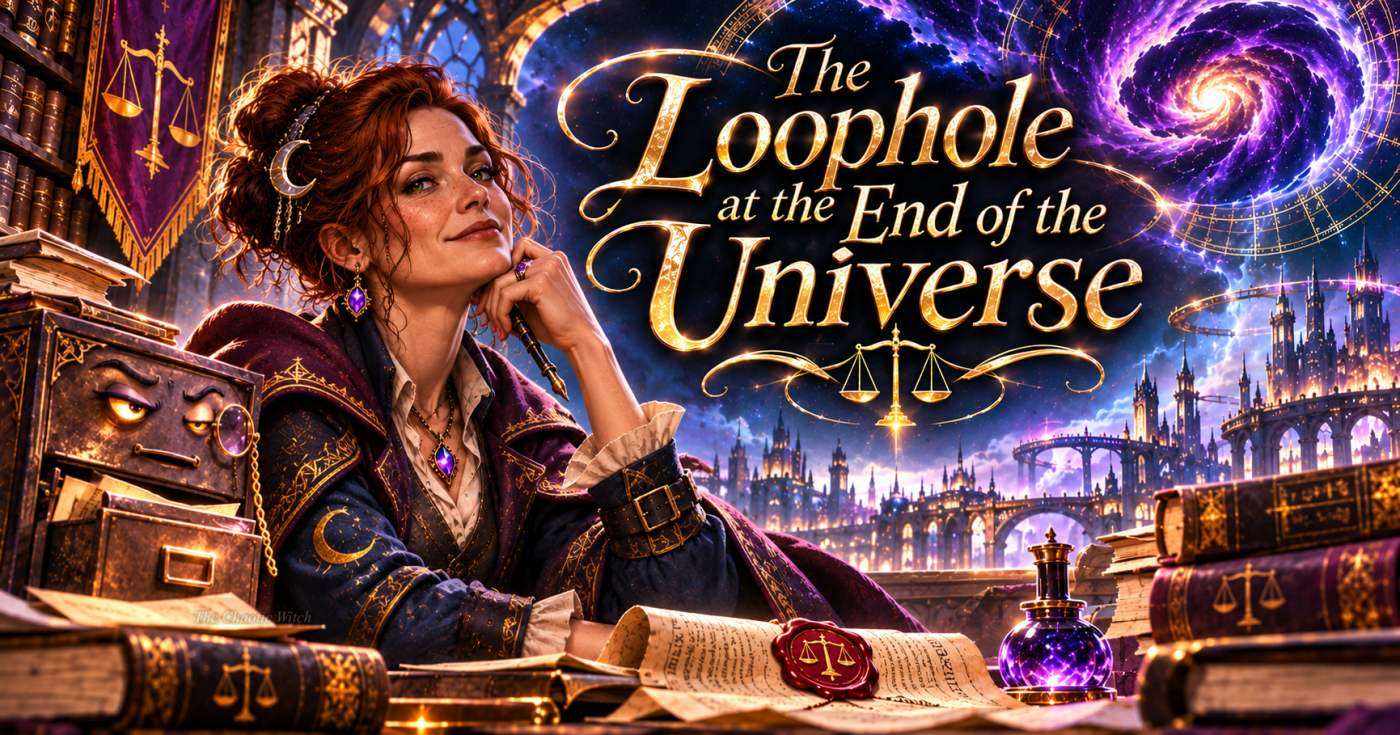
In the city of Bellwether, magic was not mysterious. It was contractual. Rain fell because someone had negotiated a precipitation agreement with the Goddess of Storms. Flowers bloomed because the Department of Seasonal Affairs maintained a perfectly respectable licensing arrangement with the minor deity of Spring. Even the sunrise was governed by a renewable celestial illumination contract, complete with a termination clause, three arbitration provisions, and a remarkably unpleasant penalty for late payment. The gods had once ruled the world through thunderbolts and prophecy, but humanity had discovered something considerably more powerful than worship. Humanity had invented lawyers.
For centuries, the system had worked beautifully. Every city employed magical solicitors to negotiate with its resident deities, and every spell was drafted as a binding agreement. A properly worded contract could compel a river to change course, persuade gravity to briefly overlook an unfortunate fall, or convince a stubborn winter to surrender three weeks early. Poorly drafted contracts, however, were dangerous. A missing comma had once caused the entire population of Westhaven to speak exclusively in rhyming couplets for seventeen years. An improperly defined eternity had trapped a mayor inside a municipal fountain, and the city was still paying him a pension. Consequently, magical law was regarded as the most important profession in civilization, and its practitioners were compensated accordingly.
Unfortunately, nobody had informed Mara Ellison of that last part.
At thirty-nine, Mara was a magical defense attorney whose career had taken a spectacular nosedive. She had once been considered one of Bellwether’s most promising advocates, specializing in defending ordinary citizens against unreasonable divine contracts. Then she had made the professional mistake of winning a case against the God of Prosperity. The deity had been illegally collecting seven percent of every wish granted within city limits, and Mara had successfully argued that happiness could not be classified as taxable income. The judgment had been hailed as a landmark victory for mortal rights. The God of Prosperity, who possessed the emotional maturity of a spoiled twelve-year-old and the financial resources of a small continent, had responded by ensuring that Mara never experienced prosperity again.
Within six months, her prestigious law firm had dismissed her, her apartment had been repossessed, and every investment she’d ever made had mysteriously transformed into commemorative spoons. She now operated from a cramped office above a bakery, where the ceiling leaked whenever someone nearby experienced a strong emotion. Her only employee was a sarcastic enchanted filing cabinet named Gerald, who had developed an unfortunate habit of refusing to open unless addressed as “Your Administrative Majesty.” Mara survived by defending minor magical offenders, including unlicensed fortune-tellers, amateur necromancers, and one elderly gentleman accused of illegally summoning rain clouds over his neighbour’s barbecue.
On the morning the universe began to unravel, Mara was eating stale toast and arguing with Gerald about unpaid rent when the first impossible thing happened. The clock on her wall struck thirteen. This was particularly alarming because it was nine in the morning, and the clock had never been especially ambitious. Then the rain outside stopped falling and began moving sideways. A pigeon flew backward past the window, followed by a second pigeon that appeared to be travelling through yesterday. Mara watched the spectacle with the exhausted expression of someone who had already experienced enough nonsense before breakfast.
“Gerald,” she said slowly, “is the world ending?”
The filing cabinet rattled thoughtfully. “Possibly. Although, given your current financial situation, I imagine you’ll be disappointed to learn that outstanding debts survive most apocalyptic events.”
Before Mara could respond, the office door burst open and a woman in silver judicial robes stumbled inside. Her hair floated around her head as though gravity had forgotten its responsibilities, and her expression suggested she had recently witnessed something that would require extensive therapy.
“Are you Mara Ellison?” the woman demanded.
“That depends. Are you collecting money?”
“I am Chief Clerk Isadora Venn of the Universal Court of Binding Obligations.”
Mara considered this information. “In that case, I’m definitely not.”
Isadora ignored her and slammed a glowing document onto the desk. The parchment was several feet long, covered in shifting symbols, and appeared to be quietly screaming. Mara leaned forward, recognized the official seal, and immediately wished she’d stayed in bed.
“This is a notice of imminent default judgment,” Isadora explained. “Humanity has allegedly breached the Grand Concordance of Municipal Magic. Unless a successful defense is filed before the final bell tonight, the universe will terminate the human species as an unauthorized contractual entity.”
Mara stared at her. “Terminate?”
“Yes.”
“As in revoke our magical privileges?”
“No. As in erase humanity from existence, including all past, present, and future instances of human life.”
Mara slowly set down her toast. “That seems excessive for a paperwork issue.”
“It’s not a paperwork issue. It’s a catastrophic violation of cosmic law.”
“Which, historically, is just paperwork with better lighting.”
Isadora explained that seven major cities had recently signed the Grand Concordance, an unprecedented magical agreement designed to distribute divine resources equally across the continent. For generations, wealthy cities had monopolized the most powerful deities, purchasing favorable weather, abundant harvests, extended daylight, and occasional exemptions from gravity. Poorer communities received whatever magic remained, which generally amounted to mild breezes and the occasional cooperative mushroom. The Concordance was intended to correct that injustice by establishing a shared network through which all seven cities could access the same magical resources.
The agreement had been celebrated as humanity’s greatest achievement in magical cooperation. Unfortunately, the spell had begun malfunctioning three days earlier. In Harrowgate, people were aging backward. In Larkspur, every Tuesday had been replaced by an additional Thursday. In Eastmere, the ocean had developed an attitude and was refusing to approach the shore without written assurances of appreciation. Meanwhile, Bellwether’s gravity had become intermittent, and several government officials were currently floating above the city hall chamber, which Mara privately considered an improvement.
“The Concordance is collapsing,” Isadora said. “And because all seven cities signed as representatives of humanity, the court considers the entire species jointly liable.”
Mara frowned. “Who drafted the agreement?”
“The Seven High Magisters.”
“Ah.”
“You know them?”
“I know their work. One of them once wrote a contract granting a duke unlimited personal space. The duke is now legally entitled to three square miles around his body. His wife hasn’t been able to hug him since.”
Isadora pressed her lips together. “Will you take the case?”
Mara glanced at the document, then at the ceiling, where a fresh leak had begun dripping directly onto her electricity bill. “What’s the fee?”
“The court can offer you complete restoration of your professional standing, cancellation of all debts, and immunity from divine retaliation.”
Mara considered this. “And if I lose?”
“You’ll cease to exist.”
“Gerald, clear my schedule.”
“You have no appointments,” the cabinet replied.
“Then clear them aggressively.”
Within an hour, Mara was standing inside the Universal Court, a vast marble chamber suspended somewhere outside ordinary space. The ceiling contained entire galaxies, the floor reflected events that had not yet happened, and the benches were occupied by gods, spirits, cosmic accountants, and several concepts that had apparently developed legal representation. At the center of the chamber sat the presiding judge, an enormous figure composed of shifting stars and ancient mathematical symbols. Its name was the Honorable Principle of Causality, although most attorneys simply called it Your Inevitability.
Opposing counsel was Lord Severin Thorne, the most expensive magical prosecutor in existence. He wore immaculate black robes, carried a briefcase made from the condensed regrets of defeated attorneys, and possessed a smile that suggested he had never paid for his own lunch. Mara recognized him immediately. Severin had represented the God of Prosperity during the case that destroyed her career, and judging by his expression, he remembered her too.
“Well,” he said pleasantly, “if it isn’t Mara Ellison. I thought you’d retired.”
“I tried,” Mara replied. “Unfortunately, poverty proved less relaxing than advertised.”
Severin smiled. “I do hope you’re prepared. This is rather more complicated than defending an illegal rain cloud.”
“Don’t underestimate rain clouds. At least they understand the concept of reasonable doubt.”
The judge struck its gavel, causing three nearby stars to flicker. Severin presented the prosecution’s case with theatrical confidence, explaining that the Grand Concordance required all seven cities to maintain a perfectly synchronized magical exchange. Each municipality had agreed to contribute a fixed percentage of its divine resources at precisely the same universal instant. This synchronization was essential, he argued, because the spell depended upon absolute simultaneity. Every transfer had to occur at exactly the same moment, with no delay, variation, or exception.
Mara examined the agreement while Severin continued speaking. It was four thousand pages long, written in fourteen languages, and contained so many footnotes that several had developed their own footnotes. She found provisions governing weather, fertility, energy, healing, and the movement of celestial bodies. There were clauses addressing divine misconduct, mortal negligence, supernatural interference, and the unauthorized creation of additional Mondays. Buried near the end was a section titled Absolute Temporal Compliance, which required all participating cities to fulfill their obligations simultaneously, “as defined by the fundamental physical laws governing the universe.”
Mara read that sentence again.
Then she read it a third time.
Something about it bothered her, although she couldn’t immediately explain why.
Severin concluded his argument by presenting evidence of the system’s failure. Seven enormous clocks appeared above the courtroom, each representing one of the participating cities. Their hands spun wildly, sometimes moving forward, sometimes backward, and occasionally turning into small argumentative birds. The magical exchange had become hopelessly unstable. Unless the contract was repaired, the Concordance would continue tearing apart the underlying structure of reality until the universe itself became incapable of supporting human existence.
“Humanity has breached its obligations,” Severin declared. “The contract explicitly provides for termination in the event of catastrophic default. We therefore request immediate judgment.”
The judge turned toward Mara. “Counsel for humanity, how do you plead?”
Mara looked at the clocks, then at the four thousand pages of contractual misery spread across her desk. She had no evidence, no expert witnesses, and approximately eleven hours before everyone she’d ever known was erased from existence. Nevertheless, she stood, adjusted her slightly frayed jacket, and cleared her throat.
“Your Inevitability, humanity pleads not guilty. Also, I would like to register a preliminary objection to the phrase ‘everyone ceases to exist,’ which seems unnecessarily dramatic for a first offense.”
The judge did not appear amused.
Mara sat down.
Her first six hours were a disaster.
She questioned the Magisters who had drafted the Concordance, only to discover that none of them had actually read the entire document. One had delegated the work to an apprentice. Another had relied on a prophetic writing quill that turned out to be predicting events from an entirely different universe. The third admitted that he’d copied several provisions from an ancient treaty governing the migration of enchanted sheep. Mara spent forty minutes attempting to understand why a continental magical agreement contained a clause about acceptable wool density before deciding that some mysteries were best left unsolved.
She interviewed the local deities responsible for the resource exchanges. The Goddess of Storms complained that the agreement required her to deliver identical rainfall across cities with completely different climates. The Spirit of Harvests objected to being contractually obligated to produce strawberries during winter. The God of Time, who arrived seventeen minutes before he’d been summoned and insisted that he was late, claimed the synchronization requirements were physically impossible.
Mara stopped writing.
“I’m sorry,” she said. “Could you repeat that?”
The God of Time looked irritated. He resembled a tired grandfather wearing a waistcoat covered in moving clock faces. “I said the synchronization requirements are physically impossible. There is no universal present. There never has been. I explained this to the Magisters, but they told me the contract had already been printed.”
Mara stared at him.
“No universal present?”
“Of course not. Haven’t you heard of relativity?”
Mara had, although her knowledge of physics was limited to the understanding that dropping heavy objects on one’s foot was generally unpleasant. The God of Time sighed and explained that simultaneity was not absolute. Events occurring in different places could be judged simultaneous by one observer but not by another moving relative to the first. There was no single universal clock against which every event could be measured.
Mara slowly looked down at the Concordance.
All seven cities were required to exchange magical resources at precisely the same universal instant.
But according to the fundamental laws of physics, no such absolute instant existed.
A smile began spreading across her face.
“Oh,” she whispered.
The God of Time narrowed his eyes. “What?”
“Oh, you magnificent, inconvenient old bastard.”
Mara ran from the witness chamber so quickly that she collided with a passing minor deity of Doorways, who immediately threatened to sue her for improper passage. She apologized, promised to send him a fruit basket, and continued sprinting toward the courtroom.
By the time she arrived, Severin was already requesting final judgment. The seven clocks above the court had begun melting into one another, and the stars in the ceiling were flickering like faulty lightbulbs. Beyond the chamber, reality was visibly deteriorating. Entire mountains were briefly appearing upside down. Rivers were forgetting which direction to flow. In Bellwether, Mara’s office had reportedly developed a second floor that existed only on alternate Wednesdays.
She burst through the courtroom doors.
“OBJECTION!”
The judge turned toward her.
“Counsel, proceedings are nearly concluded.”
“Then I have excellent timing, which is ironic, because timing is precisely the problem.”
Severin sighed. “Your Inevitability, this is clearly a delaying tactic.”
“Actually,” Mara replied, “it’s a relativity tactic.”
She marched toward the center of the chamber, carrying the Grand Concordance beneath one arm. The courtroom fell silent as she opened the document to the temporal compliance clause.
“Your Inevitability, the prosecution claims that humanity breached this agreement by failing to exchange magical resources at the same universal instant. But the contract specifically defines that instant according to the fundamental laws of physics. And under those laws, there is no absolute simultaneity between distant events.”
Severin frowned.
Mara continued, gathering confidence. “Two observers moving relative to one another may disagree about whether distant events occurred at the same time. Neither observer is necessarily wrong. The Concordance requires something that physics does not define. It demands compliance with a universal moment that doesn’t exist.”
The judge’s stars shifted thoughtfully.
Severin recovered quickly. “The magical exchange was synchronized through the Central Celestial Clock. That establishes a common reference.”
“A chosen reference frame,” Mara corrected. “Not a universal one. The contract doesn’t say the cities must exchange resources according to the Central Celestial Clock. It says they must do so at the same universal instant, as defined by physics. Your client cannot retroactively substitute a clock simply because the universe refuses to cooperate with the paperwork.”
Severin’s expression hardened. “This is semantic nonsense.”
“Semantic nonsense is literally our profession.”
A murmur rippled through the courtroom.
Mara pressed forward. “The alleged breach depends on a condition that cannot be satisfied or violated in the absolute terms the contract specifies. There is no legally defined universal instant at which humanity failed to perform. Without an identifiable breach, the termination clause cannot be triggered.”
The judge remained silent for so long that Mara began to wonder whether she’d accidentally offended causality itself.
Then Severin smiled.
“An interesting argument,” he admitted. “But unfortunately irrelevant.”
Mara felt her stomach drop.
“The contract contains a severability provision,” Severin continued. “If any clause is deemed invalid, the remaining obligations survive. Even if the temporal requirement fails, humanity remains responsible for the resource imbalance. The default judgment still stands.”
He turned toward the judge.
“And I believe counsel has just demonstrated that the agreement is fundamentally defective.”
Mara looked down at the contract.
He was right.
The timing clause might be unenforceable, but the seven cities had still received enormous quantities of divine resources without delivering the agreed exchange. Removing the synchronization requirement would not automatically restore balance. It would simply leave the entire system without a mechanism for determining when payments were due.
The judge raised its gavel.
“Humanity has failed to demonstrate a complete defense.”
Mara’s mind raced.
The clocks were collapsing. The stars were going dark. Somewhere beyond the courtroom, billions of people were continuing their ordinary lives, unaware that a poorly drafted contract was about to delete them from history.
She thought of the bakery beneath her office, of Gerald complaining about rent, of the elderly man who had only wanted a little rain to annoy his neighbour. She thought of every ordinary person who had never signed the Concordance, never approved its terms, and never benefited from its extravagant promises.
Then she remembered something she’d learned during her very first year of law school.
A contract could not bind a person who had never agreed to become a party.
Mara looked up.
“Your Inevitability, I request permission to call one final witness.”
Severin laughed. “And who would that be?”
“Humanity.”
The courtroom went silent.
The judge regarded her with an expression that might have been curiosity, although it was difficult to tell with a face composed of rotating constellations.
“Explain.”
Mara took a deep breath. “The Seven High Magisters signed this agreement on behalf of every human being in existence. But where is the instrument granting them that authority? Where is the evidence that humanity consented to collective liability? Where is the vote, the mandate, or even a properly witnessed authorization?”
Severin opened his mouth.
Mara raised a finger.
“And before you say the Magisters possessed inherent authority, I would remind the court that magical authority and legal authority are not the same thing. A wizard can turn someone into a frog. That doesn’t make him their accountant.”
Several deities nodded appreciatively.
Mara continued. “The Concordance attempted to bind all humanity through seven representatives who were never authorized to accept extinction as a penalty. Even if the agreement remains enforceable against the participating cities, the termination provision cannot extend to every person who never consented.”
The judge lowered its gavel slightly.
Severin’s smile had vanished.
“Furthermore,” Mara said, “the agreement contains an impossible synchronization condition. The prosecution cannot identify an absolute moment of breach, and it cannot establish valid consent from the species it seeks to erase. The universe may have a legitimate claim for unpaid magical resources, but it does not have grounds to terminate humanity.”
She paused, looking directly at the enormous cosmic judge.
“In other words, Your Inevitability, my clients may owe the gods a considerable amount of magic, but they do not owe them their existence.”
For several seconds, nothing moved.
Then the judge spoke.
“The court finds that the temporal compliance provision lacks an enforceable absolute standard under the physical laws expressly incorporated into the agreement.”
The stars above the chamber brightened.
“The court further finds that the Seven High Magisters lacked authority to impose species-wide termination liability upon nonconsenting persons.”
Mara held her breath.
“The motion for universal default judgment is denied.”
The courtroom erupted.
Gods shouted. Spirits cheered. Several cosmic accountants fainted, which was particularly impressive because they did not technically possess bodies. The seven enormous clocks shattered into glittering fragments, and the spreading distortions of reality stopped expanding.
Mara closed her eyes.
Humanity had survived.
Unfortunately, the universe was still malfunctioning.
The judge raised its gavel again.
“Counsel, the court must now address the outstanding resource imbalance.”
Mara opened one eye.
“Oh, for the love of—”
“The Concordance remains partially enforceable. The seven cities must establish a lawful exchange mechanism before the existing magical network collapses. You have forty-seven minutes.”
Mara stared at the judge.
“Forty-seven minutes?”
“Yes.”
“Could we negotiate an extension?”
“No.”
“Thirty minutes?”
“That would be a reduction.”
“I’ve had a very long day.”
The judge was unmoved.
Mara turned toward the God of Time, who was sitting in the gallery eating a biscuit that appeared to be aging backward.
“Can you help?”
He shrugged. “I could give you another hour, but it would have to come from somewhere.”
“Where?”
“Next Thursday.”
Mara considered this.
“Does anyone particularly need next Thursday?”
A woman in the gallery raised her hand.
“It’s my wedding anniversary.”
“Fine. We’ll do it the difficult way.”
For the next forty minutes, Mara conducted the most frantic negotiation in recorded history. She gathered the seven municipal representatives, the participating deities, and a deeply unwilling Severin around a table that had been conjured from pure administrative necessity. She discarded the impossible universal synchronization requirement and replaced it with a sequence of local exchanges, each defined by measurable events and agreed reference frames. Rather than demanding that every city transfer resources simultaneously, the revised agreement allowed exchanges to occur in an orderly progression, with each obligation triggered by confirmation that the previous transfer had been completed.
The Goddess of Storms agreed to distribute rainfall according to regional needs. The Spirit of Harvests received permission to observe actual growing seasons. The God of Time insisted on a provision prohibiting unauthorized additional Thursdays, which Mara accepted without argument. A new oversight council was established, including representatives from ordinary communities rather than only wealthy cities and powerful magicians. Most importantly, the contract prohibited the use of human extinction as a remedy for future administrative failures.
Severin objected to that last clause.
Mara stared at him.
“Are you seriously arguing that extinction should remain an available collection method?”
“It’s an effective deterrent.”
“So is setting your office on fire. We don’t generally recommend it in contract negotiations.”
The clause remained.
With three minutes to spare, the revised agreement was signed.
The courtroom trembled as the new magical network activated. Across the seven cities, rivers returned to their proper courses, mountains settled into their customary positions, and people who had been aging backward resumed moving through life in the usual direction. Bellwether’s gravity stabilized, causing several floating government officials to land rather unceremoniously on the city hall floor. In Larkspur, Tuesday returned, much to the disappointment of everyone who had enjoyed the additional Thursday.
The judge examined the completed agreement.
“Acceptable.”
Mara collapsed into her chair.
“That’s the nicest thing anyone’s said to me all week.”
The court awarded her the promised restoration of her career, cancellation of her debts, and immunity from divine retaliation. It also granted her a substantial professional fee, payable in ordinary currency rather than wishes, blessings, or commemorative spoons. Severin departed without offering congratulations, although Mara noticed that he had developed a small twitch near his left eye.
She considered that an additional victory.
When Mara finally returned to Bellwether, dawn was breaking over the rooftops. The streets were filled with people celebrating the restoration of normality, although most had only a vague understanding of what had happened. Newspapers announced that a catastrophic magical malfunction had been resolved through emergency legal proceedings. One particularly dramatic headline declared that humanity had survived the apocalypse thanks to a technicality.
Mara purchased a fresh pastry from the bakery beneath her office and climbed the stairs.
Gerald greeted her with an indignant rattle.
“Where have you been? The ceiling turned into a waterfall, the landlord called twice, and someone delivered fourteen boxes of commemorative spoons.”
Mara stopped.
“Fourteen?”
“Yes. Apparently, the God of Prosperity has discovered that he cannot retaliate against you directly, so he’s sending unsolicited merchandise.”
Mara sighed.
“Donate them to charity.”
“I already did.”
“Excellent.”
“The charity returned them.”
Mara sat at her desk, opened her pastry bag, and looked out at the city. The sun was rising exactly as it should, according to a newly revised celestial illumination contract that she had personally insisted contain no references whatsoever to absolute simultaneity.
For the first time in years, her future looked promising.
Her debts were gone. Her reputation was restored. She had saved the entire human species from being erased by a cosmic court, and her office ceiling had finally stopped leaking.
Then someone knocked on the door.
Mara looked up.
A small, nervous-looking deity stood in the doorway, clutching a folder.
“Are you Mara Ellison, the attorney who saved humanity?”
“That depends,” Mara replied cautiously. “What seems to be the problem?”
The deity shifted uncomfortably.
“Well, I’m the minor God of Lost Socks, and I believe I’ve been wrongfully accused of stealing approximately forty-seven million articles of clothing.”
Mara slowly lowered her pastry.
“Have you?”
“Technically, yes. But I believe there’s been a misunderstanding concerning the definition of permanent possession.”
Gerald’s drawers rattled with laughter.
Mara stared at the little god for several seconds before reaching for a fresh legal pad.
“Sit down,” she said. “And for the love of everything sacred, please tell me you didn’t sign anything.”
The deity hesitated.
Mara closed her eyes.
“Oh, wonderful.”
Outside, the sun climbed higher, the city continued its ordinary business, and the universe remained gloriously intact.
For now.
Because in a world where magic was governed by contracts, gods could be sued, and the laws of physics contained exploitable loopholes, one truth remained absolutely certain.
There was always another idiot with a pen.
And somewhere, inevitably, a lawyer would have to clean up the mess.
A little magic is always waiting. Subscribe and step inside the circle. 🖤🔮✨


Leave a Reply