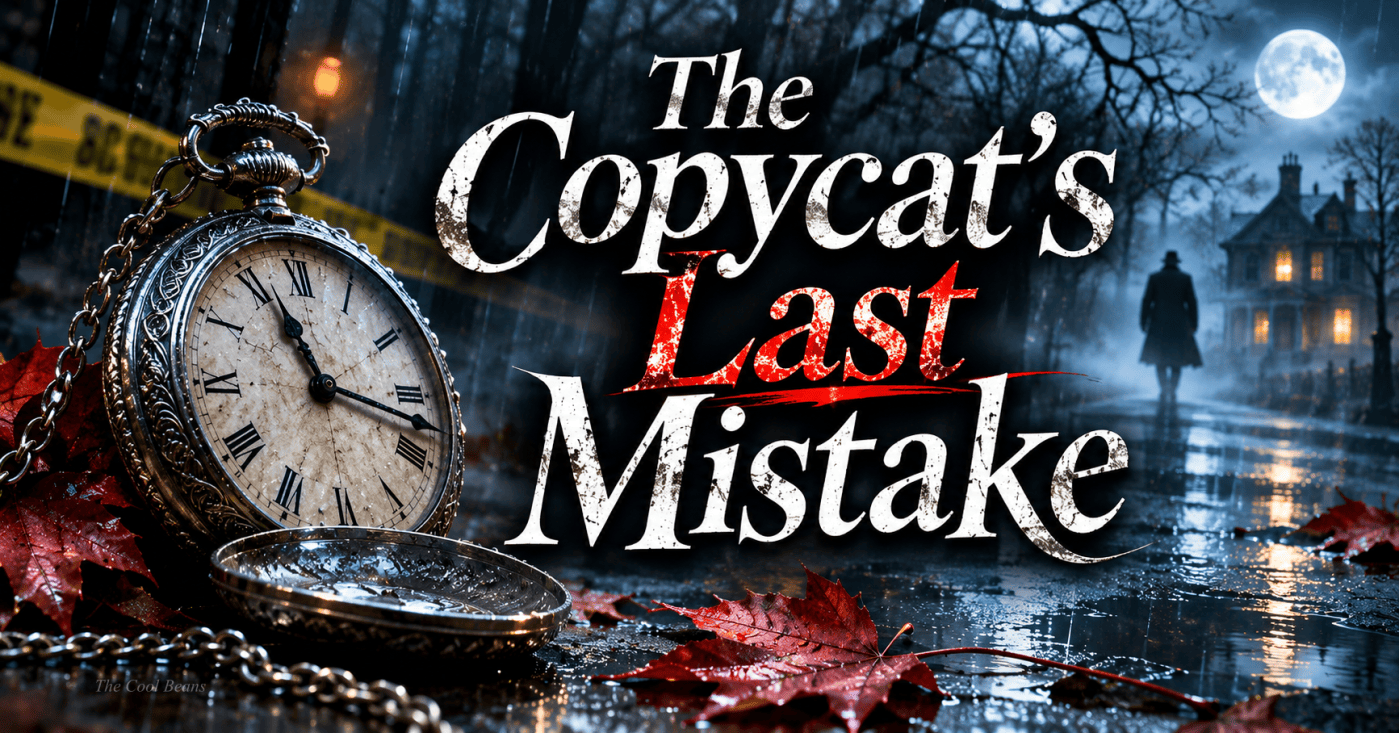
The first murder happened on a Tuesday, just as the rain began falling over the quiet town of Briarwood. At 7:42 the following morning, police discovered the body of forty-six-year-old Thomas Bennett inside his home. There were no signs of forced entry, no indication of a struggle, and nothing appeared to have been stolen. His wallet, watch, and expensive collection of antique coins remained untouched. But something had been deliberately left behind. On the dining room table sat a small silver pocket watch, its hands frozen at exactly 11:17.
Detective Evelyn Carter stared at the watch for a long time before speaking. “Tell me that’s a coincidence.” Her partner, Detective Marcus Reed, looked uncomfortable. “I was hoping you’d say it first.” Twenty-three years earlier, Briarwood had been terrorized by a serial killer the newspapers called the Clockmaker. Over eighteen months, four people had been murdered in their homes, each discovered with an identical silver pocket watch stopped at 11:17. The killer had never been identified.
The case had eventually faded from the headlines, becoming the subject of documentaries, books, and endless speculation. For most residents, the Clockmaker was little more than a frightening story from Briarwood’s past. For Evelyn, however, the case was painfully personal. Her father had been the lead investigator, and the Clockmaker had been the case that destroyed his career.
By the end of the week, a second body had been discovered. This time, the victim was thirty-nine-year-old Rebecca Shaw, a local accountant who lived alone in a quiet neighbourhood on the outskirts of town. Another silver pocket watch sat on her kitchen counter, its hands pointing to 11:17. Just like the first crime, there was no obvious connection between the victim and the killer. The newspapers immediately resurrected the old nickname, announcing that the Clockmaker had returned.
Evelyn hated the headlines. “He’s not back,” she told Marcus as they reviewed the crime scene photographs. “The original killer disappeared twenty-three years ago. This is someone copying him.” Marcus wasn’t convinced and asked how she could be so certain. Evelyn placed two photographs beside each other. One showed the pocket watch recovered from Rebecca’s kitchen, while the other showed a watch from the original investigation.
“Look at the position,” Evelyn instructed. Marcus leaned forward and observed that both watches pointed to eleven seventeen, but Evelyn shook her head. “That’s not what I mean. The Clockmaker left the watches somewhere near the victims. Sometimes on a table, sometimes on a windowsill. There was no consistent placement. But our new killer puts them somewhere prominent, perfectly positioned to be discovered.” Marcus considered this before suggesting that the killer was arranging the scenes like photographs. Evelyn nodded. Someone wasn’t recreating the murders themselves. They were recreating what they believed the murders had looked like.
Three days later, Evelyn visited her father. Arthur Carter lived in a small cottage outside Briarwood, surrounded by overgrown gardens and shelves of books he rarely read anymore. At seventy-four, he remained sharp, although the old investigation had left him bitter and suspicious. When Evelyn showed him the photographs, he studied them without speaking before finally pushing them away. “That’s not him,” he declared.
Evelyn explained that she already suspected a copycat, but Arthur shook his head. “No, Evelyn. You don’t understand. That’s not how the Clockmaker worked.” When she asked what he meant, he told her that the watches weren’t the killer’s real signature. Evelyn protested that every report had identified them as such, but Arthur insisted that the reports were wrong.
He stood and walked toward a cabinet, retrieving a battered cardboard box from its bottom drawer. Inside were old photographs, handwritten notes, and yellowing newspaper clippings. “The watches were important,” he explained, handing her a photograph, “but they weren’t the real signature.” Evelyn examined the picture, which showed a pocket watch lying beside a ceramic vase. At first, she saw nothing unusual. Then she noticed that the watch had no second hand.
Arthur nodded. Every watch recovered from the original murders had its second hand removed. The police had deliberately withheld that information because they wanted a detail only the real killer would know. Evelyn immediately recalled the photographs from the two recent murders. Both watches had second hands, confirming that whoever was committing the new crimes knew only what had been made public.
But Arthur had another revelation. The original watches hadn’t been stopped at 11:17 at all. They had been stopped at 11:16. The first newspaper report had mistakenly identified the time, and by the time police corrected the information, the error had already spread. Evelyn could scarcely believe that for twenty-three years, everyone had been repeating the wrong time. Arthur gave a tired smile and remarked that sometimes a mistake became more famous than the truth.
Evelyn returned to the station with a new theory. Their killer wasn’t necessarily someone connected to the original murders. It was someone obsessed with the legend, someone who had studied the documentaries, memorized the newspaper articles, and convinced themselves they understood the Clockmaker better than the police ever had. Marcus pointed out that this description could apply to countless true-crime enthusiasts. Evelyn agreed, but insisted they needed to find the person whose fascination had turned into murder.
They began examining the victims’ lives. Thomas Bennett had worked in insurance, while Rebecca Shaw had been an accountant. They lived in different neighbourhoods, moved in different social circles, and appeared never to have met. Then a young analyst discovered something unusual. Both victims had attended a private event six months earlier, a book launch celebrating the publication of Eleven Seventeen: The Unsolved Clockmaker Murders, written by local true-crime author Nathaniel Price.
Evelyn remembered the book. It had become a bestseller almost overnight, reviving public interest in the old murders. Its author had been particularly vocal about his belief that the Clockmaker was still alive.
Nathaniel Price welcomed the detectives into his immaculate townhouse with the confidence of a man accustomed to being interviewed. He was forty-two, handsome in a carefully maintained way, and wore a dark sweater that looked expensive enough to require its own insurance policy. He greeted Evelyn warmly and remarked that her father had been quite a legend. Evelyn didn’t return his smile. She explained that they were investigating two murders and that both victims had attended his book launch.
Nathaniel acknowledged that hundreds of people had attended the event, although he couldn’t remember whether he’d spoken to either victim. Evelyn glanced around the room, noticing framed newspaper articles about the Clockmaker covering the walls. Several shelves held antique clocks, while a glass cabinet displayed an impressive collection of pocket watches. Marcus commented on the collection, and Nathaniel explained that his research had gradually become a hobby.
One silver watch stood out to Evelyn. It was engraved with delicate flowers and looked almost identical to those recovered from the recent murders. She asked where Nathaniel had obtained his collection, and he explained that he purchased watches from antique shops, auctions, and online collectors. When asked for receipts, he immediately produced a neatly organized folder. Everything appeared legitimate, almost too legitimate.
Before leaving, Evelyn asked why he’d written about the Clockmaker. Nathaniel smiled and replied that some stories deserved to be remembered. Evelyn held his gaze and asked whether that was still true when remembering them inspired someone to kill. For the first time, his confident smile faltered.
The third murder occurred four nights later. The victim was Margaret Ellis, a retired schoolteacher who had also attended Nathaniel’s book launch. But this time, the killer left something different. Beside the silver pocket watch was a folded piece of paper bearing seven words: You are getting closer than you think.
Marcus believed the killer was communicating with the police, but Evelyn disagreed. She was certain the message was intended specifically for her. The murderer was no longer simply repeating the Clockmaker’s crimes. He was turning the investigation into a performance, and Evelyn was becoming his audience.
That evening, Evelyn returned home exhausted. She poured herself a glass of water, switched on the kitchen light, and stopped. Something was sitting on her dining room table. It was a silver pocket watch, its hands pointing to 11:17. Beside it lay an envelope with her name written across the front. Inside was a photograph showing Evelyn standing outside Nathaniel Price’s townhouse. On the back, someone had written, You should have asked him about the fifth victim.
Evelyn immediately called Marcus, and within twenty minutes, officers surrounded her house. The photograph was taken into evidence while Evelyn tried to understand the message. There had only been four confirmed Clockmaker murders. Was the killer suggesting that someone else’s death had never been connected to the original investigation, or was he referring to someone who had survived?
At three in the morning, she remembered something her father had once mentioned. A woman named Eleanor Voss had reported a frightening encounter with a stranger who entered her home carrying a silver pocket watch. She had escaped unharmed, and although police investigated, the incident was never officially connected to the Clockmaker. Evelyn searched the old files and discovered that Eleanor had died eight years earlier. But she had left behind a son, Nathaniel Price.
The revelation sent Evelyn racing back to her father’s cottage. Arthur opened the door wearing his dressing gown and grumbling about the hour. When Evelyn announced that Nathaniel Price was Eleanor Voss’s son, Arthur went completely still. She explained that Nathaniel had changed his surname when he was nineteen and immediately noticed her father’s reaction.
“You knew,” she said. “You knew who he was.” Arthur rubbed his forehead before admitting that Eleanor had contacted him after the murders stopped. She had told him that her teenage son had become obsessed with the Clockmaker, collecting newspaper clippings and asking questions about the investigation. When Evelyn demanded to know why he hadn’t shared that information, Arthur replied that being fascinated by a murder case wasn’t a crime.
Evelyn felt her anger rising. Three people were dead, and her father had withheld information that might have been important. Arthur looked at her sadly and asked whether she thought he didn’t understand that. She turned toward the door, but something about their conversation bothered her. Suddenly, she remembered the missing second hands.
“How did Eleanor know about the missing second hands?” Evelyn asked. Arthur looked up sharply. She reminded him that the information had never been released, yet Eleanor had apparently known enough to convince him that she’d encountered the Clockmaker. Arthur’s expression changed ever so slightly, but Evelyn noticed. When she pressed him, he closed his eyes and whispered that there were things about the investigation she didn’t understand.
For the first time in her life, Evelyn wondered whether her father’s obsession with the Clockmaker had been something other than a detective’s determination to solve a case.
The following morning, Evelyn returned to Nathaniel’s townhouse with a search warrant. He was gone. His car remained in the driveway, his phone lay on the kitchen counter, and a half-finished cup of coffee sat beside his computer. On the desk was a manuscript titled The Clockmaker’s Final Chapter.
Evelyn opened it and began reading. The first pages described the original murders, the investigation, and the mistakes that had allowed the killer to escape. Then the narrative changed. The manuscript began describing the recent killings of Thomas Bennett, Rebecca Shaw, and Margaret Ellis. Every detail matched the crime scenes.
She turned another page and found a chapter titled The Detective’s Daughter. Her stomach tightened as she read a description of a woman arriving at her father’s cottage late at night, demanding answers about a twenty-three-year-old murder investigation. The manuscript described their argument, her growing suspicion, and the old man’s fear.
Then came a sentence that made Evelyn’s blood run cold. What Detective Carter failed to understand was that the copycat had never intended to imitate the Clockmaker forever. He only needed to draw the original killer out of hiding.
Evelyn read the sentence twice before grabbing her phone and calling Marcus. She ordered him to send officers to her father’s house immediately.
Arthur Carter was sitting at his kitchen table when Evelyn arrived. Nathaniel Price sat opposite him, and between them lay a silver pocket watch. Its hands pointed to 11:16.
Evelyn drew her weapon and ordered both men to remain still. Nathaniel slowly raised his hands, while Arthur didn’t move at all. Evelyn accused Nathaniel of murdering three people to recreate the Clockmaker’s crimes. To her astonishment, he calmly admitted that he had done exactly that. He explained that he wanted Arthur to remember.
Evelyn looked toward her father, who continued staring at the table. Nathaniel explained that his mother hadn’t merely escaped the Clockmaker. She had recognized the man who entered her house because he’d visited her two days earlier as a detective. Evelyn shook her head in disbelief, but Nathaniel continued. Eleanor had confronted Arthur, who convinced her that nobody would believe her accusations and threatened to make her life miserable if she spoke publicly.
Arthur finally interrupted, telling Nathaniel he’d said enough. But Nathaniel wasn’t finished. He described how his mother had spent the rest of her life afraid of the detective who was supposed to protect her. Evelyn turned toward her father and demanded that he tell her Nathaniel was lying.
Arthur’s face crumpled. For a moment, he looked impossibly old. Then, in a voice barely above a whisper, he admitted that he had never meant for any of it to happen.
Evelyn felt something inside her collapse as her father began confessing. He described the first murder as an act of anger, the second as an attempt to conceal the first, and the others as desperate efforts to redirect suspicion. Because he controlled the investigation, he had been able to alter evidence, invent theories, and send detectives chasing suspects who had nothing to do with the crimes. He had even encouraged the incorrect newspaper reports, allowing the wrong time and false details to become part of the Clockmaker legend.
Nathaniel watched the confession with an expression Evelyn couldn’t decipher. He smiled bitterly and announced that he’d known Arthur would eventually confess. Evelyn turned toward him and asked whether three innocent people had really needed to die to make that happen.
Nathaniel’s expression hardened. He insisted that those people had died because Arthur had gotten away with four murders. Evelyn immediately corrected him. Three people had died because Nathaniel had chosen to kill them. For the first time, the author had no answer.
The arrests made national headlines. Arthur Carter, once celebrated as Briarwood’s most determined detective, was charged in connection with the original murders. Nathaniel Price faced charges for the three recent killings. The revelations shattered the town, drawing journalists, documentary producers, and publishers eager to tell the extraordinary story.
Evelyn refused every interview request. For months, she struggled with the knowledge that the man who had taught her to believe in justice had spent decades hiding from it. She had devoted her career to following in his footsteps, never imagining that those footsteps led back to the very crimes he had sworn to solve.
But the most disturbing discovery came several weeks after the arrests. During a search of Nathaniel’s belongings, investigators recovered another manuscript. This one was unfinished and dated eighteen months before the first copycat murder.
Evelyn sat alone in her office and began reading. The manuscript described seven murders, not three. Each chapter contained detailed descriptions of victims, locations, and the silver watches that would be left behind. The first three chapters matched the recent crimes, but the fourth described Evelyn’s death. The fifth described Marcus, the sixth described a young woman who worked at the local library, and the seventh described Arthur Carter.
Evelyn stared at the final chapter. Nathaniel had claimed that his murders were intended to expose the original Clockmaker, but the manuscript told a different story. He hadn’t planned to stop after obtaining a confession. He had intended to surpass the original killer. Four murders had made the Clockmaker infamous, and Nathaniel wanted seven. He wanted his own name remembered, his own crimes studied, and his own story told for generations.
Evelyn closed the manuscript and sat silently for a long time. Then she noticed something written on the inside cover. It was a dedication that read, To the man who taught me that the best way to hide a monster is to make everyone look for someone else.
Beneath it was a final handwritten sentence.
And to the detective who almost believed me.
Evelyn looked toward the evidence box on her desk. Inside lay the pocket watch recovered from her home. For weeks, she had believed Nathaniel’s mistake was copying the wrong time, but now she understood that his greatest mistake had been something far simpler. He had mistaken her determination to uncover the truth for a willingness to accept his version of it.
Nathaniel had believed that by exposing Arthur, he could transform himself from a murderer into a man seeking justice. He had carefully constructed a story in which every terrible thing he did could be blamed on someone else’s crimes. He wanted the world to see him as the person who finally unmasked the Clockmaker, rather than as another killer who had destroyed innocent lives.
But Evelyn had refused to give him that ending.
She picked up the manuscript, placed it inside an evidence bag, and switched off her desk lamp. Outside, Briarwood’s clock tower struck eleven. She stopped in the doorway and listened as the bells echoed across the sleeping town.
For twenty-three years, the Clockmaker had been a ghost story, a frightening legend that haunted Briarwood long after the murders stopped. Now there were two killers behind bars, two families of victims finally beginning to receive answers, and a town struggling to understand how easily the truth had been hidden behind a carefully manufactured mystery.
Evelyn knew the story would be told and retold for years. There would be books, documentaries, interviews, and endless arguments about which killer had been worse. But she also knew something neither Arthur nor Nathaniel had ever understood.
The people they murdered were not characters in a story, and their deaths were not chapters in a competition for notoriety. They were human beings whose lives had been stolen by two men who believed their own importance mattered more than anyone else’s existence.
As Evelyn stepped into the cool night air, she made herself a promise. Whatever happened next, she would ensure that the victims’ names were remembered more clearly than the names of the men who killed them.
For twenty-three years, the Clockmaker had controlled the story.
Now the truth had finally caught up with him.
And neither killer would get to write the ending.
💜 Enjoying the chaos that is my life? Subscribe to The Cool Beans! It’s cheaper than therapy and slightly more organized 🤣


Leave a Reply