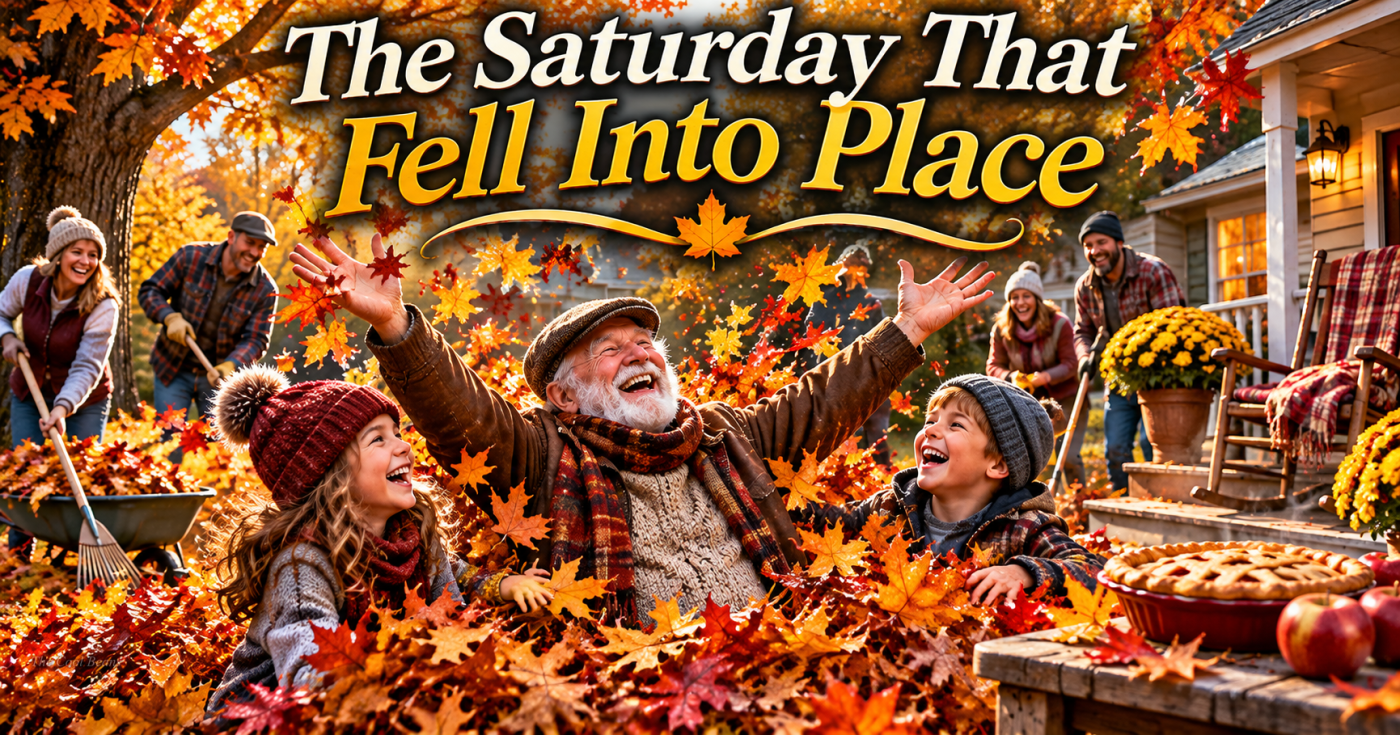
Every autumn, Harold Bennett faced the same unwelcome task. His enormous backyard, shaded by three magnificent oak trees, would disappear beneath a thick carpet of golden, copper, and rust-coloured leaves. By the middle of November, the leaves were so deep that his garden path vanished, his flower beds became impossible to distinguish, and his little wooden bench looked as though it were slowly being swallowed by the earth.
At seventy-eight, Harold no longer possessed the energy he once had. His knees complained when he bent down, his back stiffened after an hour of raking, and his old wheelbarrow seemed to grow heavier with every passing year. But the hardest part wasn’t the physical work. It was remembering how much his wife, Maggie, had loved this time of year.
Maggie had been the sort of woman who believed autumn leaves were far too beautiful to be considered a nuisance. Every October, she would stand beneath the oak trees, stretch her arms toward the falling leaves, and declare that Mother Nature was throwing the world’s most magnificent celebration. She loved the crunch beneath her boots, the smell of damp earth, and the way sunlight turned the garden into something resembling a painting.
Harold, on the other hand, had always preferred a tidy lawn. He would grumble about the endless raking while Maggie laughed and reminded him that the leaves would return whether he complained or not. She would bring him hot apple cider, steal his rake, and insist that they take a break to admire the colours. Sometimes, when she thought nobody was watching, she would kick an enormous pile of leaves into the air just to make him laugh.
Maggie had been gone for four years now, and autumn had never felt quite the same. The house was quieter, the garden seemed larger, and the annual chore had become a lonely reminder of the life they once shared. Harold still kept her gardening gloves hanging beside the back door, even though he knew she would never need them again.
On a chilly Saturday morning, Harold stood at his kitchen window with a mug of tea, surveying the seemingly endless sea of leaves. He had promised himself that today would be the day he finally tackled the yard. He had already dragged his rake out of the shed, found his oldest gardening boots, and prepared himself for several hours of exhausting work.
He sighed, finished his tea, and reached for his coat. Before he could open the back door, someone knocked at the front. Standing on his porch was nine-year-old Sylvia Miller from next door, wearing a bright yellow jacket and a knitted hat with a pom-pom almost as large as her head. Behind her stood her younger brother, Oscar, holding a rake that was considerably taller than he was.
“Good morning, Mr. Bennett!” Sylvia announced cheerfully.
Harold smiled. “Good morning, you two. What brings you out so early?”
Sylvia grinned. “We’ve come to help you with your leaves.”
Harold looked past her at the enormous yard. “That’s very kind, sweetheart, but I think you’ve underestimated the size of the job.”
“Oh, we know it’s big,” Sylvia replied confidently. “That’s why we brought reinforcements.”
Before Harold could ask what she meant, he heard voices coming from the sidewalk. Around the corner appeared Sylvia’s parents, followed by three neighbourhood teenagers carrying rakes, a retired couple with a wheelbarrow, and several more children bundled in colourful jackets and scarves. Within minutes, Harold’s front lawn resembled the gathering place for an unusually enthusiastic gardening convention.
Mrs. Patterson from across the street arrived carrying a thermos of hot chocolate. Mr. Dawson brought a leaf blower, although he admitted he wasn’t entirely certain how to operate it. The Wilson twins appeared with matching red rakes, and someone had even brought a portable speaker playing cheerful music. Harold stood in the doorway, completely bewildered.
“What on earth is all this?”
Sylvia’s mother, Laura, stepped forward with a warm smile. “A little neighbourhood project. Sylvia noticed you were having trouble keeping up with the leaves, and she thought we could all help.”
Sylvia nodded enthusiastically. “And then Oscar said we should make it fun, because nobody likes chores unless there’s a competition.”
Oscar puffed out his chest. “I said we should have the biggest leaf pile in the history of the world.”
Harold laughed despite himself. “Well, that certainly sounds ambitious.”
Laura gently touched his arm. “You don’t have to do anything today, Harold. Just sit back and let us take care of it.”
For a moment, he couldn’t find the words to answer. He had grown so accustomed to managing things alone that the sight of so many people willing to spend their Saturday helping him felt almost overwhelming. Finally, he smiled and announced that he supposed he could supervise. Sylvia beamed and informed him that he was officially the judge.
Within half an hour, the backyard had transformed into a whirlwind of activity. Rakes scraped across the grass, wheelbarrows rolled along the paths, and laughter echoed beneath the enormous oak trees. The adults worked in teams, clearing the garden beds and gathering leaves into manageable heaps, while the children enthusiastically collected the remaining leaves into one gigantic pile in the middle of the lawn.
It was Oscar who suggested the competition. He announced that they should have a leaf-jumping championship, and the children immediately cheered. Even the adults seemed intrigued. After checking that the pile was free of branches and anything sharp, they fluffed the leaves into a soft, enormous mound. Sylvia announced that the competition would include three categories: Most Dramatic Jump, Biggest Leaf Explosion, and Funniest Landing.
Harold was appointed head judge, a responsibility he accepted with exaggerated seriousness. He sat in his favourite garden chair, wearing an old woollen cap and holding a clipboard Sylvia had decorated with colourful stickers. The first contestant, Oscar, took a running start and launched himself into the pile with such enthusiasm that leaves scattered in every direction.
“Eight out of ten!” Harold announced. “Excellent commitment, but questionable landing technique.”
The children erupted into laughter. Next came the Wilson twins, who attempted a synchronized jump but collided gently in midair and disappeared into the leaves with a chorus of surprised squeals. Harold awarded them nine points for teamwork and an additional point for making him laugh so hard that his glasses slipped down his nose.
Even Mr. Dawson participated, although his contribution consisted of dramatically falling backward into the pile while shouting, “Tell my lawnmower I loved it!”
Harold laughed until his sides ached. For the first time in years, his backyard was filled with the kind of joyful chaos Maggie had always adored. He could almost hear her laughing beside him, insisting that the children deserved extra points for enthusiasm.
As the competition continued, Sylvia approached Harold and held out her hand. “Your turn, Mr. Bennett.”
Harold chuckled. “Oh, I don’t think so. These old knees aren’t built for jumping.”
“You don’t have to jump,” Sylvia replied. “You can just walk into the leaves. Everyone deserves a turn.”
Harold looked at the enormous pile, then at the smiling faces surrounding him. Something warm stirred inside his chest. He remembered Maggie kicking leaves into the air, her cheeks pink from the cold, her laughter carrying across the garden.
Slowly, he stood. With Sylvia holding one hand and Oscar holding the other, Harold stepped carefully into the pile. The leaves crunched around his boots, and the children immediately began tossing handfuls into the air. Golden leaves fluttered around him like confetti, catching the afternoon sunlight before settling gently on his shoulders.
Harold tilted his head back and laughed. Not the polite chuckle he’d grown accustomed to offering visitors, but a deep, joyful laugh that seemed to rise from somewhere he had forgotten existed.
“Well,” he declared, brushing a leaf from his hat, “I believe I’ve just won the competition.”
Sylvia threw her arms around him. “You absolutely have!”
By early afternoon, most of the yard had been cleared, the collected leaves had been bagged or moved to the garden’s composting area, and everyone was pleasantly tired. Harold expected the gathering to wind down, but Laura had one final surprise.
She disappeared into her house and returned carrying two enormous apple pies, still warm from the oven. Mrs. Patterson brought out mugs of hot cider, and someone arranged chairs along Harold’s wide wooden porch. Soon, the entire group was gathered beneath the porch roof, sharing generous slices of pie while the last few autumn leaves drifted lazily through the afternoon air.
Harold took his first bite and paused. The filling was sweet and warmly spiced, the apples tender, and the crust perfectly golden. It tasted remarkably familiar.
“Laura,” he said quietly, “where did you get this recipe?”
She smiled. “Maggie gave it to my mother years ago. Mum passed it along to me. She always said Maggie made the best apple pie in the neighbourhood.”
Harold looked down at his plate. For a moment, his eyes filled with tears. He remembered Maggie standing in their kitchen, flour dusting her apron, insisting that the secret to a good apple pie was a little extra cinnamon and a generous amount of love. She had baked those pies for birthdays, holidays, neighbours who were feeling poorly, and anyone who happened to stop by on a chilly afternoon.
He hadn’t tasted her recipe since she’d died.
Laura sat beside him. “I hope that’s all right.”
Harold nodded, smiling through his tears. “It’s more than all right. It’s wonderful.”
Sylvia, who had been listening nearby, climbed onto the empty chair beside him. “Was Mrs. Bennett nice?” she asked.
Harold looked out over the garden, where the afternoon sunshine illuminated the great oak trees. “Oh, Sylvia,” he replied, “she was the kindest person I ever knew. She loved this garden, and she loved autumn more than anything.”
“Even the leaves?”
“Especially the leaves.”
Sylvia thought about that for a moment. Then she smiled. “Well, I think she would have liked today.”
Harold swallowed the lump in his throat. “I think she would have loved it.”
As the afternoon faded, the neighbours began gathering their rakes and saying their goodbyes. Harold thanked each person, although he knew there were no words sufficient to express what the day had meant to him.
Before leaving, Sylvia handed him a piece of cardboard decorated with colourful drawings of oak leaves, smiling faces, and an enormous apple pie. Across the top, in bright green letters, she had written, “THE FIRST ANNUAL BENNETT BACKYARD LEAF FESTIVAL!” Beneath it was a smaller message asking whether they could do it again at the same time next year.
Harold laughed. “I suppose I’d better keep the oak trees, then.”
Sylvia grinned. “Definitely. We need them for the competition.”
That evening, after everyone had gone home, Harold stood on his porch and looked out over the garden. The lawn was tidy, the paths were clear, and the enormous oak trees stood proudly against the fading sky. A few leaves had already begun drifting down again. Ordinarily, Harold would have sighed at the sight of them. Instead, he smiled.
He walked into the kitchen, where Laura had left him an extra slice of apple pie, and took a small framed photograph of Maggie from the mantelpiece. In the picture, she stood beneath the oak trees, laughing as a handful of golden leaves fluttered around her.
Harold carried the photograph to the porch and settled into his favourite chair. “You would have enjoyed today, Maggie,” he said softly. “The children made an absolute mess of your garden.”
A gentle breeze rustled the branches overhead, sending another shower of leaves tumbling through the air.
Harold chuckled. “Yes, yes. I know. You always said I worried too much about keeping things tidy.”
He sat quietly for a while, watching the evening settle over the garden. The ache of missing Maggie was still there, and he knew it always would be. But for the first time in a long while, that ache had made room for something else.
Anticipation.
He had people to look forward to seeing, stories to share, and a neighbourhood full of children who apparently considered his backyard the finest leaf-jumping destination in town.
The following Saturday, Harold was surprised by another knock at his door. It was Sylvia, carrying a small paper bag. When he asked what she’d brought, she explained that her mother had made cookies. Then she added that Oscar wanted to know whether Harold needed help putting up his Christmas lights next month.
Harold raised an eyebrow. “Does he know how many lights I have?”
Sylvia shrugged. “Probably not. But he says he’s bringing reinforcements again.”
Harold laughed and invited her inside.
By the following autumn, the Bennett Backyard Leaf Festival had become a neighbourhood tradition. Families brought rakes, homemade treats, and increasingly ridiculous ideas for the leaf-jumping competition. Someone donated a small golden trophy, which Harold proudly displayed on his mantelpiece. Another neighbour made a wooden sign for the garden gate.
It read, “Where Good Neighbours Gather and Happy Memories Grow.”
And every year, when the first oak leaves began to fall, Harold no longer dreaded the work waiting outside his window. He looked forward to the laughter, the friendly competition, the warm apple pie, and the familiar sound of children racing through the garden.
Because Harold had finally learned something Maggie had understood all along. Sometimes the things that fall into our lives aren’t burdens to be cleared away. Sometimes they’re opportunities for laughter, friendship, and unexpected happiness.
And sometimes, all it takes to turn a lonely Saturday into a beautiful memory is a few fallen leaves, a little kindness, and neighbours who care enough to show up.
Enjoying what you find here? 💜 Consider subscribing and becoming part of our little community. It’s a simple way to stay connected, support what we do, and make sure you don’t miss what’s coming next. We’d truly love to have you here. 🌿✨


Leave a Reply