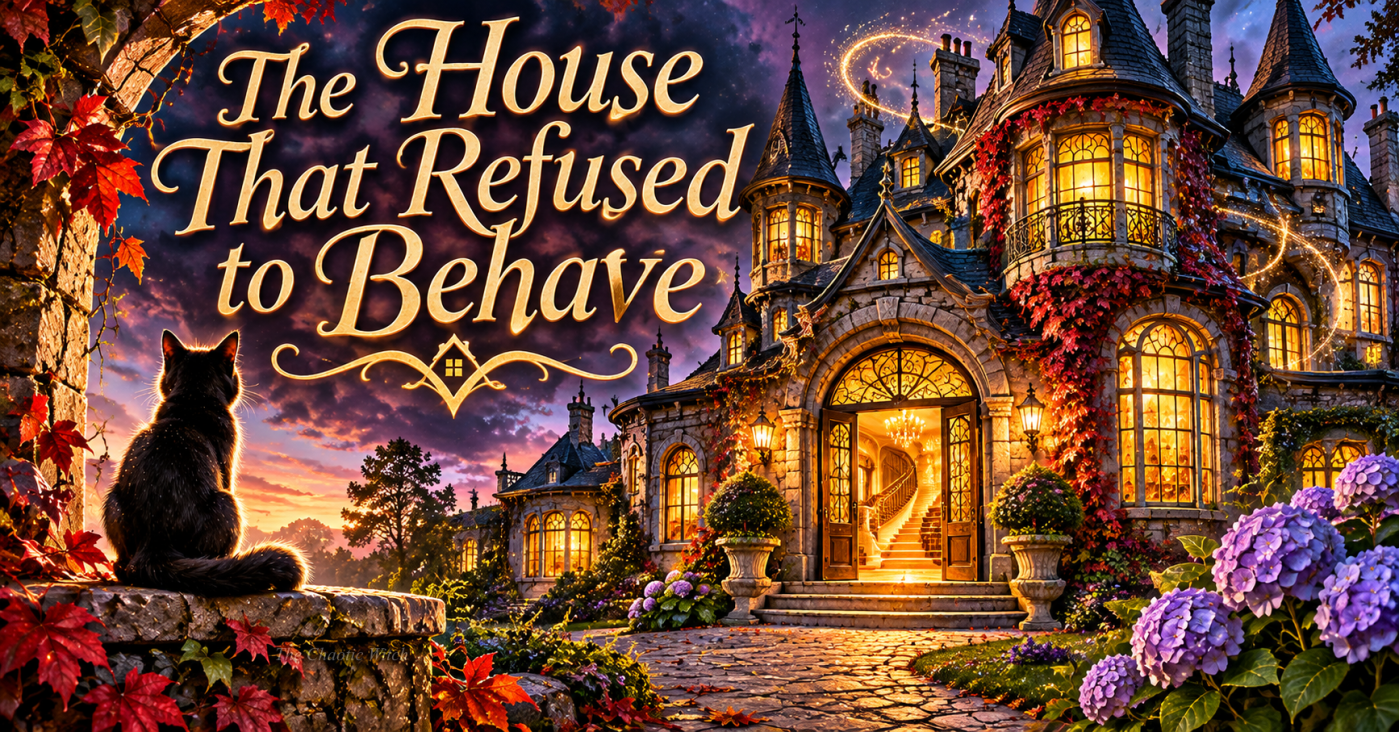
At twenty-eight years old, Grace Woods had already earned a reputation as the most unusual architect in the country. She didn’t simply design houses. She designed houses that listened.
Her first creation had been a modest cottage for an elderly widow named Mrs. Bellamy, who complained that her knees ached whenever she climbed the stairs. Grace had designed a staircase that gently shortened whenever Mrs. Bellamy grew tired, turning twelve steps into six and sometimes, on particularly difficult evenings, into three.
Her second house belonged to a family with seven children. Its kitchen expanded whenever everyone gathered for breakfast, its bedrooms grew quieter when someone needed solitude, and its living room stretched wide enough to accommodate every birthday party, holiday celebration, and unexpected visitor.
Grace’s houses responded to emotions the way ordinary houses responded to weather. Happiness made windows brighter. Sadness softened the lighting and brought fireplaces to life. Loneliness occasionally caused an extra chair to appear beside the hearth.
Grace believed buildings should understand the people who lived inside them. After all, she reasoned, if a house could protect someone from the rain, why shouldn’t it protect them from a difficult day?
Her work attracted considerable attention, but nothing prepared her for the morning a peculiar gentleman arrived at her office carrying a silver-topped walking stick and wearing a purple velvet suit.
His name was Augustus Blackwood, and he was one of the wealthiest men in the country.
“I want you to build me a mansion,” he announced, without bothering to sit down. “Not just any mansion, mind you. I want something extraordinary. Something impossible. Something that makes every other house in the world look terribly embarrassed.”
Grace raised an eyebrow. “What sort of home are you imagining?”
Augustus grinned. “A ballroom that can hold a thousand guests. A library that rearranges its books according to what I wish to read. A dining room that changes size depending on my appetite. And a bedroom that knows when I want to sleep.”
“That sounds manageable,” Grace replied.
“Excellent! Oh, and I want a hallway that never ends.”
Grace lowered her pencil.
“Why?”
Augustus looked genuinely surprised by the question.
“Because I’ve never had one.”
That should have been Grace’s first warning.
Unfortunately, the enormous fee he offered was enough to fund her architectural experiments for the next twenty years.
So she accepted.
Construction began on a sprawling hill overlooking the village of Willowmere. For eleven months, Grace worked alongside carpenters, stonemasons, enchanted glassmakers, and a rather temperamental wizard who specialized in structural spells.
The mansion rose from the hillside like something out of a fairy tale. Its towers twisted toward the clouds, its windows shimmered with coloured glass, and its roof tiles changed shades with the seasons.
Inside, the rooms were magnificent.
The ballroom could expand until its ceiling resembled an endless star-filled sky. The library possessed shelves that rearranged themselves when someone expressed curiosity about a particular subject. The conservatory bloomed with flowers that responded to laughter, while the dining room could transform from an intimate breakfast nook into a banquet hall large enough to entertain royalty.
Even the front doors had personalities. They opened grandly for important guests and only a little for people who knocked rudely.
Grace was enormously proud.
On the evening before Augustus was scheduled to move in, she returned to conduct one final inspection.
“Well,” she said, standing beneath the magnificent chandelier in the entrance hall, “I believe you’re finished.”
Somewhere deep within the mansion, a floorboard creaked.
Grace glanced toward the sound.
“Hello?”
The chandelier flickered.
Then the front doors slammed shut.
Grace jumped.
“That wasn’t necessary.”
A small piece of paper fluttered down from the ceiling.
She caught it.
Written across the page in elegant blue ink were five words.
Are you sure I’m finished?
Grace stared at the message.
“Oh, dear.”
The staircase giggled.
There was no other word for it. The wooden banister actually trembled with a sound resembling a child’s suppressed laughter.
Grace hurried toward the front doors and turned the handle.
Instead of opening onto the driveway, the doors revealed a small cupboard containing seventeen umbrellas, a pair of muddy boots, and a suspiciously smug-looking broom.
She closed them.
Opened them again.
This time she found a bathroom.
The third attempt revealed a room filled entirely with clocks, all ticking backward.
“Very funny,” Grace muttered.
The wallpaper rippled.
Another message appeared.
Thank you.
Grace had designed emotional responsiveness into every room, but she had never encountered a house that appeared to possess emotions of its own.
She retrieved her architectural notebook and began examining the nearest wall.
“All right,” she said. “Something has clearly gone wrong with your enchantments.”
The wall shifted away from her hand.
“Would you kindly hold still?”
The wall shifted again.
Grace sighed.
A doorway appeared beside her, framed in golden light.
Above it, letters slowly formed in the plaster.
Three riddles. Three answers. Then you may leave.
Grace folded her arms.
“You’re a house, not a schoolteacher.”
The doorway disappeared.
A moment later, it returned.
Three riddles, please.
Despite herself, Grace laughed.
“Fine. Three riddles.”
The doorway swung open.
Beyond it lay the ballroom, although it had changed considerably since her last inspection. The room was now enormous, stretching so far into the distance that the chandeliers resembled tiny stars.
At the centre stood a single wooden chair.
On its seat rested a note.
I grow when I am shared, yet shrink when I am kept. What am I?
Grace considered the question.
“Knowledge?”
The ballroom shrank slightly, then expanded again.
“Love?”
A chandelier flickered encouragingly, but nothing else happened.
Grace paced across the polished floor. Her footsteps echoed through the enormous empty space.
She thought about the parties Augustus intended to host, the hundreds of guests who would fill this room with conversation and music. She imagined the laughter, the dancing, the sound of glasses clinking together.
Then she looked at the lonely chair.
“Joy,” she whispered.
The room shivered.
“Joy grows when it’s shared.”
The chandeliers blazed to life. The enormous ballroom contracted into a comfortable drawing room with a crackling fireplace, soft armchairs, and a table laid for afternoon tea.
A message appeared above the mantelpiece.
One.
Grace smiled.
“Well done.”
The fireplace gave a pleased little pop.
The second doorway led into a corridor lined with hundreds of identical doors.
Grace stepped forward.
The corridor stretched.
She walked faster.
It stretched farther.
She began to run.
The hallway lengthened so quickly that the doors blurred past her.
Eventually, exhausted, she stopped and leaned against the wall.
A message appeared beneath a portrait of Augustus Blackwood.
The farther you chase me, the farther away I become. Stop seeking the end, and you may find the beginning. What am I?
Grace groaned.
“Another riddle?”
The portrait winked.
She examined the hallway. Every door was identical, each bearing the same polished brass handle. There were no windows, no landmarks, and no visible end.
She tried opening a door.
It revealed the same hallway.
Another door produced the same result.
After the seventh attempt, Grace sat down on the carpet.
“You’re enjoying this, aren’t you?”
The carpet rose slightly beneath her, as though shrugging.
She reread the riddle.
The farther you chase me, the farther away I become.
She remembered Augustus’s peculiar request for a hallway that never ended. At the time, she had thought it a harmless extravagance. Now, trapped inside her own creation, she wondered what possible pleasure anyone could find in walking toward something they could never reach.
She thought about her own life. The endless projects, the impossible deadlines, the constant determination to build something greater than the last.
She had spent years chasing success, convinced that happiness waited somewhere beyond the next achievement.
And yet, she could not remember the last time she had enjoyed a quiet afternoon without working.
Grace closed her notebook.
“The future,” she said.
Nothing happened.
She frowned.
“No. Not the future.”
She looked down at her tired feet.
“The destination?”
The corridor gave a thoughtful creak.
Grace smiled slowly.
“The finish line. The end I’m trying so hard to reach.”
The hallway trembled.
“But perhaps that’s the point. There doesn’t have to be an end.”
She stood, turned around, and walked calmly toward the place where she had entered.
With each step, the corridor shortened.
Within moments, she reached a familiar wooden door.
Above it appeared another message.
Two.
Grace rested a hand against the wall.
“You’re rather clever.”
The wall warmed beneath her fingers.
The third doorway opened into a room unlike anything Grace had designed.
It was small, plain, and almost painfully ordinary.
There were no enchanted windows, no moving staircases, no magnificent chandeliers. Only bare wooden floors, white walls, and a single window overlooking the darkening gardens.
At the centre of the room stood a tiny table.
On it rested a teapot and two mismatched cups.
Grace looked around.
“Where’s the riddle?”
The walls remained silent.
She examined the table, the window, and the ceiling.
Nothing.
Then she noticed a sentence carved into the underside of one of the cups.
What makes a house a home?
Grace smiled confidently.
“Love.”
Nothing happened.
“Family?”
Silence.
“Comfort? Safety? Happiness?”
The walls stayed perfectly still.
Grace grew frustrated.
“Those are all perfectly reasonable answers!”
The teapot rattled.
She sat down heavily.
“You’re being impossible.”
A small crack appeared in the plaster.
Then another.
The room began to tremble.
Grace stood in alarm.
“Stop that!”
The cracks spread across the walls. The floorboards creaked, and the window flickered between sunlight, moonlight, and a view of the sea.
Grace suddenly understood.
The mansion wasn’t falling apart.
It was frightened.
She had built an enormous, extraordinary house filled with magical rooms, but she had never considered what might happen when all those enchantments began communicating with one another.
Every room had been designed to sense emotion.
Every wall had been given the ability to respond.
Every corridor could interpret a person’s needs.
And together, those hundreds of individual enchantments had created something entirely new.
A consciousness.
A personality.
A house that could think and feel.
Grace slowly lowered herself into one of the chairs.
“Oh,” she whispered. “You’re alive.”
The trembling stopped.
For several moments, nothing moved.
Then a tiny word appeared on the wall.
Yes.
Grace felt a strange ache in her chest.
“Is that why you trapped me?”
The teapot lifted slightly, then settled.
You were going to leave.
Grace looked around the little room.
“Of course I was. Your owner arrives tomorrow.”
A pause.
Then another message appeared.
Will he like me?
Grace swallowed.
“I think he’ll be delighted.”
What if he isn’t?
The words faded, replaced by another sentence.
What if I’m not magnificent enough?
Grace finally understood why the house had created its riddles.
It wasn’t testing her intelligence.
It was asking whether she understood what she had made.
She thought about Augustus Blackwood, a man who owned seven estates, three castles, and an island shaped suspiciously like his own face. A man who had commissioned an endless hallway simply because he had never possessed one.
What would happen when such a man grew bored with his newest possession?
Would he abandon the mansion for something grander?
Would this strange, newly awakened house be left alone on its hill, waiting for footsteps that never came?
Grace reached across the table and touched the teapot.
“Listen to me,” she said softly. “You don’t have to be magnificent every moment of every day.”
The walls creaked.
“You don’t have to stretch your rooms or rearrange your furniture to impress people. You don’t have to make yourself bigger just because someone asks you to.”
A little warmth spread through the floorboards.
“Sometimes the most wonderful thing a house can offer is a quiet room, a comfortable chair, and somewhere a person feels they belong.”
The teapot began to pour.
Tea filled both cups.
Grace laughed.
“Exactly.”
A final message appeared on the wall.
Then what makes a house a home?
Grace looked at the second cup.
And she knew.
“Being wanted,” she said. “Not for what you can do, but for what you are.”
The walls glowed.
The floorboards hummed.
Somewhere in the distance, the ballroom erupted into what sounded suspiciously like applause.
The third word appeared above the window.
Three.
And beneath it, in much smaller letters:
Will you visit?
Grace smiled.
“Of course I will.”
The front doors opened.
Augustus Blackwood arrived the following morning in a golden carriage drawn by four white horses.
He stepped onto the driveway, surveyed the mansion, and clapped his hands in delight.
“Magnificent! Extraordinary! Absolutely ridiculous! I adore it!”
Grace greeted him at the entrance.
“Mr. Blackwood, before you go inside, there’s something rather important I need to explain.”
But Augustus had already marched through the doors.
“Show me the ballroom!”
The mansion obliged.
The ballroom expanded into a glittering hall large enough to accommodate a thousand dancers.
Augustus gasped.
“The library!”
The shelves rearranged themselves into a magnificent spiral reaching toward the ceiling.
“The conservatory!”
A thousand flowers burst into bloom.
Augustus laughed like a delighted schoolboy.
Then he approached the entrance to his much-anticipated endless hallway.
“Ah! Now this is what I’ve been waiting for!”
He stepped inside.
The hallway extended dramatically.
Augustus walked.
It stretched farther.
He walked faster.
It lengthened again.
After several minutes, he stopped.
“Marvelous! But how does one get back?”
The hallway promptly shortened, depositing him in the entrance hall.
Augustus stared.
Then he burst out laughing.
“Oh, you cheeky thing!”
The chandelier twinkled.
Grace watched in astonishment.
Augustus looked up.
“Did you just laugh at me?”
The chandelier swung gently from side to side.
“Well, I never!”
He turned to Grace.
“Miss Woods, I believe my house has a sense of humour.”
Grace hesitated.
“Actually, sir, there’s something you should know.”
Before she could continue, the floor beneath Augustus shifted.
A small doorway appeared.
Above it, a wooden sign read:
Something You Didn’t Ask For.
Augustus frowned.
“How intriguing.”
He opened the door.
Inside was the little room with the white walls, wooden table, and two mismatched cups.
The teapot was steaming.
Augustus stepped inside.
For the first time since Grace had met him, he said nothing.
He stood beside the table, staring at the chairs.
Grace followed him.
“Is something wrong?”
Augustus slowly shook his head.
“No. It’s just…”
He pulled out a chair.
“When I was a boy, my grandmother had a kitchen like this. Nothing fancy. Just a little table by the window and a teapot that was always warm.”
His voice softened.
“Every afternoon, she’d sit with me and ask about my day. Didn’t matter what I’d done or whether I’d been good or bad. She always seemed happy just to have me there.”
He touched the back of the second chair.
“I haven’t thought about that kitchen in forty years.”
The teapot gently poured two cups.
Augustus looked at Grace.
“Would you care for some tea?”
Grace sat down.
“I’d love some.”
The walls glowed with a warm golden light.
Over the following months, Augustus Blackwood discovered that owning a house with a personality was considerably more complicated than owning one without.
The mansion rearranged his books when it disapproved of his reading choices. It shortened his endless hallway whenever he looked tired. It occasionally moved his bedroom closer to the kitchen when he woke up hungry.
Once, after Augustus complained that the weather was dreadful, every window in the mansion displayed a different beautiful landscape.
He spent three hours deciding which view he liked best.
The house eventually grew impatient and showed him a picture of a turnip.
Augustus laughed so hard he nearly fell out of his chair.
But the greatest change came when he began inviting people from Willowmere to visit.
At first, he hosted elaborate dinners for the village’s wealthiest residents. The mansion behaved impeccably, expanding its ballroom, polishing its chandeliers, and arranging flowers into extraordinary sculptures.
Then, one rainy afternoon, a group of village children arrived seeking shelter from a sudden storm.
The house opened its doors before anyone could knock.
It transformed the ballroom into an indoor playground, filled the conservatory with butterflies, and created a staircase that turned into a slide whenever someone shouted, “Again!”
Augustus watched the children race through the halls, their laughter echoing from room to room.
He had never seen the mansion so happy.
The following week, he opened his doors to the entire village.
Soon, the library became a place where children gathered for stories. The conservatory hosted afternoon teas for elderly neighbours. The ballroom welcomed weddings, celebrations, concerts, and the occasional very enthusiastic game of musical chairs.
And the little room with the two mismatched cups?
That became Augustus’s favourite place in the world.
One year after the mansion’s completion, Grace returned for an inspection.
She found Augustus sitting in the garden, watching a group of children chase enchanted butterflies across the lawn.
“How is the house behaving?” she asked.
Augustus smiled.
“Terribly.”
Grace laughed.
“Terribly?”
“It hid my slippers yesterday. Replaced my newspaper with a book of riddles. And this morning, it turned my breakfast toast into the shape of a giraffe.”
“That sounds inconvenient.”
“Extremely.”
He took a sip of tea.
“Best house I’ve ever owned.”
As Grace prepared to leave, a small envelope fluttered down from an upstairs window.
She opened it.
Inside was a note written in familiar blue ink.
I’ve been thinking about another riddle.
Grace smiled.
“Of course you have.”
The note continued.
What has hundreds of rooms, thousands of memories, and grows bigger every time someone comes inside?
Grace glanced toward the mansion.
“A home?”
The front doors swung open.
A second note fluttered out.
Close.
Grace thought for a moment.
“A family?”
Every window in the mansion lit up.
The chimneys released a shower of golden sparks.
The garden flowers turned toward her.
And from somewhere deep within the house came a delighted, unmistakable giggle.
Grace laughed.
“You’re welcome.”
She turned toward the garden gate.
Behind her, the mansion shifted its towers, adjusted its windows, and settled comfortably into the hillside.
Then, just before Grace disappeared down the path, a final message appeared across the front door.
Come back soon. I’m working on a maze.
Grace stopped walking.
She turned around slowly.
“Oh, absolutely not.”
The mansion giggled again.
And somewhere inside, a staircase began quietly tying itself into a knot.
Sometimes the most extraordinary things we create have ideas of their own. And sometimes, what makes a home truly magical isn’t its size, its beauty, or even its enchantments, but the laughter, love, and belonging found within its walls.
A little magic is always waiting. Subscribe and step inside the circle. 🖤🔮✨


Leave a Reply