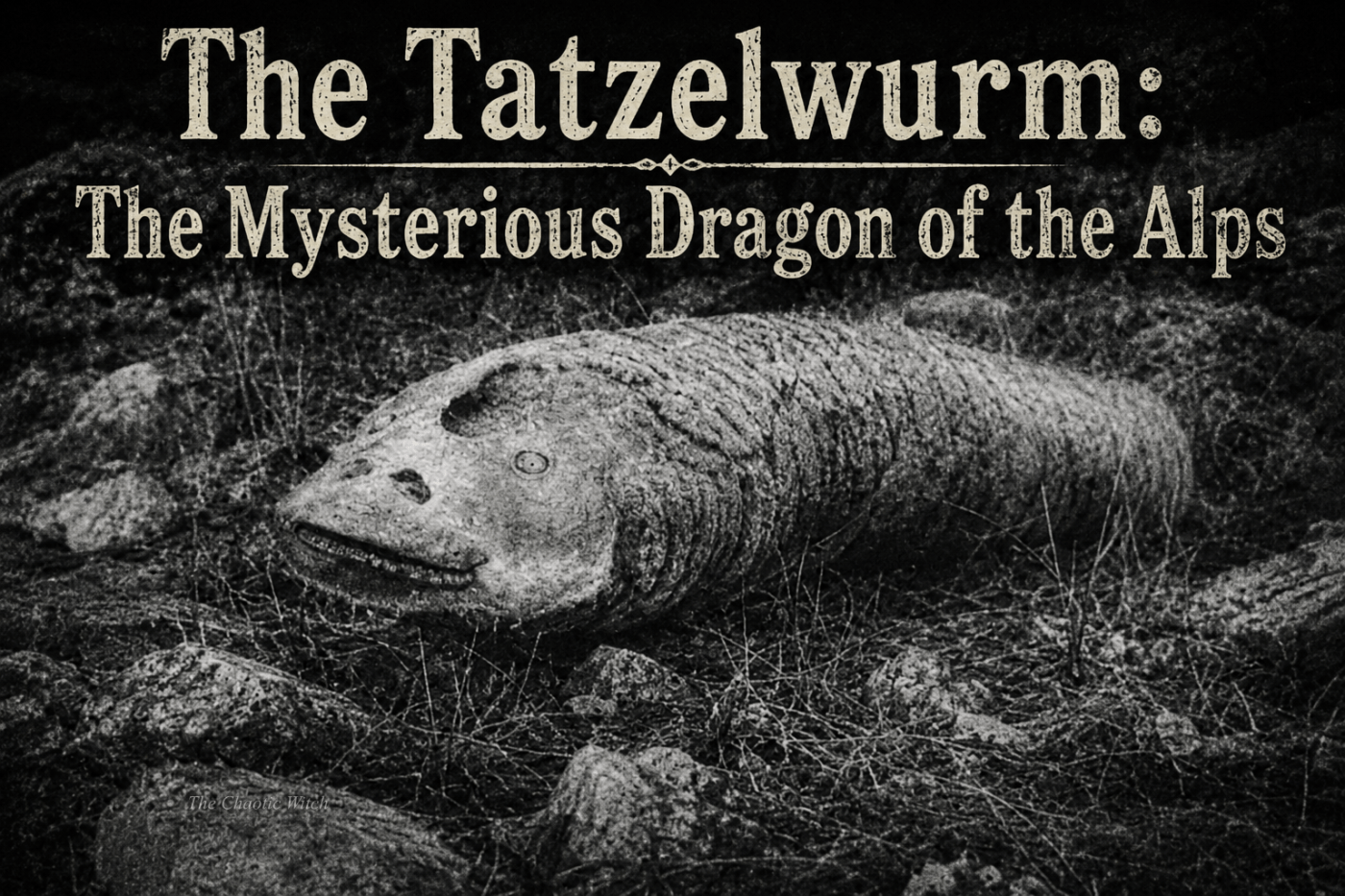
For centuries, people living among the mountains of Central Europe have told stories about something strange hiding between the rocks, caves and isolated valleys of the Alps. It wasn’t quite a snake, wasn’t quite a lizard and, according to some witnesses, had a face that looked disturbingly like that of a cat. The creature became known as the Tatzelwurm, one of Europe’s oldest and most peculiar cryptids.
Stories of the Tatzelwurm are most strongly associated with Austria, Switzerland, southern Germany and northern Italy, although similar creatures appear elsewhere in Alpine folklore. Its name roughly translates to “worm with paws,” but different communities knew it by names such as Stollenwurm, Springwurm and Bergstutz. Although descriptions varied considerably, a recognizable picture eventually emerged: a thick-bodied reptilian creature with a short or serpentine body, a broad rounded head and unusually short legs. Some witnesses insisted it had four legs, while others claimed it possessed only two front legs and simply dragged or slithered the rest of its body behind it.
The stranger stories gave the Tatzelwurm an almost dragon-like quality. It was sometimes said to hiss or whistle, leap surprisingly long distances and possess venom or poisonous breath. Swiss traditions frequently described its head as resembling that of a cat. Reported sizes were wildly inconsistent, ranging from something not much larger than an ordinary reptile to a creature several feet long.
Stories resembling later Tatzelwurm accounts were being recorded in Switzerland as early as the 1600s. Naturalists collected reports of strange serpent-like creatures supposedly encountered in the mountains, including one account of a blackish-grey, cat-headed serpent said to have measured more than seven feet long. The witnesses reportedly claimed that its breath caused headaches and dizziness. These early stories were generally described as encounters with dragons rather than Tatzelwurms, but later writers connected them with the same Alpine tradition.
One of the most famous Tatzelwurm stories occurred in 1779 near Unken, Austria. According to local tradition, a hunter named Hans Fuchs encountered strange creatures while travelling through the mountains. Terrified, he fled toward home but collapsed and died after reaching his farm. The story was preserved on a votive memorial, or Marterl, associated with Fuchs. The original image is reportedly preserved at the Haus der Natur in Salzburg.
Exactly what Fuchs encountered, assuming the story originated with a real encounteris impossible to determine. Later versions describe him seeing two Tatzelwurms or Springwürmer, and the creatures became increasingly monstrous as the story was retold. Even today, the tale of Hans Fuchs remains an important part of the Tatzelwurm legend around Unken.
By the early 1800s, however, accounts of the creature were being treated somewhat more seriously. Swiss naturalist Samuel Studer discussed the Stollenwurm in 1814 and recorded local descriptions of a short, thick serpent with a rounded head and small clawed feet. Mountain residents reportedly believed the creature was poisonous and appeared during particular weather conditions.
Studer also preserved an alleged eyewitness encounter from 1811. A schoolmaster named Heinrich in the Guttannen Valley claimed to have seen an unusual creature with a broad, snake-like head, a forked tongue and two short feet. The importance of reports such as this is not that they prove the Tatzelwurm existed, but that descriptions of strange short-legged reptiles were already circulating in Alpine communities long before modern cryptozoology existed.
Another frequently repeated story comes from 1828, when a farmer supposedly discovered the body of a strange animal. Versions of the story differ, and there is no preserved specimen available today. Like so many cryptid stories, the tantalizing possibility of physical evidence ultimately leads nowhere.
Reports continued throughout the 19th century. Witnesses described strange animals hiding among rocks, disappearing into holes and moving with surprising speed. Some accounts sounded almost like encounters with unusually large lizards or salamanders, while others became increasingly difficult to reconcile with any known Alpine animal.
Naturalists eventually began asking whether there might be a more ordinary explanation. Austrian zoologist Karl Wilhelm von Dalla Torre examined Alpine dragon traditions during the late 19th century and suggested that known snakes and lizards could account for at least some of the reports. From this perspective, the Tatzelwurm might have developed through generations of misidentification, exaggeration and folklore rather than from an undiscovered animal.
Yet the stories refused to disappear.
Interest in the creature surged during the early 1930s. The South Tyrolean journal Der Schlern published articles examining numerous alleged encounters, with approximately 85 reports becoming associated with the investigation. Unfortunately, the descriptions weren’t particularly consistent. Some witnesses seemed to be describing snakes. Others described something resembling a large lizard. Still others reported creatures so unusual that determining what they had actually seen was virtually impossible.
Then came the photograph that appeared to offer the evidence everyone had been waiting for.
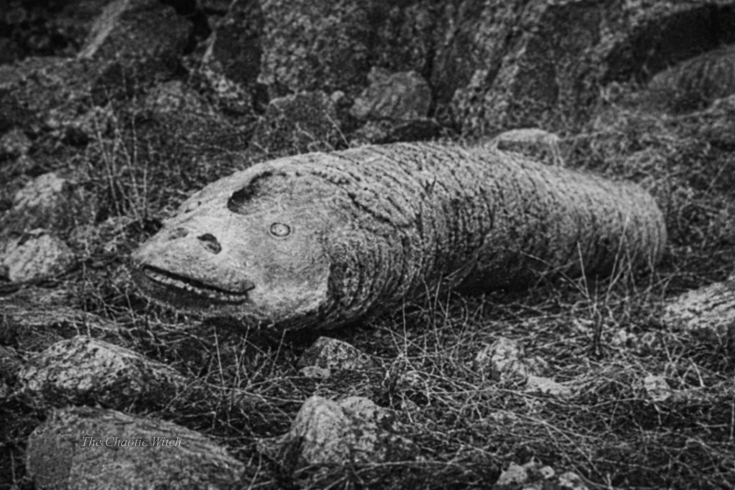
During the mid-1930s, a photograph attributed to a man generally identified as Balkin was publicized as showing a Tatzelwurm in Switzerland near the Aare Gorge and Meiringen. The image appeared to show a bizarre creature peering toward the camera from a rocky landscape.
The photograph caused a sensation. The Berliner Illustrirte Zeitung devoted extensive coverage to the supposed Tatzelwurm, and reporters travelled to the region searching for the creature. A reward of 1,000 marks was reportedly offered for anyone who could capture one.
Nobody collected it.
Questions soon arose about the photograph itself. Critics suggested that the supposed animal might have been a model or other manufactured object. No specimen accompanied the photograph, no independent evidence established what it depicted, and its authenticity has remained deeply questionable. Rather than solving the mystery, the most famous supposed photograph of the Tatzelwurm simply became another part of the legend.
Sightings continued sporadically after the excitement faded. Reports emerged from different parts of the Alps during the following decades, but the creatures being described remained inconsistent.
One particularly interesting encounter reportedly occurred near Lengstein in South Tyrol in the summer of 1969. A witness described a relatively small reptilian creature resembling a salamander. Most intriguingly, it supposedly had only two legs and appeared capable of inflating or expanding its throat. If accurately reported, that behaviour sounds far less supernatural than the poisonous breath and tremendous leaps of earlier legends—and perhaps more suggestive of an unusual encounter with an ordinary animal.
Other alleged sightings appeared in the French and Italian Alps during the latter half of the 20th century. Some involved enormous serpents, others small two-legged reptiles, and still others animals that seemed to combine characteristics of several different species. None produced a body, clear photograph, DNA sample or other evidence capable of establishing the existence of an unknown Alpine animal.
That inconsistency may ultimately be the biggest problem with the Tatzelwurm.
If every witness had described essentially the same animal for hundreds of years, the case would be considerably more intriguing. Instead, the Tatzelwurm seems to change depending upon where and when it appears. Sometimes it is two feet long; sometimes several times that size. Sometimes it has two legs, sometimes four. Sometimes its face resembles a cat, while other witnesses describe an unmistakably reptilian head. In folklore it can possess venomous breath and extraordinary abilities, while other accounts describe what sounds like little more than an unfamiliar lizard.
There are several possible explanations. Snakes, salamanders, lizards, otters and other mammals glimpsed briefly in difficult mountain terrain could have inspired some sightings. Folklore likely influenced how later witnesses interpreted unfamiliar animals, while exaggeration and deliberate hoaxes probably contributed additional stories. There has even been speculation that an unknown or unusually large species of skink could explain the peculiar combination of a long body and reduced limbs, although no evidence has demonstrated that such an undiscovered reptile lives in the Alps.
And yet, the Tatzelwurm remains fascinating precisely because the legend is so old.
Long before Bigfoot became internationally famous and decades before modern cryptozoology developed, Alpine villagers were already telling stories about strange short-legged creatures hiding among their mountains. Naturalists recorded the stories, witnesses claimed encounters, newspapers investigated, rewards were offered and expeditions went searching.
Nothing conclusive was ever found.
Perhaps the Tatzelwurm was never a single animal at all. It may represent centuries of encounters with snakes, lizards and mammals transformed by fear, isolation and storytelling into one legendary Alpine creature. Or perhaps an unusual animal once inhabited those mountains and disappeared before science had the opportunity to document it.
Whatever the explanation, somewhere between the folklore of Hans Fuchs, the eyewitness accounts collected by early naturalists and that wonderfully suspicious photograph from the 1930s, the Tatzelwurm became more than just another dragon legend.
It became the creature generations of people insisted was hiding in the Alps.
And after centuries of stories, one question remains: were they all simply seeing familiar animals in unfamiliar circumstances, or did something strange once crawl among those mountains?
Sources: the Municipality of Unken’s history of the Hans Fuchs memorial and Tatzelwurm legend, SWI swissinfo.ch’s history of the Tatzelwurm and Aare Gorge, historical material summarized in Der Schlern, the works of Samuel Studer and Karl Wilhelm von Dalla Torre, and reference material concerning Alpine Tatzelwurm and Stollenwurm folklore.
A little magic is always waiting. Subscribe and step inside the circle. 🖤🔮✨


Leave a Reply