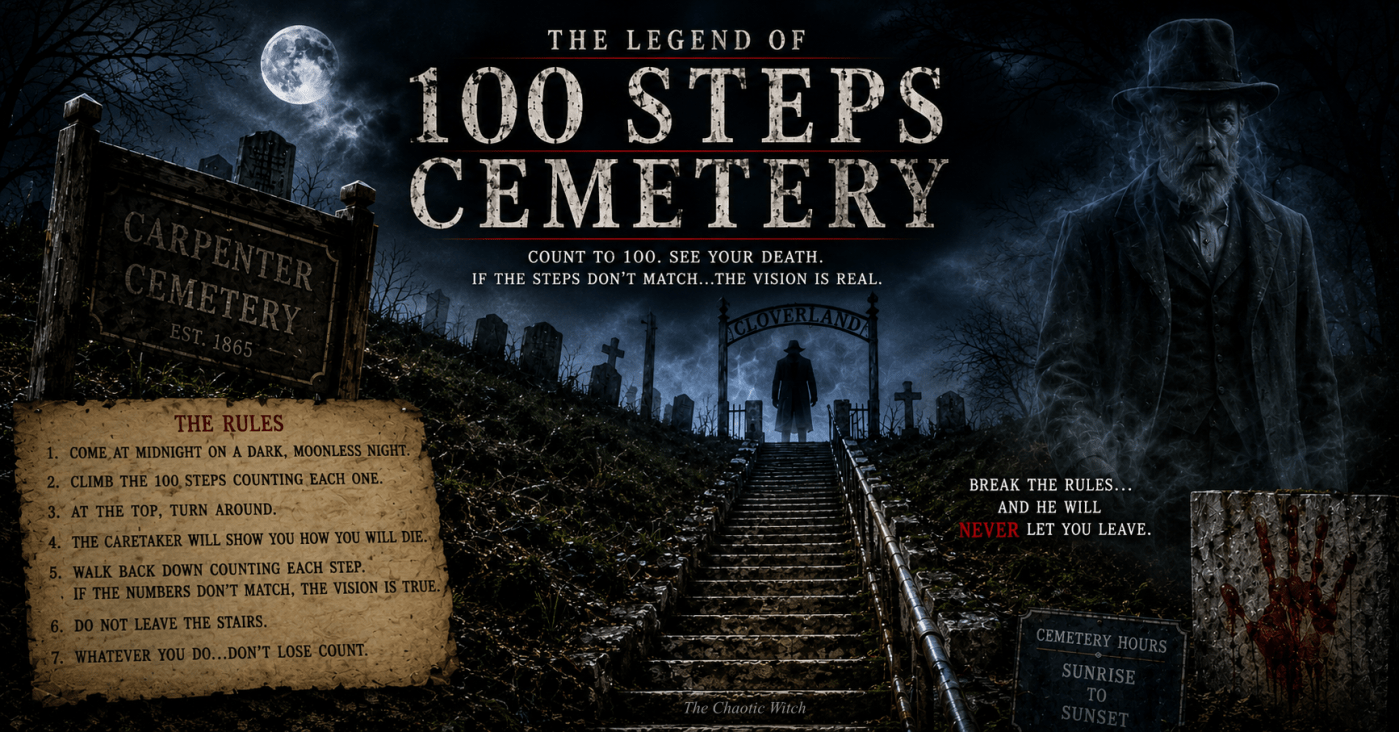
There is a lonely hillside cemetery in rural Clay County, Indiana, where an old staircase has inspired generations of people to ask one unsettling question: if you could learn exactly how you were going to die, would you really want to know?
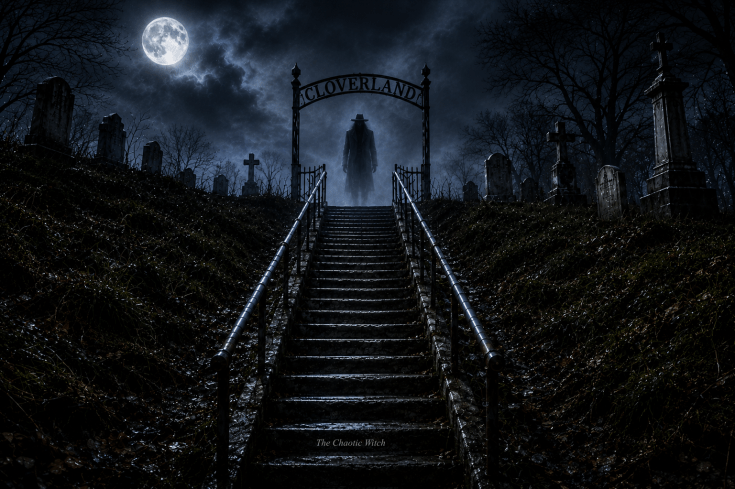
Known as 100 Steps Cemetery, Carpenter Cemetery, and Cloverland Cemetery, the burial ground lies near the community of Cloverland, between Brazil and Terre Haute. The cemetery dates to around the Civil War era and is still an active burial ground. During daylight hours, there is little about it that immediately suggests the frightening reputation it has acquired. Old gravestones dot a grassy hillside, trees surround the property, and a staircase climbs from the road toward the cemetery above.
But according to the legend, everything changes at midnight.
The traditional story says you must arrive on a completely dark or moonless night. Standing at the bottom of the cemetery staircase, you begin climbing while carefully counting every step.
One.
Two.
Three.
You continue upward into the darkness until you finally reach the cemetery at the top.
Your count should be exactly 100.
Once you reach the final step, you are supposed to turn around and look back down the hill. That is when the cemetery’s original caretaker, or undertaker, depending on which version of the story you hear, is said to appear.
He doesn’t chase you.
He doesn’t attack you.
Instead, he shows you something arguably much worse.
Your own death.
According to the most famous version of the legend, the apparition gives the visitor a vision revealing the manner in which they will eventually die. Some retellings say the caretaker also reveals when the death will occur. Once the vision ends, there is only one thing left to do.
Walk back down.
And count every step again.
This second count is supposedly what determines whether the terrible vision you just witnessed will actually come true. In one widely documented version of the story, reaching the bottom with the same number of steps means the caretaker’s prediction was false. If the number is different, however, the vision was genuine.
Other versions of the legend are even stranger. You might count exactly 100 steps while climbing but only 99—or perhaps 98—while descending. Folklore collected about the cemetery contains numerous variations, and the rules have shifted as the story has passed from one storyteller to another.
But there is another rule almost everyone agrees upon.
You must use the stairs.
According to the legend, anyone who tries to avoid the ritual by walking beside the staircase will discover that something doesn’t want them leaving that way. An invisible hand supposedly knocks the person violently to the ground. Some versions claim the unfortunate visitor later discovers a deep red handprint on their chest or back, a mark that remains visible for days.
Other retellings have grown considerably darker. Some say unseen hands attempt to disrupt your counting. Others describe mysterious voices calling from the cemetery, trying to make you lose track of the numbers. Another variation claims that failing to complete the staircase correctly could result in taking a final supernatural “step” directly into Hell.
There is no evidence that any of these things actually happen. What makes 100 Steps Cemetery particularly interesting, however, is that its legend wasn’t simply created for a modern paranormal website.
Versions of the story have been preserved in Indiana folklore collections, and accounts of the cemetery ritual were circulating long before social media existed. Indiana State University’s folklore collections reportedly contain numerous retellings, illustrating exactly how an urban legend evolves. The central ingredients remain recognizable liek the cemetery, the steps, counting, midnight and death, but individual storytellers add, remove and alter details.
Some accounts suggest versions of the legend were well established locally by the mid-20th century. That makes 100 Steps a classic example of what folklorists call “legend tripping”: people don’t merely tell the story around a campfire. They travel to the actual location and attempt to perform the ritual themselves.
And Carpenter Cemetery has a genuinely macabre piece of history that predates the ghost stories.
In 1892, the grave of a woman named Emma West was reportedly disturbed by body snatchers. Contemporary reporting described her grave being opened and her corpse disappearing. Grave robbing and body snatching were very real phenomena during the 19th century, particularly when bodies could be sold to medical institutions for anatomical study.
There is no evidence connecting Emma West’s missing remains to the supernatural caretaker or the 100 Steps ritual. But a real body disappearing from a grave is exactly the kind of historical event that can become tangled with a cemetery’s folklore over generations.
As the legend spread, additional paranormal stories became attached to the property. Some visitors have spoken of a mysterious woman in white. Others have claimed that the staircase is somehow connected to a gateway to Hell. These stories aren’t as consistent across the older versions of the legend, however, and should be considered later additions or variations rather than established parts of the original tale.
Then there is the biggest problem with the legend.
There may not actually be 100 steps.
The original staircase deteriorated badly over time. Individual steps became damaged, overgrown or partially buried, making them surprisingly difficult to count. Eventually, county officials installed a newer staircase to make reaching the cemetery safer.
Visitors have consequently reported wildly different totals.
One visitor writing for Indiana’s official tourism website counted 98 steps while going up—and 96 coming back down.
Which, admittedly, is exactly the sort of thing the legend says is supposed to happen.
There is, of course, a perfectly ordinary explanation. Old, irregular and partially buried stairs can be difficult to distinguish from one another. Add darkness, nervous anticipation and the mental effort required to keep counting while climbing, and getting two different totals isn’t particularly mysterious.
But folklore doesn’t require the supernatural to be real.
It only requires someone to wonder.
Imagine standing at the bottom of those stairs after hearing the story your entire life. You know perfectly well that ghosts probably aren’t waiting above you. You know the changing number of steps can be explained. You know the caretaker is just a character in an old legend.
Then you start climbing.
Twenty-seven.
Twenty-eight.
Twenty-nine.
The cemetery grows darker around you.
Seventy-six.
Seventy-seven.
Something moves in the trees.
Ninety-eight.
Ninety-nine.
One hundred.
And suddenly you’re standing at the top.
That’s the brilliance of the 100 Steps Cemetery legend. It transforms something completely ordinary—a staircase—into a ritual. Once someone begins counting, every misplaced number becomes meaningful. Every sound becomes suspicious. Every shadow has the potential to become the caretaker.
And then you have to walk back down.
Perhaps you reach the bottom and count 100 again.
Nothing happens.
You laugh, get into your car and go home.
Or perhaps your second count ends differently.
Ninety-seven.
Ninety-eight.
Ninety-nine.
And there are no more stairs.
There is one final detail worth remembering before anyone decides to test the legend themselves. The cemetery is reportedly open only from sunrise to sunset. That means the traditional midnight challenge would require visiting outside permitted hours. It is also an active cemetery containing the graves of real people, so exploring it respectfully during permitted hours is very different from trespassing at midnight to perform the ritual.
Whether anyone has ever encountered a supernatural caretaker at the top of those stairs is another matter entirely. There is no credible evidence that the apparition exists, that anyone has been shown their death, or that a phantom hand attacks visitors who leave the staircase.
But more than a century after people began burying their dead on that Indiana hillside, the legend continues.
Climb the stairs.
Count to 100.
Turn around.
And whatever you do, when you walk back down…
don’t lose count.
Sources: Visit Indiana; Indiana State University folklore collections as referenced by Visit Indiana and regional folklore reporting; Indiana Connection; Tripping on Legends; 92.9 NiN/Ultimate Unexplained.
A little magic is always waiting. Subscribe and step inside the circle. 🖤🔮✨


Leave a Reply