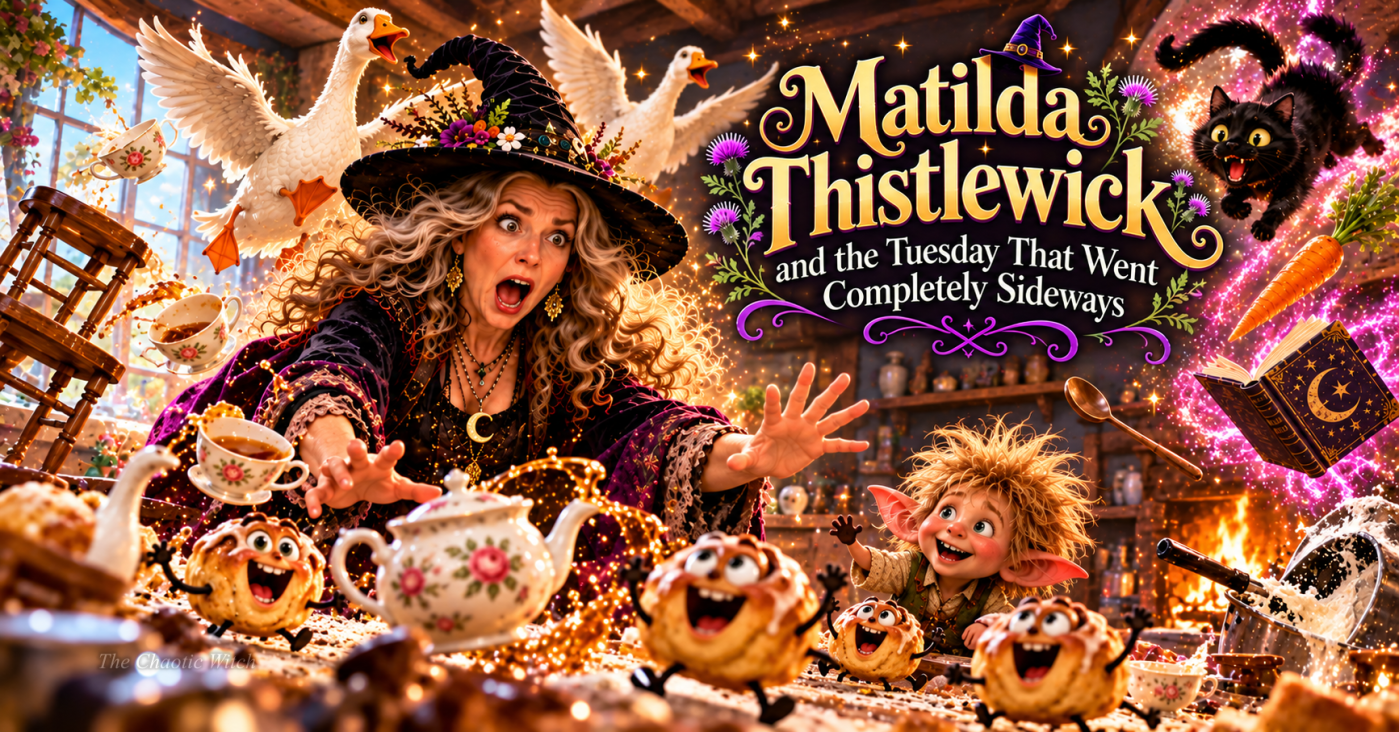
Matilda Thistlewick had always maintained that there were three things a respectable witch should never trust: a smiling tax collector, a mushroom that introduced itself, and a Tuesday that began pleasantly.
Unfortunately, this particular Tuesday began with sunshine, birdsong, and a perfectly brewed cup of tea.
“Suspicious,” Matilda muttered, standing at her kitchen window in her faded purple dressing gown. “Deeply suspicious.”
Outside, the village of Bramblewick was waking beneath a golden autumn sky. Smoke curled lazily from crooked chimneys, the bakery was sending the smell of cinnamon buns down the cobblestone street, and somewhere in the distance, a rooster was arguing with a church bell.
Matilda took another sip of tea.
Then her cottage sneezed.
Not a small sneeze, either. It was an enormous, window-rattling, chimney-shaking sneeze that sent three teacups flying from the cupboard and knocked Matilda’s favourite hat into the porridge.
“Oh, for the love of boiled beetles!”
The cottage sneezed again.
A cloud of pink dust exploded from the fireplace, coating the kitchen in a fine layer of glitter.
Matilda stared at it.
“I have told you repeatedly,” she said to the cottage, “that if you’re going to develop allergies, you must do it during reasonable hours.”
The cottage responded by hiccupping.
Every chair in the kitchen turned into a goose.
Matilda closed her eyes.
It was going to be one of those Tuesdays.
Her cottage, Thistlewick End, was an old enchanted dwelling with a rather complicated personality. It had belonged to seven generations of Thistlewick witches and had developed opinions about everything from curtain patterns to the proper temperature of soup. It occasionally rearranged its rooms when bored, refused to open its front door for rude visitors, and once spent an entire winter pretending to be a castle because Matilda had called it shabby.
But sneezing furniture into poultry was new.
The geese began honking indignantly.
“Yes, yes, I understand,” Matilda snapped. “Nobody enjoys becoming a waterfowl before breakfast.”
She reached for her wand, which was resting beside the sugar bowl.
It had become a carrot.
Matilda stared at the carrot.
The carrot stared back.
“Oh, don’t you start.”
At that moment, there came a frantic knock at the front door.
“Matilda! Matilda, are you in there?”
It was Mrs. Puddlesworth, the village baker, whose voice suggested that something dreadful had happened to either her bakery or her husband. Matilda considered both possibilities equally likely.
“Come in!” she shouted.
The front door swung open, and Mrs. Puddlesworth stumbled into the kitchen wearing a flour-covered apron and an expression of absolute horror.
“Matilda, something terrible has happened!”
“Yes,” Matilda replied, gesturing toward the honking furniture. “I appear to have developed a dining room full of opinions.”
“No, it’s worse than that!”
Mrs. Puddlesworth held out a tray.
On it sat six cinnamon buns.
They were singing.
Not particularly well, either.
One was attempting a dramatic opera solo while the others provided an enthusiastic but completely unnecessary harmony.
Matilda leaned closer.
“Good heavens. That one’s flat.”
“That’s not the problem!”
“Well, it certainly isn’t helping.”
Mrs. Puddlesworth wrung her hands. “Everything in the village is behaving strangely! Mr. Wobble’s trousers have run away, the mayor’s moustache has turned into a pair of butterflies, and the village fountain is dispensing custard!”
Matilda considered this.
“What flavour?”
“Vanilla!”
“Could be worse.”
“And the postmaster has been transformed into a decorative urn!”
Matilda sighed.
“Again?”
Mrs. Puddlesworth nodded miserably.
Matilda set down her tea.
There were mornings when a witch simply had to accept that breakfast was over.
She retrieved her emergency wand from a hollowed-out loaf of bread, changed out of her dressing gown, and selected a sensible pair of boots. Her favourite pointed hat was still floating in the porridge, so she settled for a battered green one that occasionally insulted strangers.
“Your eyebrows are uneven,” the hat informed her.
“And your brim looks like a dead ferret,” Matilda replied.
The hat fell silent.
Outside, Bramblewick had descended into spectacular nonsense.
A flock of teapots was migrating south over the village square. Three elderly gentlemen were trapped inside a giant soap bubble, arguing about whose fault it was. A wheelbarrow was chasing the blacksmith, and the butcher’s shop had begun loudly reciting poetry.
Matilda stepped into the street just as the mayor hurried toward her.
He was holding his hat over his face.
“Miss Thistlewick! Thank goodness!”
“Good morning, Mayor.”
“Can you fix this?”
He removed his hat.
Two magnificent blue butterflies fluttered where his moustache had once been.
Matilda tilted her head.
“I rather like it.”
“Matilda!”
“Very well. Stop flapping.”
“I’M NOT FLAPPING!”
“The moustache, Mayor. I was speaking to the moustache.”
She waved her wand.
The butterflies vanished, and his moustache returned.
Unfortunately, it was now bright orange.
Matilda inspected her handiwork.
“Festive.”
The mayor made a noise like a kettle coming to the boil.
“Best not to dwell on it,” she advised.
She continued through the village, examining the various magical disturbances. Every spell she attempted either failed or produced an entirely unrelated result. A charm intended to quiet the singing cinnamon buns caused the church bells to yodel. A spell to restore Mr. Wobble’s trousers transformed them into a particularly aggressive pair of bloomers.
By the time she reached the village green, Matilda had developed a headache behind her left eyebrow.
And then she saw it.
Sitting beneath the ancient oak tree was a tiny creature no taller than a teapot.
It had enormous ears, a round pink nose, and a waistcoat made from stitched-together leaves. Its hair resembled an exploded dandelion, and it was eating a biscuit approximately the size of its own head.
Matilda stopped walking.
The creature looked up.
“Oh,” it said.
Matilda folded her arms.
“Oh, indeed.”
The creature attempted to hide behind the biscuit.
Matilda raised one eyebrow.
“Name.”
The creature swallowed.
“Pip.”
“Full name.”
“Pipkin Puddlefern the Third.”
“Occupation?”
“Assistant apprentice.”
“To whom?”
The creature hesitated.
“Currently? Nobody.”
Matilda looked toward the village, where a flock of enchanted underpants was circling the clock tower.
“Pipkin,” she said slowly, “have you been practising magic?”
Pipkin looked offended.
“Practising? Absolutely not!”
Matilda waited.
“I’ve been experimenting.”
There was a long silence.
Somewhere behind them, the village fountain burped custard.
Matilda pinched the bridge of her nose.
“What did you do?”
Pipkin produced a small, battered book from his waistcoat.
It was titled A Beginner’s Guide to Enormous Magical Success.
Matilda recognized it immediately.
“Oh, no.”
Pipkin brightened. “You’ve read it?”
“I used it to prop up a wobbly table for seventeen years.”
His ears drooped.
“But it said I could make everyone happy!”
Matilda’s irritation softened slightly.
“What did?”
Pipkin opened the book to a page covered in elaborate silver lettering.
At the top were the words:
The Grand Enchantment of Perfect Happiness.
Matilda stared.
Then she groaned.
“Oh, you foolish little turnip.”
Pipkin’s bottom lip trembled.
“I only wanted to help.”
Matilda sat down beside him on the grass.
“Help with what?”
Pipkin picked at the corner of his waistcoat.
“Everyone was unhappy yesterday. Mrs. Puddlesworth burned her bread. Mr. Wobble lost his spectacles. The mayor shouted at the postmaster. And the little girl who lives beside the pond was crying because her father is away.”
He looked toward the village.
“I thought if I made everything wonderful, nobody would be sad anymore.”
Matilda was quiet for a moment.
The breeze stirred the oak leaves above them.
“Oh, Pipkin,” she said gently. “Happiness isn’t something you can pour over people like gravy.”
Pipkin sniffled.
“But wouldn’t it be nice if nobody ever had to feel sad?”
“Of course it would.”
“Then why shouldn’t we try?”
Matilda looked out across Bramblewick.
At the runaway trousers. The yodelling bells. The three gentlemen still arguing inside their soap bubble.
“Because,” she said, “sometimes the things we think will make people happy aren’t the things they actually need.”
Pipkin frowned.
“I don’t understand.”
“Well, take Mrs. Puddlesworth. She burned her bread yesterday, yes?”
He nodded.
“And today you’ve given her singing cinnamon buns. But what she really needed was someone to tell her that one ruined loaf doesn’t make her a bad baker.”
Pipkin considered this.
“And Mr. Wobble?”
“He needed someone to help find his spectacles. Not trousers that can outrun a horse.”
Pipkin looked down.
“And the little girl?”
Matilda’s expression softened.
“She misses her father. No spell can make that longing disappear without taking away something important. But someone could sit beside her, listen to her, and remind her she’s loved.”
For the first time that morning, Pipkin had nothing to say.
Matilda patted his small shoulder.
“Magic can do extraordinary things, my dear. But it cannot replace kindness.”
Pipkin wiped his nose on his sleeve.
“Have I ruined everything?”
Matilda glanced toward the fountain, where a small boy was happily filling his pockets with custard.
“Well,” she said, “not everything.”
Together, they examined the spellbook.
It took Matilda approximately three minutes to discover the problem.
Pipkin had misread a single word.
Instead of casting The Grand Enchantment of Perfect Happiness, he had cast The Grand Enchantment of Perpetual Happenings.
Matilda stared at the page.
Then at Pipkin.
Then back at the page.
“Do you know what this means?”
Pipkin shook his head.
“It means,” Matilda said, “you have accidentally instructed every object in Bramblewick to do whatever it pleases.”
Pipkin looked horrified.
“Can we fix it?”
“Certainly.”
He brightened.
“How?”
Matilda closed the book.
“We ask them nicely.”
Pipkin blinked.
“That’s it?”
“That’s it.”
“But you’re a powerful witch!”
“Yes, and I am powerful enough to know when not to use more magic.”
So they began.
They asked the teapots to come down from the sky. They thanked the fountain for its custard and politely requested water. They persuaded the singing cinnamon buns that a bakery was not the appropriate venue for an opera career.
The cinnamon buns were disappointed, but Mrs. Puddlesworth promised to let them perform at the harvest festival.
The geese that had once been Matilda’s kitchen chairs required considerably more negotiation.
One demanded a cushion.
Another wanted a window seat.
The third insisted on being called Gerald.
Matilda agreed to the first two requests and firmly refused the third.
By late afternoon, Bramblewick was almost entirely restored.
The mayor’s moustache was brown again, although it still fluttered whenever he became excited. The postmaster had returned to human form but retained an inexplicable fondness for flowers. Mr. Wobble’s trousers had been captured in the cabbage patch and were undergoing a stern lecture about responsibility.
Only one problem remained.
Matilda’s cottage was still sneezing.
She and Pipkin returned to Thistlewick End just as the front windows rattled with another enormous sneeze.
A shower of silver sparks erupted from the chimney.
Pipkin ducked.
“Why is it still doing that?”
Matilda studied the cottage thoughtfully.
Then she walked to the front door and placed her palm against the old wooden frame.
“What’s the matter, old girl?”
The cottage gave a miserable little creak.
Matilda listened.
Then her face changed.
“Oh.”
Pipkin looked up.
“What?”
Matilda smiled sadly.
“She’s lonely.”
Pipkin blinked.
“A house can be lonely?”
“This one can.”
Matilda looked around the little garden.
For generations, Thistlewick End had been filled with people. Children had raced through its hallways, witches had brewed potions in its kitchen, and countless visitors had gathered around its enormous fireplace.
But lately, Matilda had spent much of her time alone.
She had grown accustomed to the quiet.
Perhaps the cottage hadn’t.
Pipkin stepped forward.
“Could I visit?”
The cottage stopped sneezing.
Matilda looked at him.
“You?”
Pipkin nodded enthusiastically.
“I could help in the garden! And polish your cauldrons! And organize your spellbooks!”
Matilda raised an eyebrow.
“Organize my spellbooks?”
Pipkin hesitated.
“Perhaps not the spellbooks.”
The cottage gave a hopeful little creak.
Matilda sighed dramatically.
“Oh, very well. But there will be rules.”
Pipkin’s face lit up.
“No enchanting the furniture. No experimenting without supervision. No feeding the broomsticks after midnight. And absolutely no spells involving happiness, happenings, or anything beginning with the word grand.”
Pipkin nodded so vigorously that his ears flapped.
“Agreed!”
The cottage opened its front door.
A warm golden light spilled onto the garden path.
And for the first time all day, everything was peaceful.
That evening, Matilda sat by the fireplace with a cup of tea while Pipkin slept curled up in an oversized armchair beneath a patchwork blanket.
Outside, autumn leaves drifted past the windows.
The cottage hummed softly to itself.
Matilda looked around the room.
Her chairs were chairs again. Her wand was no longer a carrot. The porridge had been cleaned from her hat, and the kitchen smelled of cinnamon and freshly baked bread.
It had been a thoroughly ridiculous day.
An exhausting day.
A day involving far too many geese.
But as Matilda watched the little creature sleeping beside the fire, she found herself smiling.
Perhaps the cottage hadn’t been the only one who was lonely.
She reached for her tea.
“Not a bad Tuesday after all,” she murmured.
The cottage gave a contented sigh.
Then, from somewhere upstairs, came a small voice.
“Matilda?”
She closed her eyes.
“Yes, Pipkin?”
“I may have accidentally taught your bathtub to tap-dance.”
There was a pause.
Then came the unmistakable sound of porcelain feet performing an enthusiastic jig across the bathroom floor.
Matilda stared into her teacup.
“Wednesday,” she announced firmly, “is cancelled.”
And somewhere deep within the walls of Thistlewick End, the old enchanted cottage began to laugh.
Sometimes the greatest magic isn’t making every problem disappear. It’s finding someone willing to sit beside you while you work through the chaos.
A little magic is always waiting. Subscribe and step inside the circle. 🖤🔮✨


Leave a Reply