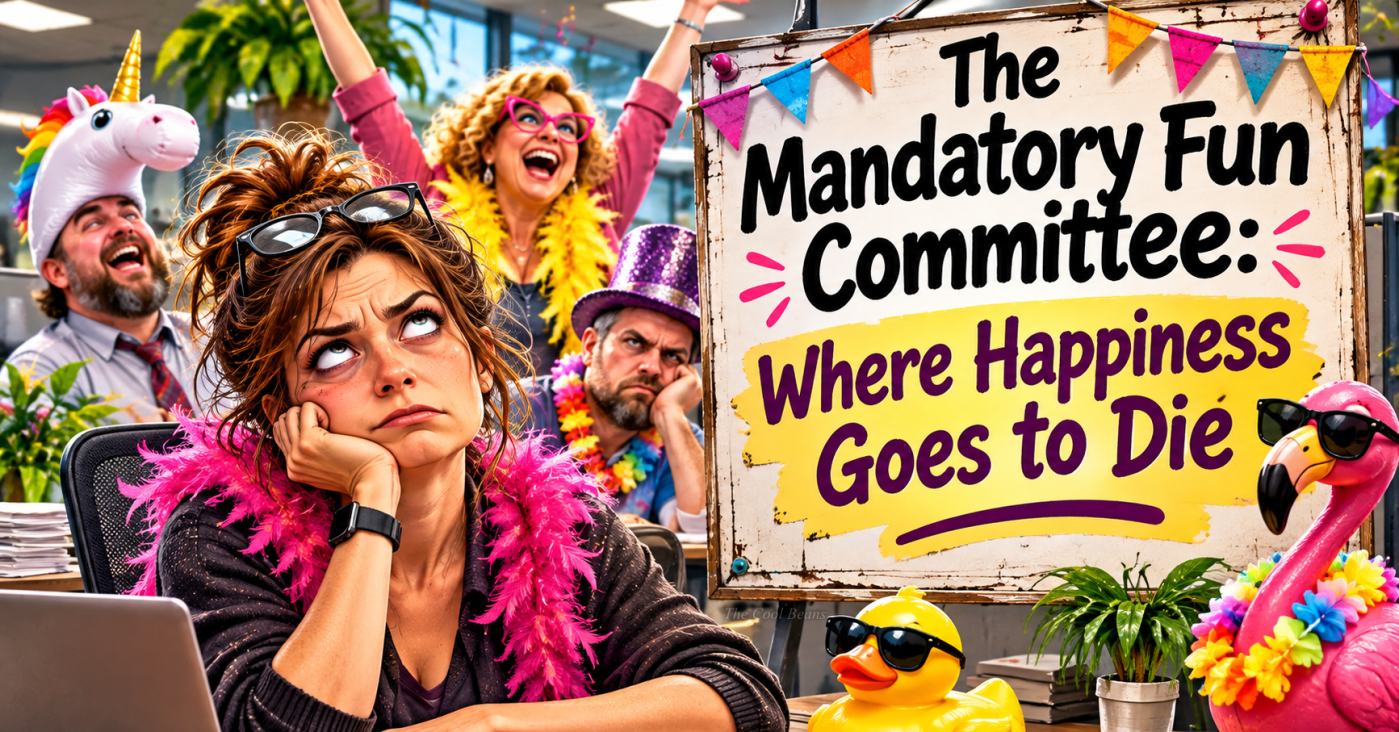
There are three things nobody wants to hear at work: “We need to talk,” “We’re restructuring,” and “Congratulations! You’ve been selected for an exciting new opportunity!” The third one is particularly dangerous because it usually means someone in management has had an idea. And management ideas, as everyone knows, are like food poisoning. They arrive unexpectedly, ruin your entire day, and leave you questioning every decision that brought you to this point.
For thirty-eight-year-old Rebecca Miller, the beginning of the end arrived on a Tuesday at 9:14 am. She was sitting at her desk, eating a slightly stale blueberry muffin and contemplating whether unemployment might actually be a lifestyle upgrade, when an email appeared in her inbox. The subject line read, “EXCITING ANNOUNCEMENT!!!” followed by three party emojis. Rebecca immediately suspected a crime.
The email was from Tiffany Sparkle, the company’s Human Resources Engagement and Positivity Enhancement Coordinator. Nobody knew what Tiffany actually did. She had a standing desk, a collection of motivational mugs, and the unsettling ability to use the phrase “super exciting” while discussing payroll deductions.
Rebecca opened the email and read the greeting: “Dear Amazing Team Family!” She immediately stopped reading. Anyone who referred to coworkers as family was either trying to sell something or preparing to violate labour laws. Against her better judgment, she continued.
The company was apparently thrilled to announce the launch of its brand-new Mandatory Fun Committee, an innovative initiative designed to foster joy, connection, collaboration, and authentic workplace happiness. Participation was required, and failure to participate could result in corrective action.
Rebecca stared at the screen. “Mandatory fun,” she whispered. “Well, that sounds like a hostage situation with cupcakes.”
Then she reached the final paragraph, which enthusiastically congratulated Rebecca Miller on being selected as Chairperson of Fun. Rebecca slowly lowered her muffin. She refreshed the email, hoping the announcement might disappear. It didn’t. She checked the recipient list and discovered that the entire company had been informed of her exciting new position.
From the next cubicle, her coworker Daniel leaned over the divider. “Congratulations, Fun Queen.”
“I will throw this muffin at you,” Rebecca replied.
“Careful. That’s workplace violence. You’ll have to attend a seminar.”
Rebecca picked up her phone and called Tiffany. “There’s been a mistake.”
“Oh my gosh, Rebecca! I’m so glad you called! Are you just BURSTING with excitement?”
“I’m experiencing a sensation, yes.”
Tiffany explained that Rebecca had been chosen because of her incredible leadership potential. Rebecca pointed out that she had once told a printer to go fuck itself, but Tiffany considered that an excellent demonstration of passion.
When Rebecca explained that she didn’t want the position, Tiffany assured her that it wasn’t about wanting something. It was about embracing opportunities for growth. Rebecca asked whether she could decline the opportunity, and Tiffany cheerfully informed her that she absolutely could, although declining would be noted in her professional development assessment.
“So it’s not optional,” Rebecca said.
“It’s an opportunity!”
“An opportunity with consequences.”
“Exactly! You’re getting it already!”
Rebecca hung up and stared at the ceiling. Somewhere, God was laughing. And frankly, she hoped He’d choke.
The first meeting of the Mandatory Fun Committee took place in Conference Room B, a windowless space decorated with a poster reading, “TEAMWORK MAKES THE DREAM WORK.” Someone had drawn a tiny gallows beneath it, and Rebecca decided to leave it.
Her committee consisted of Daniel from Accounting, Brenda from Payroll, Marcus from IT, and Linda from Customer Service. All four had been selected because they had failed to respond to Tiffany’s volunteer recruitment email. Apparently, silence was now legally binding.
Rebecca stood at the front of the room and welcomed everyone, announcing that she assumed they were all there against their will. Four heads nodded. She congratulated them on having something in common.
Brenda, who had worked for the company for twenty-six years and possessed the emotional warmth of a parking enforcement officer, wanted to know whether employees could be fired for refusing to have fun. Rebecca confirmed that they could. Brenda then asked whether they could also be fired for having too much fun. Rebecca admitted that was probably possible too.
“Good,” Brenda replied. “Just establishing the rules.”
Rebecca opened the executive-approved Fun Initiative Handbook. It was forty-seven pages long, contained numerous charts and diagrams, and devoted an entire section to “Leveraging Joy-Based Synergies to Maximize Employee Delight.”
Marcus read over her shoulder. “This was written by a psychopath.”
“Or a consultant,” Rebecca replied.
“Same invoice.”
Their first assignment was to organize an office-wide event called Wacky Hat Wednesday. Every employee was required to wear a funny hat, and management had generously approved a budget of twelve dollars for all 146 employees.
Daniel calculated that the company was investing approximately eight cents of happiness per person. Brenda pointed out that this was before tax.
Rebecca emailed Tiffany requesting additional funding. Tiffany responded within thirty seconds, reminding her that creativity thrived under constraints. Rebecca replied that so did mould. Tiffany did not respond.
Wacky Hat Wednesday began at 8:00 am. By 8:15, the office looked like a convention for people who had suffered minor head injuries. One employee wore a lampshade, another wore a colander, and Brenda arrived wearing a baseball cap with the words “I AM HERE UNDER DURESS” written across the front.
Daniel wore a paper bag. When Rebecca asked why, he explained that it was his emotional support anonymity. Marcus had constructed a hat from an old computer monitor. It weighed eleven pounds, and he claimed it was a metaphor for the crushing weight of corporate expectations.
Tiffany arrived wearing a giant foam sunflower and loudly announced that she could see joy everywhere. Nobody answered. At 10:00 am, she reminded employees that their enthusiasm would be judged and their participation scores reflected in their quarterly engagement reviews.
Brenda raised her hand and asked whether she could earn extra points for not screaming. Tiffany encouraged her to keep her language positive, so Brenda rephrased the question and asked whether she could receive extra points for successfully containing her enthusiasm for homicide.
Rebecca pretended not to hear.
By lunchtime, three people had reported neck strain, someone had accidentally stapled their hat to a report, and the fire marshal had ordered Marcus to remove his computer monitor because it blocked an emergency exit.
Tiffany declared the event a tremendous success. Management agreed and immediately requested more activities. Rebecca considered faking her own death, although she suspected HR would require a death certificate and two weeks’ notice.
The following week, Tiffany unveiled the company’s new Trust Through Gravity initiative, which was essentially a series of trust falls. Rebecca immediately objected, pointing out that trust falls were excellent at building lawsuits rather than confidence.
Unfortunately, the executive team had specifically requested something bold and innovative. The original plan involved employees falling backward from raised platforms into the arms of their coworkers. Rebecca discovered that the platforms were actually office chairs with wheels and immediately cancelled that portion.
Tiffany called an emergency meeting and accused Rebecca of resisting growth. Rebecca explained that she was resisting a workers’ compensation claim. When Tiffany insisted that employees needed to step outside their comfort zones, Rebecca reminded her that comfort zones were where the bones remained unbroken.
Eventually, they compromised. Employees would perform trust falls while standing on the floor. This arrangement lasted eleven minutes.
The first participant, Gerald from Shipping, announced that he didn’t trust anyone in the building because someone had stolen his yogurt in March. He refused to fall. The second participant, Karen from Marketing, fell backward before her partner was ready and landed in a recycling bin.
The third participant, Dennis from Sales, took one look at the activity and shouted that he had a pre-existing condition. When Tiffany asked what condition he meant, Dennis announced that he suffered from self-preservation.
By the end of the morning, two employees had strained muscles, one had filed an incident report, and Brenda had submitted a formal request to replace the committee with a bowl of antidepressants.
Tiffany described the event as a beautiful exploration of vulnerability. Rebecca described it as Thursday.
Over the next month, the company descended into an increasingly deranged festival of compulsory happiness. Motivational Monday required employees to shout positive affirmations at their computers. One person from Finance loudly declared that they were successful, while someone from Legal announced that their printer was a piece of shit.
Compliment Your Coworker Tuesday ended when Brenda informed the regional manager that he was surprisingly competent for someone with his responsibilities. Office Dance Party Friday featured a Bluetooth speaker, three songs from 2009, and a visibly distressed man from Compliance attempting the Macarena while clutching his lower back.
Then came Bring Your Authentic Self to Work Day. Marcus arrived in pyjamas, Daniel brought a blanket and slept under his desk, and Brenda spent the entire day telling people exactly what she thought of them.
By 3 pm, six employees had cried, two managers had requested transfers, and the CEO had sent an email reminding everyone that authenticity must remain aligned with company values.
Rebecca printed the email and taped it to the wall beneath a sign that read, “BE YOURSELF. TERMS AND CONDITIONS APPLY.”
Tiffany was delighted with Rebecca’s leadership development and congratulated her on finding her voice. Rebecca explained that it was the voice of someone screaming into a pillow. Tiffany loved that energy.
The situation became critical when senior management announced the company’s first annual Synergy Summit: A Journey Into Joy. It would be a mandatory two-day team-building retreat at a lakeside resort, complete with outdoor challenges, collaborative problem-solving exercises, group bonding sessions, and something the brochure ominously described as transformational laughter experiences.
Rebecca examined the itinerary. There was a sunrise gratitude circle, a blindfolded obstacle course, a corporate scavenger hunt, a workshop called Unlocking Your Inner Dolphin, and competitive canoe dancing.
Rebecca approached Tiffany and demanded to know what the hell canoe dancing was. Tiffany enthusiastically explained that teams would express their workplace values through movement while seated in canoes.
Rebecca wanted to know whether the canoes would actually be on the water. Tiffany confirmed that they would, prompting Rebecca to ask whether the executives understood that drowning was generally considered bad for morale.
Tiffany laughed and complimented Rebecca on her wonderful sense of humour. Rebecca explained that she wasn’t joking, which Tiffany found even funnier.
The retreat was scheduled for the following Friday. Rebecca began updating her résumé. Under special skills, she wrote that she had survived organized psychological warfare disguised as team building.
The retreat began badly. The buses arrived forty minutes late, and the resort had accidentally booked the company into a facility primarily used for children’s summer camps. The cabins smelled like wet socks and existential despair, and there were no private bathrooms.
The CEO, Richard Pemberton, arrived in a luxury SUV wearing a polo shirt that cost more than Rebecca’s monthly grocery bill. Richard was sixty-two, had the complexion of a man who considered sunlight a personal attack, and communicated almost exclusively through phrases such as “circle back” and “move the needle.”
He addressed the employees from a wooden platform, enthusiastically announcing that they were about to break down barriers, build meaningful connections, and discover what made their organization truly special.
From the back of the crowd, Brenda whispered, “Direct deposit.”
Rebecca coughed to hide her laughter.
Richard assured everyone that there were no wrong answers at the retreat. Daniel immediately raised his hand and asked whether they could go home. Richard lowered his microphone and clarified that there was, apparently, one wrong answer.
The first activity was the blindfolded obstacle course. Employees were divided into teams and instructed to guide one another through cones, ropes, and inflatable barriers.
Unfortunately, Marcus had discovered that the facilitators’ walkie-talkies operated on the same frequency as the resort’s maintenance crew. Within minutes, instructions became hopelessly confused.
Employees were being told to turn left, proceed toward blue markers, watch for drainage ditches, and investigate an overflowing toilet in Cabin Six.
Gerald from Shipping walked directly into a shrub. Karen from Marketing sat down and refused to continue. Brenda removed her blindfold, surveyed the obstacle course, and announced that she had survived two recessions, three divorces, and the invention of Microsoft Teams. She had absolutely no intention of dying in a hedge for the company.
She walked to the snack table. Rebecca gave her full participation marks.
The second activity was a scavenger hunt. Employees were instructed to find objects representing the company’s core values: a smooth stone for resilience, a leaf for growth, a feather for innovation, and something blue for integrity.
Daniel returned with a rock, a dead leaf, a discarded chicken nugget, and an empty beer can.
Tiffany examined his collection and asked how the objects represented the company’s values. Daniel explained that the rock symbolized management, the dead leaf represented their benefits package, the chicken nugget represented their annual raise, and the empty beer can represented his five-year career plan.
Tiffany declared his interpretation incredibly creative. Daniel looked genuinely disappointed.
By late afternoon, the canoe dancing began. The activity was supposed to symbolize balance, communication, and collaborative leadership. Instead, it became the most expensive aquatic disaster in company history.
The executives had insisted on participating. Richard was placed in a canoe with the Chief Financial Officer, Stuart, a man who had once described paid sick leave as a concerning productivity trend.
Their assigned dance theme was Rising Together. Rebecca watched from the dock as the two men attempted synchronized arm movements. Richard leaned left, Stuart leaned right, and the canoe began to tilt.
Richard shouted that they needed to align their strategic direction. Stuart responded by screaming at him to stop moving the damn boat.
Then both men fell into the lake.
The splash was magnificent. It was the sound of a thousand unanswered employee surveys finally receiving justice.
For one glorious moment, the entire company stood in silence. Then Brenda began clapping slowly and deliberately, like a villain watching her enemies descend into a volcano.
The applause spread. Someone cheered, and another employee shouted that this was what immersive leadership looked like.
Richard emerged from the water looking like an angry, waterlogged accountant. His expensive polo shirt clung to him, his hair had surrendered, and his dignity was last seen floating toward the opposite shore.
Rebecca rushed forward to ask whether he was okay. Richard stared at her as water dripped from his nose and a piece of pondweed hung from his ear.
He opened his mouth, closed it, and finally announced that he hated this.
Rebecca blinked and asked him to repeat himself.
“I HATE THIS!” Richard shouted.
The entire lakeside fell silent. Richard climbed onto the dock and announced that he hated team building, icebreakers, trust falls, and being told to describe his emotions using a weather forecast.
Tiffany gasped and tried to explain that the initiative had been designed to encourage engagement, but Richard interrupted her with a furious declaration that he did not want to unlock his inner dolphin.
A nearby duck flew away.
Richard continued, explaining that he didn’t want to wear silly hats, attend sunrise gratitude circles, or dance in a bloody canoe.
Rebecca slowly raised her hand and asked why he had approved the Mandatory Fun Committee in the first place.
Richard stared at her and explained that HR had told him the employees wanted it.
Every head turned toward Tiffany.
Her smile began to twitch as she explained that the employee engagement survey had indicated that people wanted more opportunities for connection.
Rebecca pointed out that the survey had asked whether employees would appreciate improved workplace morale, and the only available answers were “Absolutely” and “Enthusiastically.”
Tiffany explained that these were positivity-aligned response options. Brenda wanted to know whether they had seriously distributed a survey where the choices were essentially yes or yes.
Tiffany defended the decision by explaining that they wanted to avoid negative framing.
Daniel raised his hand and announced that he had selected “Enthusiastically” because the system wouldn’t let him submit “Please leave me alone.”
Richard looked around at his employees and asked whether anyone actually enjoyed these activities.
Nobody moved. A cricket chirped. Somewhere in the distance, a canoe bumped against a rock.
Finally, Marcus raised his hand. Richard brightened and invited him to speak.
Marcus explained that he had enjoyed watching Richard fall into the lake.
A ripple of laughter spread through the crowd. Richard stared at him for a moment and then, unexpectedly, began laughing too. It was a real laugh, not the polite executive chuckle reserved for quarterly earnings meetings.
He wiped the water from his face and announced that the Mandatory Fun Committee was officially dissolved.
The employees erupted into cheers. People clapped, someone threw their name badge into the air, and Brenda looked as though she had just witnessed a religious miracle.
Richard held up his hand and continued. From that moment forward, participation in company social activities would be completely voluntary. There would be no more forced icebreakers and no more mandatory team-building retreats.
The applause grew louder. Someone began crying.
Then Richard announced that the following month’s morale workshop would be replaced with a company-wide paid day off.
The cheering became so loud that birds abandoned several nearby trees.
Tiffany looked devastated. She asked how the company was supposed to measure happiness if employees weren’t required to participate in happiness-related activities.
Rebecca smiled and suggested that perhaps they should stop measuring it.
On Monday morning, Rebecca arrived at the office to find an email from Richard announcing a new direction for employee well-being.
Following the recent feedback, the company had decided to discontinue all compulsory morale-building initiatives. Management now recognized that employees were adults who did not require scheduled opportunities to experience joy. Instead, the company would focus on practical improvements, including better break facilities, more flexible scheduling, and a review of employee compensation.
Rebecca read the email twice before forwarding it to Brenda.
Brenda replied that Richard was finally a man who had learned something from falling into a lake.
At 10:00 am, Tiffany appeared beside Rebecca’s desk holding a clipboard. Rebecca felt her soul leave her body.
Tiffany cheerfully announced that she had good news. Rebecca immediately said no.
Tiffany insisted that Rebecca hadn’t even heard the news yet. Rebecca explained that she had already heard enough good news from Tiffany to qualify for disability.
Undeterred, Tiffany announced that the company had decided to create a brand-new Employee Wellness and Work-Life Balance Task Force. Naturally, they wanted Rebecca to chair it.
Rebecca slowly put down her coffee and asked Tiffany whether she remembered the lake.
Tiffany nodded enthusiastically, describing it as a transformative experience.
Rebecca then asked whether Tiffany remembered how Richard had fallen into it. Tiffany confirmed that she did.
Rebecca smiled sweetly and informed her that there was another lake behind the building.
Then she picked up her coffee and suggested that Tiffany take a little walk.
Three weeks later, the company experienced its highest employee satisfaction scores in recorded history. Absenteeism decreased, productivity improved, and employees began talking to one another voluntarily.
Someone even organized a Friday pizza lunch. Nobody was required to attend, yet everyone showed up.
Everyone except Tiffany.
She was attending a three-day HR conference titled Reimagining Mandatory Engagement Through Consent-Based Enthusiasm.
Rebecca thought that sounded promising until she noticed the conference brochure.
Attendance was compulsory.
She laughed so hard she nearly choked on her pizza.
For the first time in years, Rebecca genuinely enjoyed herself at work. Not because someone had ordered her to, not because her happiness was being measured, and certainly not because she had unlocked her inner dolphin.
She was happy because, for once, the company had finally discovered the secret to employee morale: pay people properly, treat them like adults, and stop making them fall backward into Gary from Accounting.
It wasn’t complicated. It was just apparently beyond the reach of executive leadership.
Somewhere in a quiet corner of the office, Brenda was already designing a commemorative plaque for the committee’s untimely demise.
It read:
“IN MEMORY OF THE MANDATORY FUN COMMITTEE, 2026–2026. It died doing what it loved. Making everyone miserable.”
And for the first time in the company’s history, everyone agreed that the plaque deserved an award.
💜 Enjoying the chaos that is my life? Subscribe to The Cool Beans! It’s cheaper than therapy and slightly more organized 🤣


Leave a Reply